A student newspaper reports that the rule allowing professors to leave the classroom during exams has been abolished for the first time in 133 years due to the widespread use of AI for cheating.
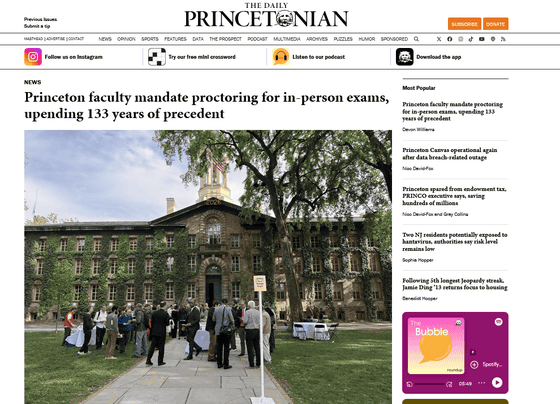
Princeton faculty mandate proctoring for in-person exams, upending 133 years of precedent - The Princetonian
https://www.dailyprincetonian.com/article/2026/05/princeton-news-adpol-proctoring-in-person-examinations-passed-faculty-133-years-precedent
How AI Killed a 133-Year-Old Princeton Tradition - The Atlantic
https://www.theatlantic.com/ideas/2026/05/-ai-honor-code/687144/
An editorial published in 'The Princetonian,' a newly established campus newspaper at Princeton University in 1876, argued against the practice of assigning 'exam proctors' during final exams. The editorial's author stated, 'Exam proctoring is a bad means of moral education. If students are treated as cheaters from the outset, some will actually cheat. Conversely, if they are treated as honest students, they will behave honestly.' The editorial suggested that 'each student should sign a pledge at the end of their answer sheet stating that they have neither cheated nor been cheated on, and professors and tutors should focus on more useful work than monitoring for cheating.'
This recommendation was actually put into practice as a code of honor, which stipulated that 'professors must leave the classroom when students take their final exams,' 'students must submit a written pledge not to cheat,' 'those who cheat will be reported,' and 'students accused of cheating will be tried by a jury of their classmates.' This code remained largely unchanged for 133 years from 1893.
However, according to 'THE DAILY PRINCETONIAN,' the student newspaper of Princeton University, a proposal to mandate faculty supervision during exams was passed by a majority vote with only one dissenting vote at a faculty meeting held on May 11, 2026, and it has been decided that all in-person exams will be conducted with supervisors starting July 1, 2026.

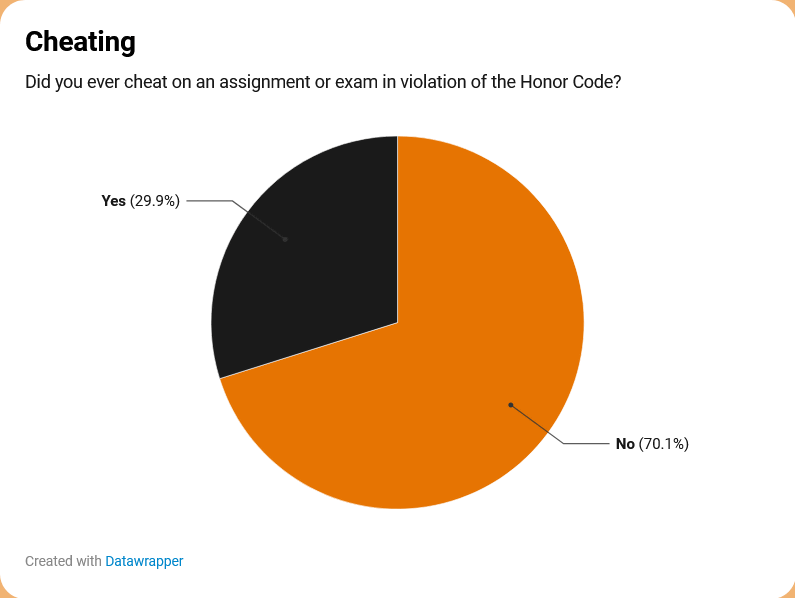
According to reports, the decision comes after months of discussions between university officials and student councils on how to address growing concerns about ethical violations, including the increasing use of AI. In a draft policy submitted to the Educational Advisory Board by Princeton University Dean Michael Godin, the reason for repealing the rule is that 'the ease of access to AI tools on small personal devices has changed what cheating looks like during exams, making it much more difficult for other students to witness and report it.'
It has also been pointed out that there is growing reluctance among students to directly report classmates. In recent years, anonymous accusations have increased, and it is believed that this is due to the fear of 'having personal information exposed online or being humiliated among peers.'
Related Posts:







in AI, Posted by log1e_dh