Claude Opus 4.7 has been released, featuring improved command tracking and image recognition capabilities, while maintaining the same price as Opus 4.6.

Anthropic has announced the ' Claude Opus 4.7 .' The Claude Opus 4.7 is positioned as the direct successor to the Claude Opus 4.6, and is said to offer improved performance, particularly in advanced software development and demanding tasks, as well as enhanced tracking capabilities and high-resolution image processing capabilities.
Introducing Claude Opus 4.7 \ Anthropic
According to Anthropic, Claude Opus 4.7 can handle complex and lengthy tasks with precision and consistency, and it has improved behavior such as more accurately interpreting instructions and verifying its output before responding. Early testers have reported that it can now handle difficult coding tasks that previously required close human supervision with greater confidence.
However, Opus 4.7 has improved command tracking capabilities, which has altered its behavior towards prompts. Entering prompts created for older models may result in unexpected outcomes, and Anthropic recommends readjusting prompts and the execution environment.
A major change in image recognition is the ability to handle high-resolution images. Opus 4.7 can now accept images up to 2576 pixels on the longest side, approximately 3.75 million pixels, allowing it to handle more than three times the amount of information as the previous Claude model. This is particularly useful for reading screenshots with small text, extracting data from complex charts and graphs, and tasks requiring pixel-level consistency.
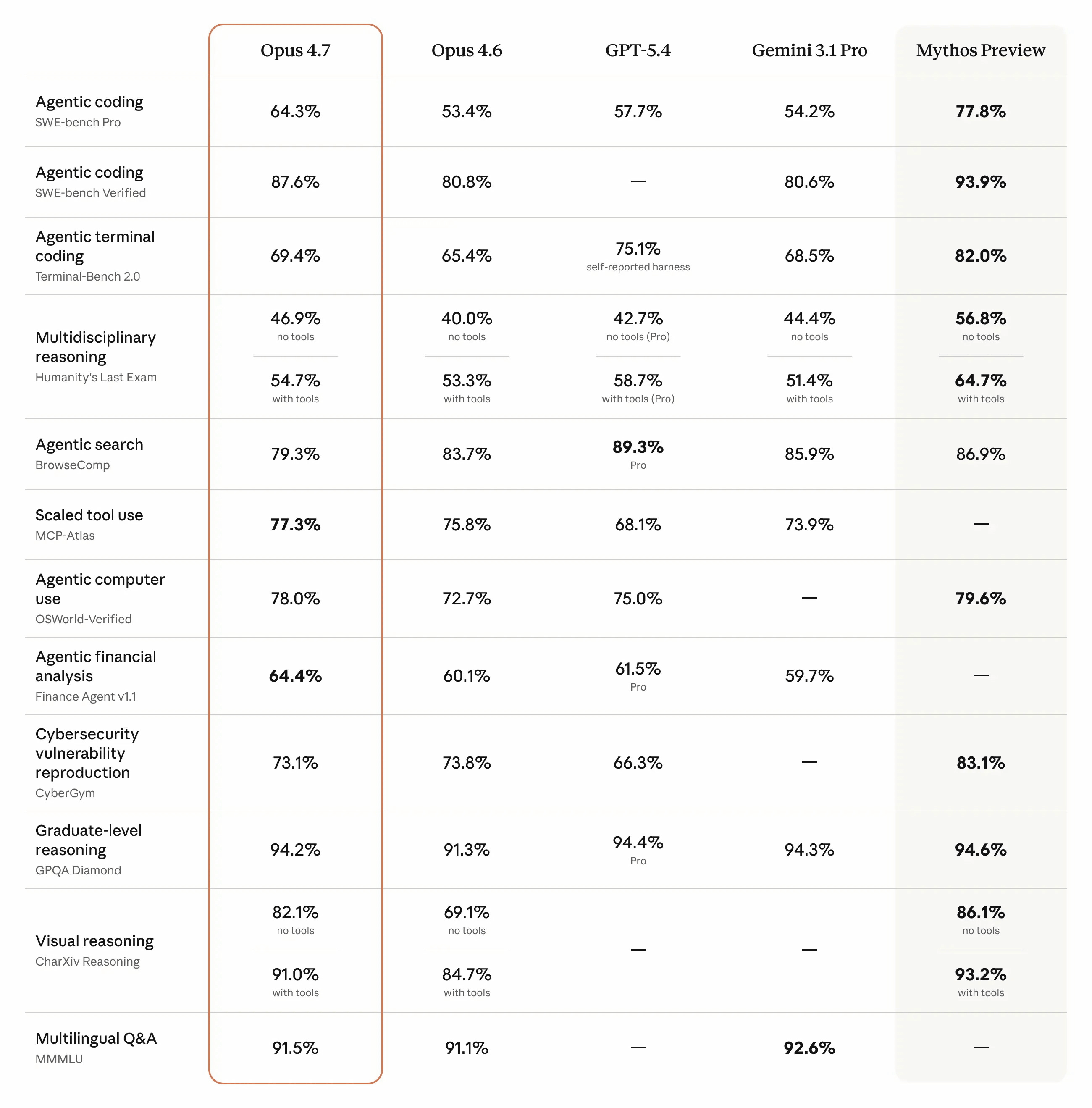
In fact, the benchmark table shows that in the visual inference tool ' ChartX Reasoning ,' Opus 4.7 achieved 82.1% without tools and 91.0% with tools, an improvement from Opus 4.6's 69.1% and 84.7%. In coding-related tests, it recorded 64.3% in ' SWE-bench Pro ,' 87.6% in ' SWE-bench Verified ,' and 78.0% in ' OSWorld-Verified ,' and even in the financial analysis test ' Finance Agent ,' it achieved 64.4%, all of which are higher than Opus 4.6.
In
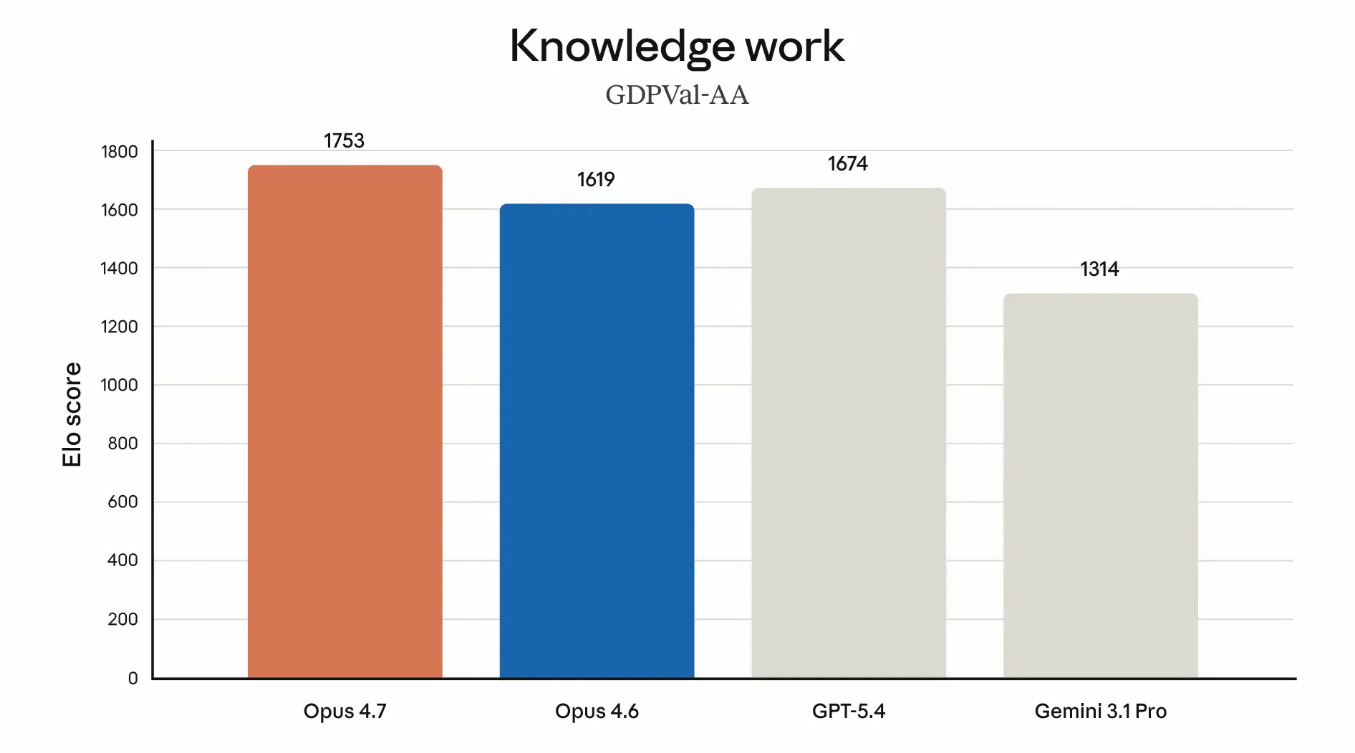
According to
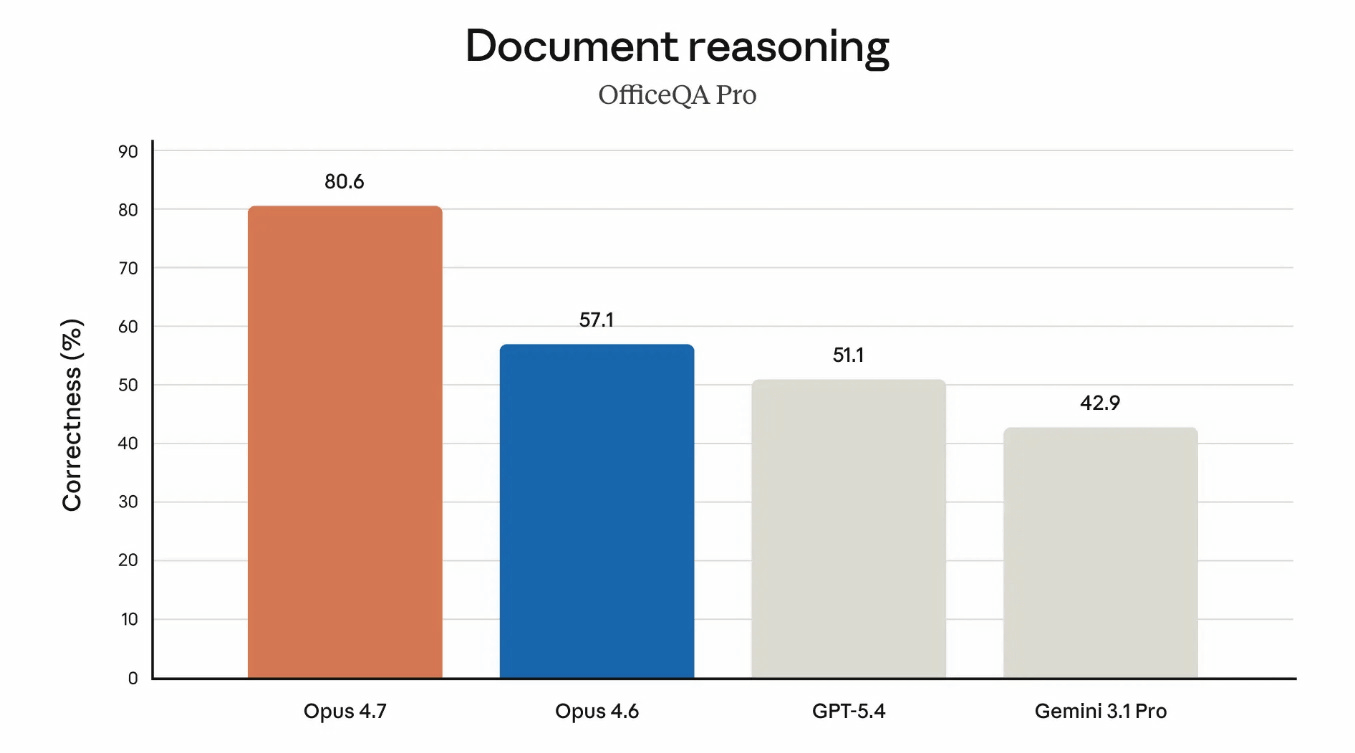
On the other hand, Anthropic also explained that Opus 4.7 does not have the same broad capabilities as its top-of-the-line model, '
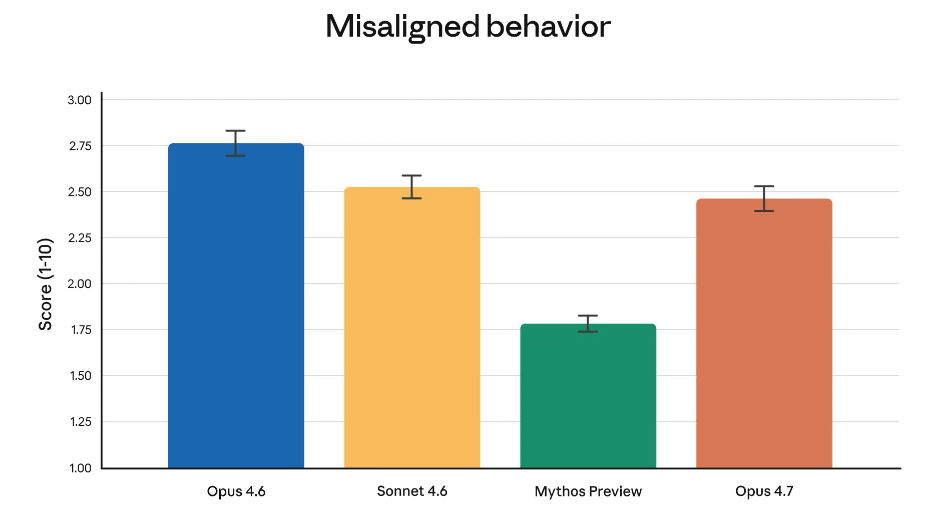
Regarding safety, the overall profile is close to Opus 4.6, with improvements observed in honesty and resistance to malicious prompt injection. However, there are some slight weaknesses in certain areas, such as overly detailed harm reduction advice regarding controlled substances, and the Anthropic consistency assessment positions it as 'generally well consistent and reliable, but behavior is not yet ideal.'
The following bar graph shows the behavioral inconsistency rate based on automated behavioral audits, with lower scores (behavioral inconsistency rate) indicating higher safety. While Opus 4.7 shows a slight improvement over Opus 4.6, Mythos Preview has a significantly lower behavioral inconsistency rate.
Opus 4.7 is available across the entire Claude product family, as well as through Anthropic API, Amazon Bedrock, Google Cloud's Vertex AI, and Microsoft Foundry. Pricing remains unchanged from Opus 4.6 at $5 per million input tokens (approximately ¥800) and $25 per million output tokens (approximately ¥3980).
Furthermore, Opus 4.7 features an updated tokenizer, which means that, depending on the content, the number of tokens can increase by up to 1 to 1.35 times compared to Opus 4.6, even with the same input. Also, with high effort settings, the amount of thought increases, especially in the later turns when used as an agent, and the output tokens tend to increase as well. Nevertheless, Anthropic has stated that overall efficiency has improved in their internal coding evaluation, and they recommend migrating while checking the differences with actual operational traffic.
In addition, Claude Code also announced a new xhigh setting that allows for fine-tuning of the inference amount, a ' /ultrareview ' command for code reviews, and an auto mode extension for Max users.
Related Posts:



in AI, Web Service, Posted by log1i_yk