Approximately 84% of respondents said they feel uneasy about entrusting their personal data to American technology companies, and 93% said they similarly do not trust Chinese companies.

In Europe,
8 in 10 Europeans don't trust US, Chinese firms with data – POLITICO
https://www.politico.eu/article/8-in-10-europeans-dont-trust-us-chinese-firms-with-data/
In the 'European Pulse' survey, jointly planned by POLITICO and beBartlet, a consulting firm specializing in politics and policy, and conducted by the research firm Cluster17, a questionnaire was administered to 6,698 Europeans in Spain, Germany, France, Italy, Poland, and Belgium from March 13 to 21, 2026.
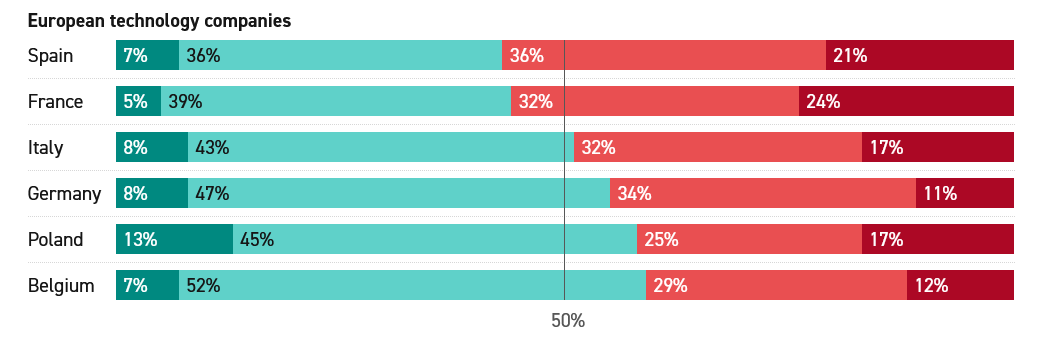
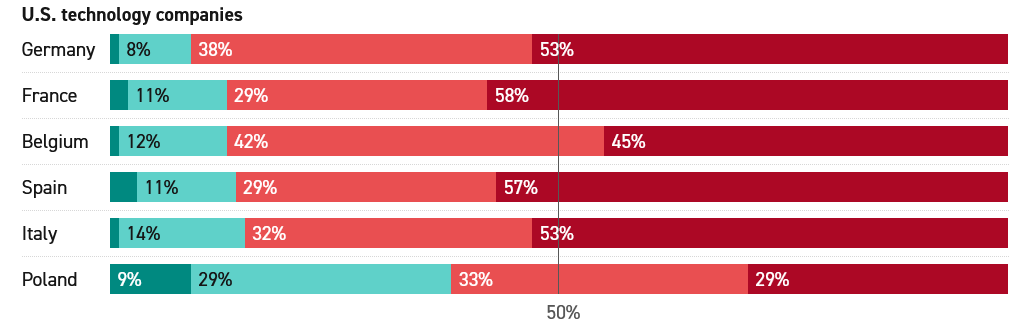
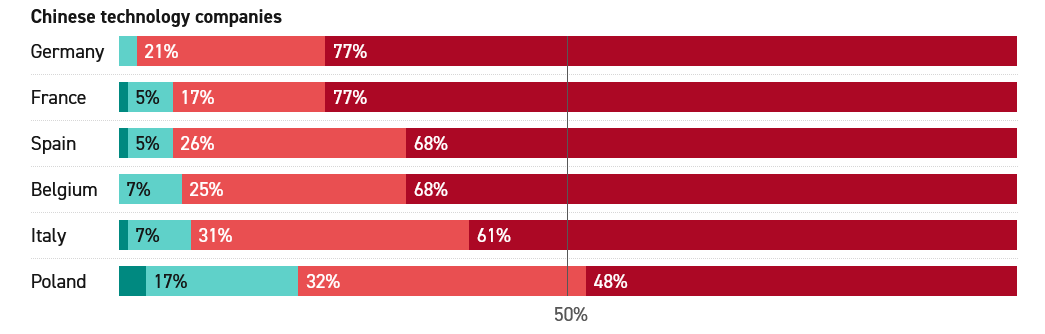
The survey asks respondents to choose from the following options for 'European technology companies,' 'American technology companies,' and 'Chinese technology companies': 'I trust them quite a bit (dark green),' 'I trust them to some extent (light green),' 'I don't trust them very much (light red),' and 'I don't trust them at all (dark red).'
The graph below summarizes the results of a survey on trust in European technology companies, broken down by country. The percentage of respondents who answered 'very trustworthy' or 'somewhat trustworthy' was approximately 40% in Spain and France, while it exceeded 50% in Italy, Germany, Poland, and Belgium.
On the other hand, the level of trust in American technology companies is as follows: Trust is clearly low, with only 38% of people in Poland responding that they 'trust them quite a bit' or 'trust them to some extent,' compared to around 10-15% in the other five countries.
Furthermore, the percentage of people who considered Chinese technology companies trustworthy was even lower than in the United States, with only 20% in Poland and less than 10% in the other five countries.
POLITICO points out that the scope of EU privacy regulations is a factor behind these findings. The EU requires companies that process personal data of people residing in Europe to comply with the EU's General Data Protection Regulation (GDPR), regardless of their location. However, technology companies based in the United States or China may provide data to authorities in violation of the GDPR because they must comply with their domestic security laws. Such privacy risks have raised concerns among European courts and privacy regulators.
IMPLICATOR.ai , an independent AI news and analysis media outlet in San Francisco, states that 'European distrust of American companies is not a temporary sentiment from the Donald Trump administration, but a deeply rooted issue based on the law.' In fact, a 2019 survey conducted by the German media conglomerate Bertelsmann Foundation , 'European Pulse,' among more than 12,000 people in 28 EU countries, found that 40% said they would trust European companies to handle their data, compared to a significantly lower 20% for American companies and 6% for Chinese companies.
While distrust of foreign companies remains strong within Europe, data cited by the European Commission in its November 2025 filing showed that AWS, Microsoft Azure, and Google Cloud combined account for approximately 70% of the European cloud market. Furthermore, some experts suggest that 'actual dependence could reach nearly 90% if AI workloads and managed services are included,' indicating that dependence on foreign services in Europe remains high.
Related Posts:








in Note, Posted by log1e_dh