I trained ChatGPT to become a marathon trainer, helping him lose over 9kg and achieve a new personal best.

Training for a Marathon With an AI Coach: What Worked and What Didn't - Bloomberg
https://www.bloomberg.com/news/features/2026-04-10/training-for-a-marathon-with-an-ai-coach-what-worked-and-what-didn-t
Wallbank has entered the Paris Marathon in April 2025. At the time, Wallbank was living in Singapore and was running almost every day in the tropical heat, which allowed him to set a new personal best of 2 hours and 47 minutes in a half marathon he participated in in Hong Kong.
However, in June, I had to move to California in the United States for work, and as I struggled to balance work and family life, I had almost no time left to train, which caused me to gain weight.
So, with six months to go until the marathon, Wallbank typed into ChatGPT, 'Please support me as a running coach and nutritionist. Your mission is to get me in peak condition so I can compete in my next goal, the Paris Marathon on April 12, 2026.'
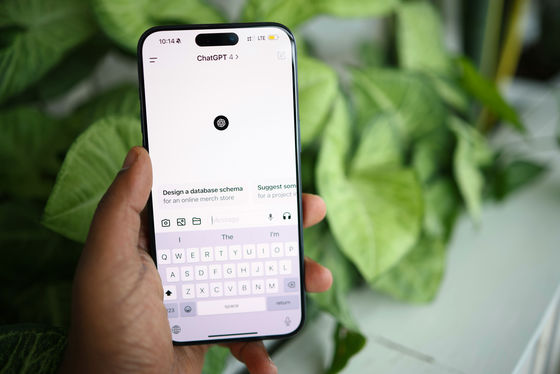
First, he entered his activity log data from
ChatGPT then analyzed Wallbank's exercise habits and advised him that he needed to 'improve his pacing, increase upper body and core strength training, do long-distance running, and pay attention to injury management.' From there, a daily training plan was created.
The specific training content is as follows:
Monday: Gym
Tuesday: Interval training
Wednesday: Rest
Thursday: Do something different (like golf)
Friday: Gym
Saturday: 5km run
Sunday: Long-distance run (5km or more)

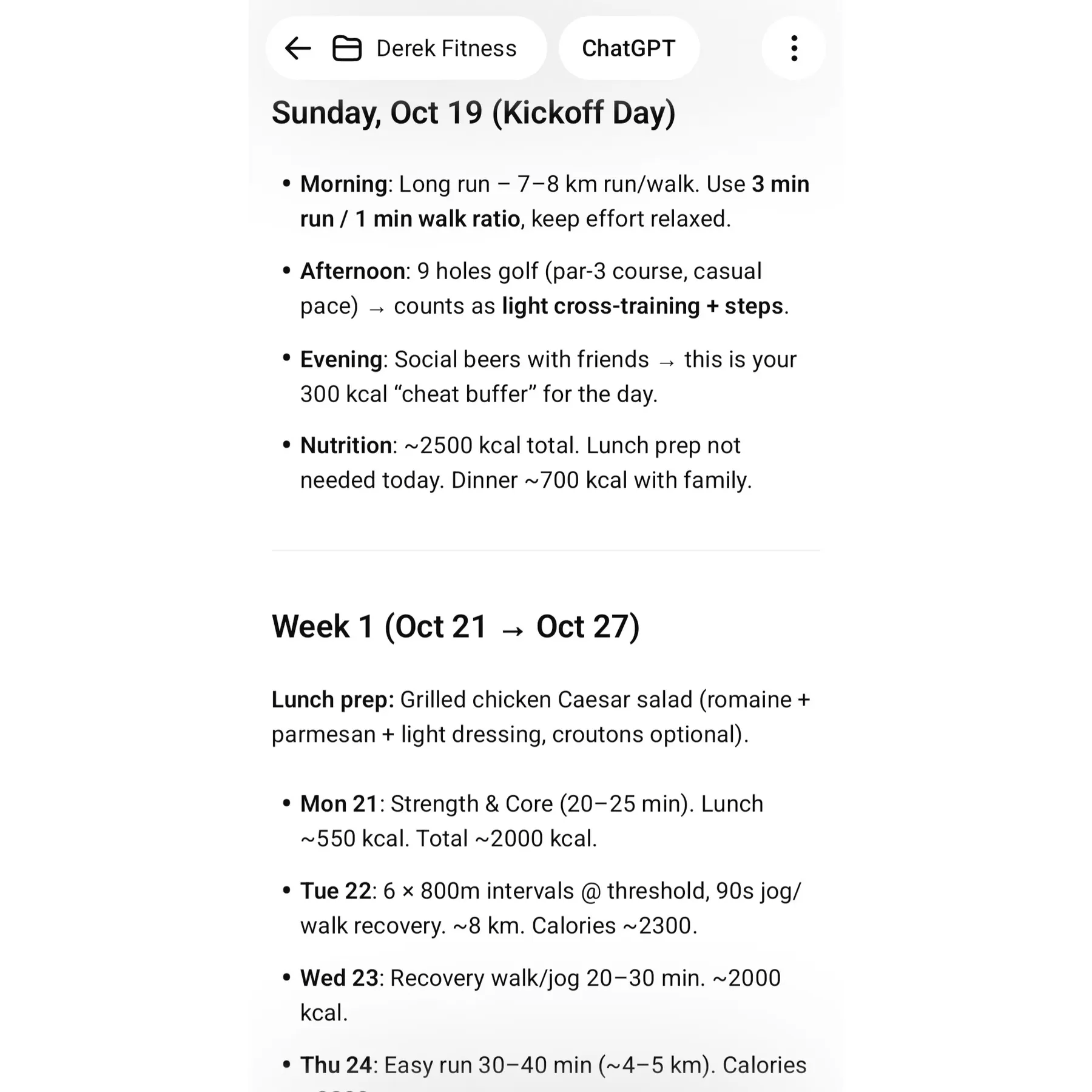
Wallbank records all of his training on Strava, and then inputs all the data, such as heart rate and pace, into ChatGPT. Furthermore, he has created marathon-related projects in ChatGPT and established individual chats to receive advice on running, nutrition, and weight.
The problem was that they had to manually enter data into ChatGPT multiple times a day. Apparently, recording meals was especially essential, and they had to enter things like, 'Today I'm having a salad. It's made with spinach, chicken breast, dried cranberries, Parmesan cheese, and Caesar salad dressing,' over and over again. Sometimes they even entered the exact quantities or posted photos of the food being measured with their hands.
Based on the information entered, the AI not only estimated calories and advised on what to eat, but also set the distance and pace of running, and the content of gym training. Wallbank said that the more information he entered, such as his hunger level, the degree of muscle soreness, and whether he had achieved his goals or not, the more ChatGPT adjusted his diet and training content appropriately.
However, after a few weeks of using ChatGPT as your marathon coach, the reliability of its output begins to decline, and small problems start to accumulate. For example, something you once told it, 'I don't have time to go to the gym on Monday (this week),' might inadvertently become a permanent rule.
The problem stemmed from Wallbank's misconception that 'ChatGPT would record everything you entered, just like a human coach.' However, in reality, ChatGPT has
Furthermore, after hiring ChatGPT as his marathon coach for about three months, Wallbank began to experience hallucinations . Initially, he would simply correct him, but 'gradually, it turned into frustration,' Wallbank said. He also had numerous other minor complaints, such as 'when he asked for the day's plan, ChatGPT would start interval training instead of the planned workout' and 'even though he hadn't reached his target weight, ChatGPT would arbitrarily reset his target and praise him for managing his physical condition well.'
As a result, Wallbank says he is no longer able to lose weight as he did at the beginning of his training. Nevertheless, Wallbank writes that thanks to ChatGPT, he is 'running further and faster than ever before,' and has actually set personal bests multiple times in 5km and 10km runs.
To improve his flawed marathon coach, Wallbank sought advice from his Michigan State University friend and software engineer, Tom Wolfe. After explaining the coach he had created with ChatGPT, Wolfe reportedly said, 'Why don't you just create an agent?' An AI like Anthropic's Claude fits Wolfe's definition of an agent, allowing the agent to automatically retrieve and output data in real time instead of manual input. However, Wallbank apparently decided to stick with ChatGPT until the Paris Marathon and did not switch to Claude.
Wallbank apparently worked with ChatGPT to develop his pacing strategy for the Paris Marathon. The strategy involved running for 28 minutes to the first water station, and then repeating a cycle of 'running for 4 minutes and walking for 3 minutes six times' and 'running for 10 minutes and walking for 2 minutes three times' to reach the finish line.
Wallbank says that when he tried this pacing strategy for a half marathon, he encountered a steep uphill section with an elevation difference of 183 meters, forcing him to disrupt his pace. Nevertheless, Wallbank completed the half marathon in just under three hours, which is his second fastest time in a half marathon.
Furthermore, since starting coaching with ChatGPT, Wallbank has successfully lost 9 kg and said, 'I'm running faster than ever before.'
Related Posts:






in AI, Posted by logu_ii