ChatGPT may accelerate learning but may not be effective for long-term memory retention.

Chat AIs like ChatGPT are widely used as learning aids because they can quickly organize things you don't understand and break down difficult explanations. Andre Barcaoui and his colleagues at the Federal University of Rio de Janeiro in Brazil studied 120 university students to see how learning with ChatGPT affected the time it took to complete tasks and how well they retained information 45 days later.
ChatGPT as a cognitive crutch: Evidence from a randomized controlled trial on knowledge retention - ScienceDirect
Study Finds ChatGPT May Help You Learn Faster, But There's a Catch : ScienceAlert
https://www.sciencealert.com/study-finds-chatgpt-may-help-you-learn-faster-but-theres-a-catch

Barkawi and his colleagues randomly divided 120 university students into two groups: one that used ChatGPT as a learning aid and the other that learned using traditional methods without AI. They then gave them the task of 'learning about artificial intelligence and summarizing their findings in a 10-minute presentation.'
The group using ChatGPT was able to use it not only to look up things they didn't understand, but also to summarize content briefly, get explanations of meanings, organize the flow of presentations, and get concrete examples. However, the other group, which learned using traditional methods without AI, had to do these tasks themselves, researching and organizing the information without relying on AI.
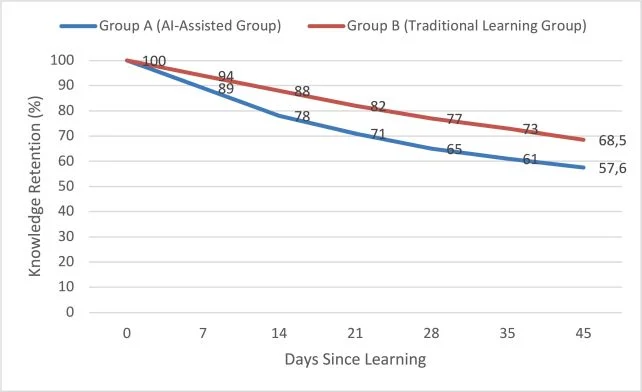
According to the research team, when the group that used ChatGPT was tested on the learned material 45 days later without prior notice, the average correct answer rate was 57.6%. This was lower than the average correct answer rate of 68.5% for the group that learned without using AI, and the research team reported that 'this difference is difficult to explain by chance.'
The research team not only compared the average accuracy rates on a test 45 days later, but also graphed how much knowledge was retained over time, with the initial learning level set at 100%. In the graph below, the blue line represents the group that used AI, and the red line represents the group that learned using conventional methods without AI. The vertical axis shows the knowledge retention rate, and the horizontal axis shows the number of days since learning. After 7 days, a difference began to emerge between the AI-using group and the group that learned using conventional methods, and it can be seen that the group that learned using conventional methods consistently maintained a higher rate of knowledge retention thereafter.
According to the science media outlet ScienceAlert, the average time it took to complete the task was 3.2 hours for the group using ChatGPT and 5.8 hours for the group that did not use AI. While the group using ChatGPT completed the task faster, their knowledge retention rate was lower in the test 45 days later.
The research team believes that these results may indicate that by delegating some of the tasks of thinking, remembering, and organizing to ChatGPT, the mental burden may have been reduced too much. Similar things happen with computers and search engines, but the team believes that ChatGPT can handle not only calculations and searches but also summarization and explanation, potentially further reducing the need for independent thinking during learning.
The research team also touched upon the concept of ' desirable difficulty ,' where a little effort during learning makes it easier to remember things for a long time. If AI makes learning too easy, it may reduce the mental effort needed to understand and retain information.
However, the research team is not against using generative AI to aid in education or research, stating that 'the important thing is not to leave everything to the AI, but to use it while maintaining the process of thinking and understanding for oneself.'
Related Posts: