A communication technology has been developed that uses magnetic fields to penetrate even underground where Wi-Fi signals are often weak, making communication and rescue possible in the event of an emergency underground.

A South Korean research institution has developed wireless technology that enables communication down to 100 meters underground, where conventional wireless communication is largely unusable. This technology utilizes magnetic fields instead of radio waves to achieve stable communication underground, and is expected to have applications in disaster relief and underground infrastructure management.
Wideband Magnetic Induction Wireless Communications in Challenging Underground Environments: A Current-Driven Scheme | IEEE Journals & Magazine | IEEE Xplore
Researchers develop ground-penetrating 'Wi-Fi' tech with 100m range — magnetic induction method could help reach those trapped or lost underground | Tom's Hardware
https://www.tomshardware.com/tech-industry/researchers-develop-ground-penetrating-wireless-communications-tech-with-100m-range-magnetic-induction-based-method-could-help-reach-those-trapped-or-lost-underground
A research team at the Korea Electronics and Telecommunications Research Institute (ETRI) has successfully developed a new underground wireless network technology called 'broadband magnetic induction (MI) wireless communication,' which can penetrate radio waves even in underground environments up to 100 meters below the surface. While it is a wireless communication technology similar to Wi-Fi, it actually differs from typical wireless LANs in that it uses magnetic induction to achieve stable communication with underground equipment and avoids the signal attenuation and degradation that occur with conventional radio frequency methods.
Conventional wireless communication uses radio waves, but underground, the signal is rapidly attenuated by soil, rocks, and moisture, resulting in extremely short communication ranges. On the other hand, magnetic fields are less affected by these factors and have the advantage of transmitting signals more stably.
In conventional MI wireless communication architectures, communication signals are transmitted and received using coils that utilize the fundamental principle of mutual magnetic induction. The transmitting coil transmits a signal in the form of a sinusoidal current, which induces another similar sinusoidal current inside the receiving node, thereby enabling communication. The interaction between the transmitting and receiving coils is due to mutual induction. This mechanism is similar to an electrical transformer, and is characterized by transmitting signals using the coupling of short-range magnetic fields rather than transmitting radio waves into space. However, while such MI wireless communication technology has advantages such as a stable communication channel and miniaturization of coils, it also has technical limitations such as a narrow communication range and large path loss over long transmission distances.
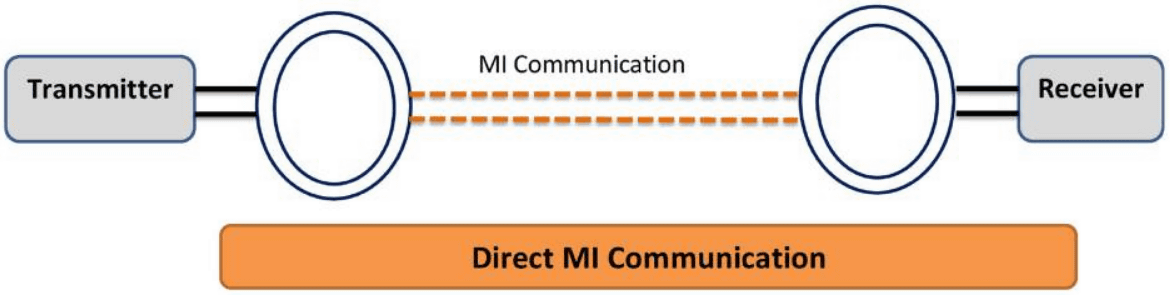
Therefore, previous
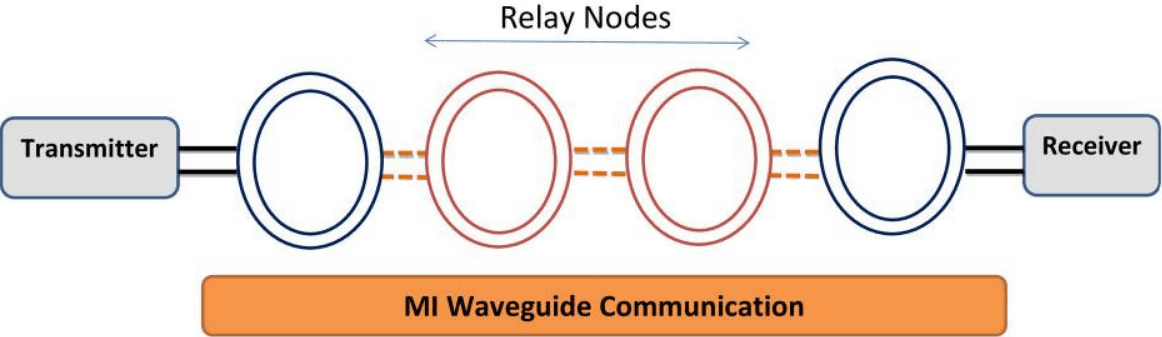
ETRI applied these studies and conducted experimental research toward practical application. The MI wireless communication test setup consists of a 0.9 sq m x 0.9 sq m transmitting loop antenna and a magnetic field receiving sensor, all connected to a wireless communication system that uses ' quadrature phase-shift keying modulation ' for data transmission. The transmission speed is very limited to only 2 kb/s, but is considered sufficient bandwidth for voice communication. The tests were conducted in a limestone bedrock environment known to effectively block wireless signals.
In a field experiment transmitting signals from 100 meters underground to the surface, the researchers stated that the efficiency measurement for 'transmission and reception at a low carrier frequency of 15 kHz and a data rate of 2 kb/s' recorded a high value of 13.33%, demonstrating the feasibility of MI wireless communication using this method. Furthermore, the energy-to-noise power spectral density ratio per bit was measured at 23.98 dB and the error vector amplitude at 14.74%, and the paper claims that 'this demonstrates that the proposed system is sufficiently reliable.'
Compared to conventional underground communication methods, magnetic field-based MI wireless communication has the potential to be incorporated into smaller, lower-power devices with a wider range of applications, leading researchers to suggest the possibility of integrating MI wireless communication technology into smartphones. If MI wireless communication becomes available on smartphones, it would expand the range of underground communication for people working or exploring in tunnels and caves, and could also serve as a means of communication during disasters when people are lost or trapped underground. Furthermore, the potential applications of this technology in offshore drilling and national defense are also being discussed.
Related Posts:






in Hardware, Web Service, Posted by log1e_dh