A wireless transceiver capable of communicating at speeds comparable to optical fiber will be developed

In radio frequency communications, the speed and efficiency of the radio transceivers used to send and receive data are crucial. A research team at the University of California, Irvine, has developed a radio transceiver that uses a radio frequency band up to 140 GHz, achieving communication speeds comparable to those of physical fiber optic cables.
An Antenna-to-Bits F-Band 120-Gbps CMOS RF-64QAM Receiver | IEEE Journals & Magazine | IEEE Xplore
A Bits-to-Antenna F-Band 120-Gb/s CMOS RF-64QAM Transmitter for FutureG Wireless Links | IEEE Journals & Magazine | IEEE Xplore
https://ieeexplore.ieee.org/document/10833751
Engineers invent wireless transceiver that rivals fiber-optic speed
https://techxplore.com/news/2026-01-wireless-transceiver-rivals-fiber-optic.html
'The Federal Communications Commission (FCC) and 6G standards bodies see the 100 GHz frequency band as the new frontier,' said Jisong Wang, lead author of the paper and currently working at Marvell Technology . 'However, at these speeds, traditional transmitters that use analog-to-digital converters to create signals are very complex and power-hungry, running into bottlenecks in the so-called DAC (digital-to-analog converter) .'
At the time of writing, the maximum frequency band used for 5G communications is 28 GHz. Attempting to increase data speeds by using a higher frequency band would require a significant increase in the power required for data processing, resulting in rapid battery life degradation.
'Traditional receivers have a hard time receiving data at such high speeds without using a large, power-hungry component called a DAC,' said Yousef Hassan, lead author of the paper and currently working at Qualcomm.
So the research team devised a way to avoid these inefficiencies by moving the heavy processing load into the analog domain. 'We envisioned an entirely new, all-analog architecture that overcomes the tough power trade-offs that plague high-speed designs,' said Payam Heydari , co-author of the paper and professor of electrical engineering at the University of California, Irvine.
The new wireless transceiver developed by the research team is shown below. By constructing a signal directly in the radio frequency domain using three synchronized sub-transmitters, they completely eliminate the DAC. 'It's like packing your suitcase perfectly before you leave home, rather than trying to organize it while running to the airport,' Wang said.
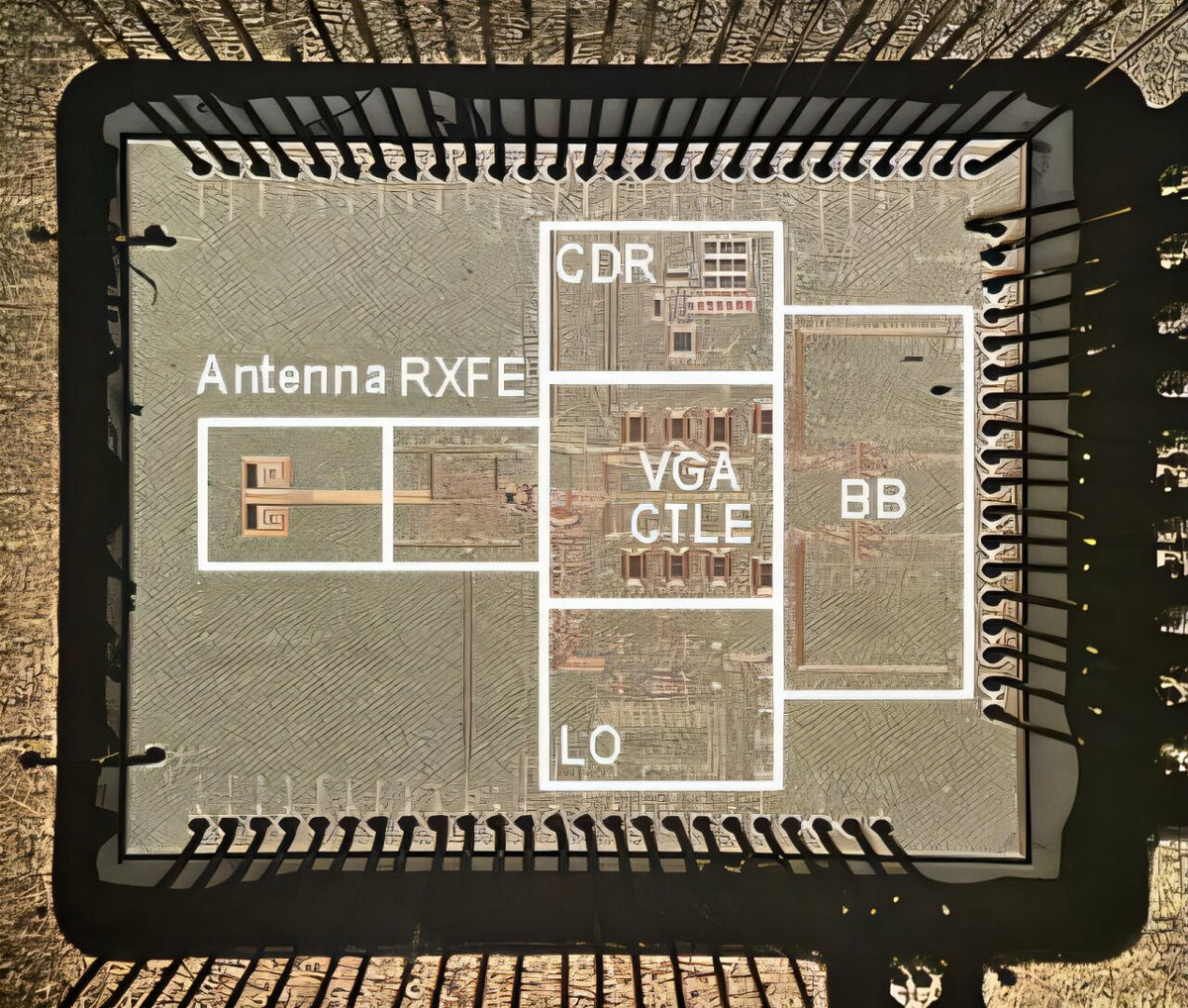
The wireless transceiver developed by the research team operates at 120Gbps, achieving communication speeds fast enough to transmit multiple 4K videos in an instant. The receiver chip is fabricated using 22nm fully depleted silicon-on-insulator (SOI) technology and consumes only 230 milliwatts of power, making it efficient enough for portable devices, the research team explains.
'Our innovation eliminates the need to lay kilometers of complex copper cabling inside data centers. It enables data company operators to achieve ultra-fast wireless links between server racks, significantly reducing hardware, cooling and power costs,' said Heydari.
Related Posts:





in Hardware, Web Service, Science, Posted by log1h_ik