Google has invested 160 million yen in 'Animaj,' an AI animation studio for children, but some critics argue that it's an investment in low-quality AI-generated content that preys on children.

Google, the parent company of YouTube, has announced it will invest $1 million (approximately 160 million yen) in Animaj , a video studio that uses AI to create animations for children. Some experts have criticized this investment, saying it will lead to an increase in the 'low-quality AI-generated content' that is a problem on YouTube.
Google Backs AI Studio to Produce YouTube Videos for Children - Bloomberg
https://www.bloomberg.com/news/articles/2026-03-11/google-backs-animaj-studio-using-ai-to-make-content-for-kids-on-youtube
'Harming babies': Child safety group blasts Google's investment in AI content for kids | Mashable
https://mashable.com/article/google-youtube-animaji-ai-kids-videos
The video platform YouTube is overflowing with AI-generated, low-quality content and misinformation. For example, a fake movie trailer generated by AI became so popular that it surpassed the views of the official trailer, leading to the channel being shut down for violating YouTube's spam and misleading metadata policies.
YouTube shuts down two major channels, Screen Culture and KH Studio, for using AI to create fake movie trailers; combined they boasted over 2 million subscribers and 1 billion views - GIGAZINE

YouTube is taking various measures to combat low-quality AI-generated content, and in March 2026, it just released a tool to detect 'AI-generated fake videos impersonating politicians.'
YouTube launches tool to detect 'AI-generated fake videos impersonating politicians' - GIGAZINE

It seems that low-quality AI-generated content, especially that aimed at infants and toddlers, can easily generate huge profits . And, as the overseas media outlet Mashable points out, YouTube, with its large number of infant and toddler viewers, is a particularly fertile ground for this low-quality AI-generated content.
Google has long acknowledged that low-quality content created by AI is rampant on YouTube, and has stated that it is taking steps to stop monetizing accounts that post 'low-quality, miscellaneous content.'
However, according to a New York Times report published in February 2026, thousands of low-quality AI-generated content pieces targeting young viewers were found, including some that violated YouTube's child safety policies . YouTube's failure to require animated videos to be labeled as AI-generated has also been criticized.
Rachel Franz, director of the Offline Content Development Program for Toddlers at Fairplay for Kids , a child safety non-profit that studies the impact of screen time and commercial advertising, said, 'It's common for Google to try to distract from the real problem. YouTube and YouTube Kids are rife with AI-generated substandard content that is endangering developing children. If 'controlling AI-generated substandard content' was truly YouTube's top priority, then millions of AI-generated 'kids' videos would have already been removed.'
Amidst this situation, on March 4, 2026, Google, the parent company of YouTube, announced that it would invest $1 million (approximately 160 million yen) in Animaj , an AI-powered entertainment company for children. This investment will allow Animaj to join Google's AI Futures Fund and gain access to Google's cutting-edge generative AI. Animaj became the first children's media company supported by the AI Futures Fund.
animaj.com/post/animaj-joins-googles-ai-futures-fund-to-redefine-how-kids-content-gets-made
https://www.animaj.com/post/animaj-joins-googles-ai-futures-fund-to-redefine-how-kids-content-gets-made
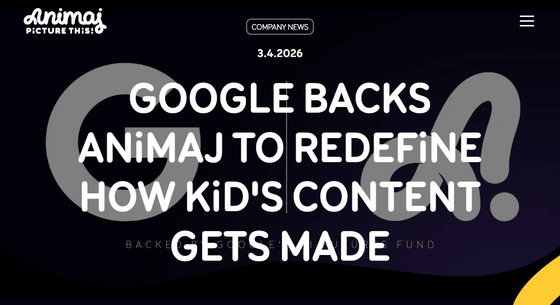
Animaj is an AI content studio specializing in children's media. Animaj's content includes popular children's shows such as Pocoyo and Rabbids . Animaj describes itself as 'growing children's IPs like Pocoyo and The Adventures of Maya the Bee into global franchises through a digital-first, multi-platform strategy powered by AI-driven creativity.' Sixte de Vauplan, co-founder of Animaj, says 'Animaj is a proof of concept for creating high-quality feature films powered by AI.'
Animaj Showreel 2026 | Building the Future of Kids' Entertainment - YouTube
Animaj has partnered with children's YouTube channels, including ' HeyKids ,' which has over 4.7 million subscribers. According to Bloomberg, the total number of views for the YouTube channels partnered with Animaj will exceed 22 billion by 2025.
Franz commented on the videos created by Animaj, saying, 'They are typical AI-generated videos that attract families, as they use nursery rhymes as their theme and feature child-friendly characters. However, the true essence of these videos lies, above all, in captivating the viewer.'
Child safety advocacy groups and education experts are warning against content designed to 'captivate' children with sensational images and music, and instead recommending slower-paced, interactive, evidence-based educational content such as call-and-response videos. The American Academy of Pediatrics has also warned parents to be cautious of AI-generated content and recommends choosing longer videos over shorter ones.
Franz points out that the abundance of content on YouTube that captivates children 'takes away time that infants and toddlers need to play, interact, and fully engage their five senses' during a period when their brains are still 'wiring up.' This is a problem that applies especially to AI-generated videos, but also to popular YouTube channels like CocoMelon and some well-intentioned content created for children.
Franz added, 'Animaj's YouTube channel is full of videos for babies. Google investing in Animaj is equivalent to investing in channels like Hey Kids, which means investing in something that harms babies.'
Furthermore, Franz warned that YouTube's design itself is inappropriate for children's development. Specifically, he pointed out that features such as infinite scrolling of short videos, algorithm-based video recommendations, and the inability to turn off autoplay are harmful to healthy development.
Animaj aims to extend existing intellectual property with AI and may not be the kind of company that produces the surreal, often obscene, 'low-quality' content that hundreds of other YouTube creators are promoting. However, Franz is concerned that 'the proliferation of AI and its generation tools will rapidly accelerate an industry that is doing the exact opposite of what early childhood education researchers recommend.'
Related Posts: