Does 'Providing Paid Holidays' Reduce Turnover Rates?

In the United States, there is no statutory paid vacation system, and with the exception of a few states, providing paid vacation is optional. Research has shown that simply improving these benefits can significantly reduce turnover rates.
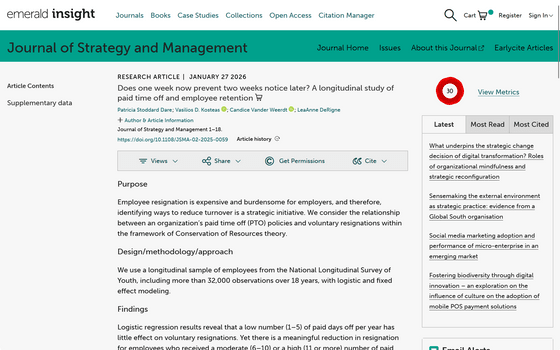
Does one week now prevent two weeks notice later? A longitudinal study of paid time off and employee retention | Journal of Strategy and Management | Emerald Publishing
More paid time off keeps US workers from quitting, study finds
The United States is the only country among the 38 developed countries in the Organization for Economic Cooperation and Development (OECD) that does not legally guarantee paid vacation. As of December 2024, 18 states mandate paid vacation, but most cap it at five days. While some employers are expanding paid vacation, many workers still do not receive any paid vacation at all, and fewer than half of workers have access to paid vacation.
Patricia Derr and her colleagues at Cleveland State University used 18 years of data and over 32,000 observations to examine how the number of paid vacation days granted affects workers' voluntary turnover rates.

The results showed that offering one to five days of paid leave only slightly reduced turnover rates, and no significant effect was found when analyzed separately for men and women. However, increasing the number of days of paid leave from six to ten days significantly reduced turnover rates, particularly among men. Although men have a lower turnover rate than women to begin with (4.7% vs. 6.7%), it was found that increasing the number of paid leave days has the effect of reducing turnover rates.
The strongest effect was observed when 11 or more days of paid leave were offered, significantly reducing the likelihood of quitting for both men and women. For women, the effect of paid leave is negligible until 11 or more days are offered, but after that, the quit rate drops significantly. Women tend to need more paid leave than men to reduce their likelihood of quitting.

Research has shown that increasing paid vacation days to six or more days significantly reduces turnover rates, but only nine states require this level of paid vacation for employees, and no state requires more than eight days of paid vacation per year, so system reform is needed. Furthermore, it has been pointed out that, based on estimates that the cost of rehiring a worker is equivalent to one year's salary, it would be more beneficial to increase paid vacation time and stabilize employment.
'Five days of paid leave is clearly not enough. Many state laws stop at this minimum, and no state mandates more than eight days of paid leave. But our data show that the strongest retention effects occur well above that level,' said co-author LeeAnne DeLigne. 'If policymakers and employers want to retain workers, they need to recognize that paid leave is a stabilization strategy, not a luxury.'
Related Posts:








in Science, Posted by log1p_kr