China mentions AI over 50 times in new five-year plan, including quantum computing, 6G, and embodied AI
On March 5, 2026, China released a government work report at the fourth session of the 14th National People's Congress, its highest legislature, outlining its policy direction for the 15th
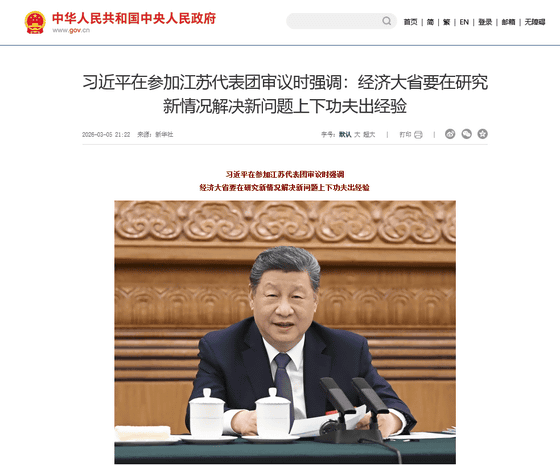
Participating Jiangsu representatives from Jiangsu University, time and place of training: Research by the Ministry of Education, New Information, New Issues, High and Low Performance, Presentation_Chinese Government
https://www.gov.cn/yaowen/liebiao/202603/content_7060929.htm
China's new five-year plan calls for AI throughout its economy, tech breakthroughs | Reuters
https://www.reuters.com/world/asia-pacific/china-vows-accelerate-technological-self-reliance-ai-push-2026-03-05/
According to a report by China's state-run news agency, Xinhua , President Xi Jinping attended the deliberations of the Jiangsu delegation at the Fourth Session of the 14th National People's Congress on March 5, 2026, and spoke about the system for achieving the economic and social development goals of the 15th Five-Year Plan.
It has been reported that the five-year plan lowered the annual economic growth target to around 5%, the lowest growth target China has set in recent years. According to the BBC, China-related analysts believe that by lowering the target, China intends to reduce the huge fiscal burden it must shoulder just to achieve the target and give itself more room to maneuver the economy.
President Xi also emphasized the development of 'new productive forces.' This refers to the concept of using high-tech industries such as AI, semiconductors, quantum computing, and robotics as new engines of economic growth. Specifically, the plan sets goals such as 'promoting the integrated development of education, science and technology, and talent, strengthening original innovation, and venturing into key core technologies to seize the leadership in science and technology,' 'promoting deep integration of the innovation chain, industry chain, capital chain, and talent chain, and exploring new ways to promote the efficient transformation and application of scientific and technological achievements,' and 'opening up new frontiers in optimizing and upgrading traditional industries, nurturing and expanding emerging industries, and proactively planning for future industries.'

In particular, the 141-page Government Work Report mentions 'AI' more than 50 times. Other reports also point out that 'China is outpacing its competitors in AI research and development,' and that it leads the world in both research and development and applications in areas such as biomedicine, robotics, and quantum technology. Furthermore, the report outlines a policy to encourage the introduction of AI, robotics, and other technologies in areas experiencing labor shortages. Furthermore, the report outlines plans to increase investment in areas such as machine-brain interfaces, quantum computing, and 6G, and also promises to develop a large reusable rocket and demonstrate the feasibility of building a lunar research station.
'The Chinese government's goal is to use AI and robotics to improve performance and productivity in a variety of sectors, including manufacturing, logistics, education, and healthcare,' explained Kyle Zhang of the Brookings Institution , a think tank specializing in Chinese technology.
The Fourth Session of the 14th National People's Congress will continue discussions for about a week, and the full text of the five-year plan will be adopted on the final day of the meeting and then announced on a later date by state media.
Related Posts:






in AI, Posted by log1e_dh