US Food and Drug Administration suddenly denies, then retracts, approval of Moderna's mRNA influenza vaccine
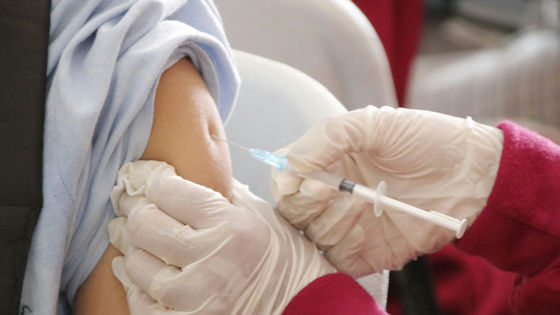
Moderna Announces the US Food and Drug Administration will Initiate the Review of Its Investigational Seasonal Influenza Vaccine Submission
https://feeds.issuerdirect.com/news-release.html?newsid=8923338804483797
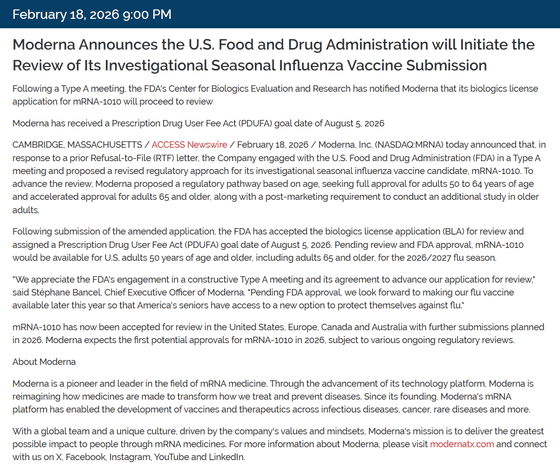
FDA reverses surprise rejection of Moderna's mRNA flu vaccine - Ars Technica
https://arstechnica.com/health/2026/02/fda-does-u-turn-will-review-modernas-mrna-flu-shot-after-shocking-rejection/
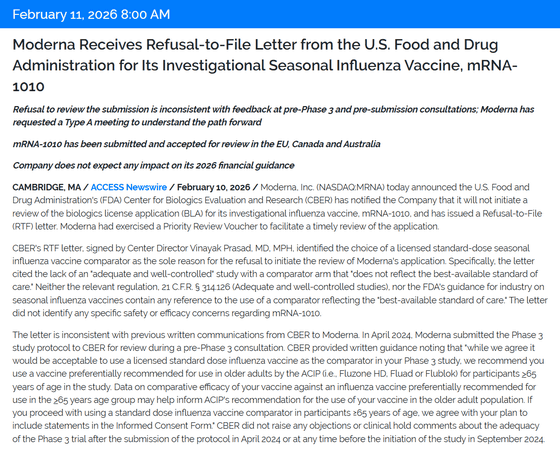
On February 11, 2026 local time, Moderna announced that its Biologics License Application (BLA) for clinical trials of its seasonal influenza vaccine, mRNA-1010, had been rejected by the FDA. The FDA explained that the reason for the rejection was the design of Moderna's Phase 3 trial, but that the rejection was unexpected, citing that similar applications for mRNA-1010 had already been accepted in the EU, Canada, and Australia, and that this contradicted feedback from consultations conducted prior to the application.
Moderna Receives Refusal-to-File Letter from the US Food and Drug Administration for Its Investigational Seasonal Influenza Vaccine, mRNA-1010
https://feeds.issuerdirect.com/news-release.html?newsid=7346090610333866
Moderna's Phase 3 trial, which tested the safety and efficacy of mRNA-1010 in approximately 41,000 participants, used standard doses of FDA-approved influenza vaccines, including GlaxoSmithKline's seasonal influenza vaccine, Fluarix, as a control. Results showed that mRNA-1010 was 26.6% more effective than the control vaccine, as reported in July 2025.
Moderna announces that mRNA influenza vaccine is more effective than conventional vaccines - GIGAZINE
According to Moderna, the FDA will review and approve the trial design at least twice, in April 2024 and August 2025, before submitting a Biologics License Application for mRNA-1010.
Moderna CEO Stephane Bancel questioned the FDA's refusal to review the product, saying, 'The FDA's Center for Biologics Evaluation and Research (CBER)'s decision does not identify any safety or efficacy concerns regarding Moderna's product, nor does it contribute to our shared goal of strengthening American leadership in innovative drug development.' 'There should be no argument for the FDA to conduct a comprehensive review of an influenza vaccine application that compares approved vaccines with CBER in a study previously discussed and agreed upon with CBER,' he said.
The FDA's decision to reject Moderna's mRNA-1010 review was made by Vinay Prasad, the Trump administration's top vaccine regulator. Stat News reports that the decision was made solely by Prasad, overriding the opinions of FDA scientists. In fact, David Kaslow, a senior FDA official in charge of vaccine reviews, explained to Prasad that the FDA's scientific team was ready to review mRNA-1010 and was in a position to proceed. Kaslow also reportedly submitted a memo to Prasad outlining the reasons for proceeding with the review, but Prasad ignored these and rejected the review.
Prasad cited Fluarix, which mRNA-1010 used as a control vaccine in its Phase 3 trials, as the reason for the rejection, saying the clinical trials were not 'adequately controlled' because they 'did not reflect the best available standard of care.'
However, on February 18, 2026 local time, Moderna revealed that the FDA had notified them that it would proceed with the review of its Biologics License Application for mRNA-1010. Moderna explained that it had engaged in discussions with the FDA regarding its rejection of the application and had been able to secure a review of the rejection.
'Pending FDA approval, we look forward to beginning to offer mRNA-1010 in the second half of 2026, providing older Americans with a new option for protecting themselves from influenza,' said Bancel, CEO of the company. The FDA is expected to make a decision on vaccine approval by August 5, 2026.
Andrew Nixon, a spokesperson for the U.S. Department of Health and Human Services, told Ars Technica, 'Following discussions with Moderna, the FDA has revised its regulatory approach and amended its application, which it has accepted. As with all products, the FDA will continue to hold itself to the same high standards during review and approval.'
Related Posts:
in Science, Posted by logu_ii