NVIDIA CEO Jensen Huang says AI is a 'five-layer cake' and a critical infrastructure for humanity

NVIDIA CEO
'Largest Infrastructure Buildout in Human History': Jensen Huang on AI's 'Five-Layer Cake' at Davos | NVIDIA Blog
https://blogs.nvidia.com/blog/davos-wef-blackrock-ceo-larry-fink-jensen-huang/
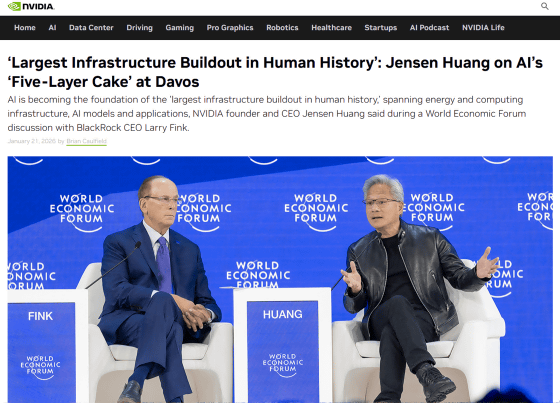
On the main stage of the Davos Forum, Huang spoke with Larry Fink, CEO of BlackRock , the world's largest asset management company, in a discussion in which he described AI not as a single technology but as a 'five-layer cake' consisting of five layers: energy, chips and computing infrastructure, cloud data centers, AI models, and applications.
'For the AI sector to thrive, each of these five layers must be built and operated. This platform shift will create jobs across the economy, from energy to application development. Huang argues that AI is already creating a demand for highly skilled labor, from power generation to semiconductor manufacturing, data center construction, and cloud operations.'
At the top, the application layer, the focus could be on integrating AI into financial services, healthcare, manufacturing, etc. 'Ultimately, this is where the economic impact will happen,' Huang said.
As an indicator of how rapidly AI is transforming the global economy, Huang pointed out that venture capital investment will peak in 2025, with the majority of that investment going to 'AI-native companies' that have AI at the core of their business. These companies span a variety of sectors, including healthcare, robotics, manufacturing, and financial services.

While some fear that the development of AI will reduce the human workforce, Huang argues that AI is unlikely to take away jobs. For example, hospital radiology departments have introduced AI-powered image scanning tools, which has resulted in more patients being seen and more radiologists than ever before.
It is said that there is a shortage of approximately 5 million nurses in the United States, and nearly half of that work is spent on creating medical records and charts. AI tools are beginning to take over these administrative tasks, and if this improves productivity, hospitals will see an increase in performance and, as a result, the number of nurses hired will increase.
Huang explained that the reason AI will not take away jobs is because it will not take away the 'purpose of work.' For example, AI can take over Huang's job of typing, but typing itself is not Huang's purpose, so even if AI emerges, his job will not be taken away. Huang then asked the audience, 'So, my question is, what is the purpose of your work?'

'AI is infrastructure,' Huang said, arguing that all countries should treat AI as part of their infrastructure, like electricity or roads, and build it using local languages and cultures. 'Let's continue to develop and improve AI, and make national intelligence part of the ecosystem,' he said.
Fink questioned whether AI would benefit only the most educated people, to which Huang responded, 'AI is so easy to use. It's the easiest piece of software ever made.' He added that in just two or three years, AI tools have reached nearly one billion people, and many more are benefiting from them.
However, Huang acknowledged that AI literacy will be essential in the world of the future. 'It's clear that learning how to use AI—how to guide, manage, protect, and evaluate it—is essential,' he said.
Huang also said that AI offers developing countries an opportunity to close long-standing technological gaps, while Europe, which already has a strong manufacturing and industrial sector, will need to integrate AI and AI, particularly in the field of robotics, where AI represents a once-in-a-generation opportunity.

Fink concluded the discussion by saying that the current state of AI does not appear to be a bubble, and asked, 'Are we investing enough?' Huang responded, 'We need to build the infrastructure needed for all the higher layers of AI. This opportunity is truly amazing, and everyone should participate,' calling for massive investment.
Related Posts:




in AI, Posted by log1h_ik