'Asker' and 'Guesser': Japan is a typical 'guessing culture'

When making a request or negotiating, the same words can be interpreted differently, leading to awkwardness and dissatisfaction. One framework to explain this discrepancy is the idea of dividing people into two types: askers (those who ask questions) and guessers (those who make guesses).
'Askers' vs. 'Guessers' - The Atlantic
The Asker/Guesser classification originated from a comment made on a web message board on January 16, 2007.
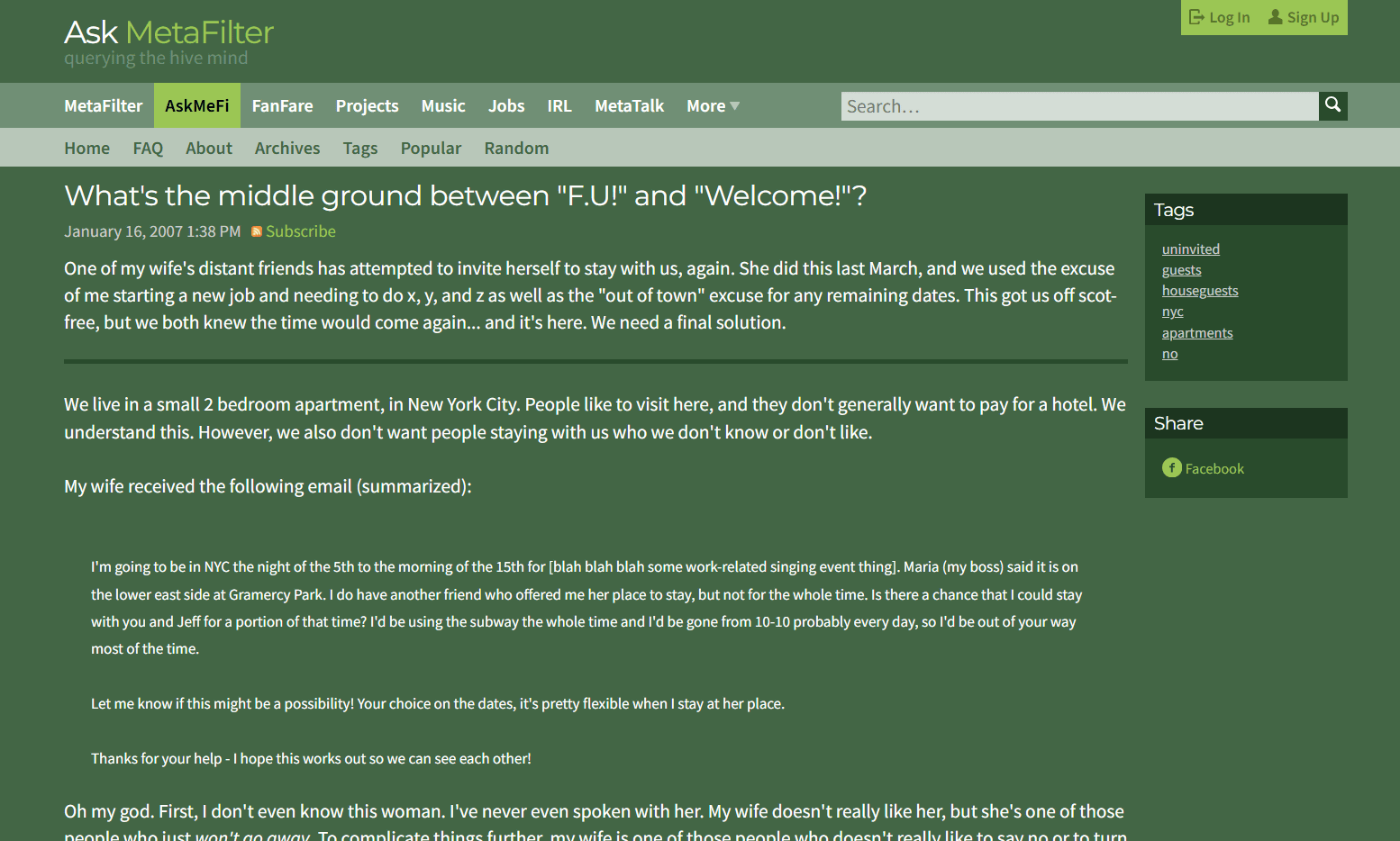
The comment was about a person living in a small two-bedroom apartment in New York who was in trouble after a distant acquaintance of her partner asked her to stay for a long period of time again. The acquaintance asked if she could stay at her husband's house, saying, 'They'll be out during the day so they won't be a bother. The dates are flexible, so please let me know if that's possible.' The poster barely knew the woman, and her partner wasn't particularly interested, but the acquaintance persisted in contacting her.
The poster commented that if he wanted to ask for a favor, he should first explain his current situation and wait for the other person to make a request, and that he felt it was presumptuous to directly ask for accommodation. Last time, he'd gotten away with it by making excuses like he'd just changed jobs and was busy, but this time he wanted to draw a definitive line, as it would set a precedent for him to be asked again if his situation changed. He suggested using an excuse like not being able to duplicate the key, or simply saying 'that's not possible' without giving a reason, and also discussed on the message board how he should respond, taking into account his wife's tendency to find it difficult to say no clearly.
In response, message board user tangerine
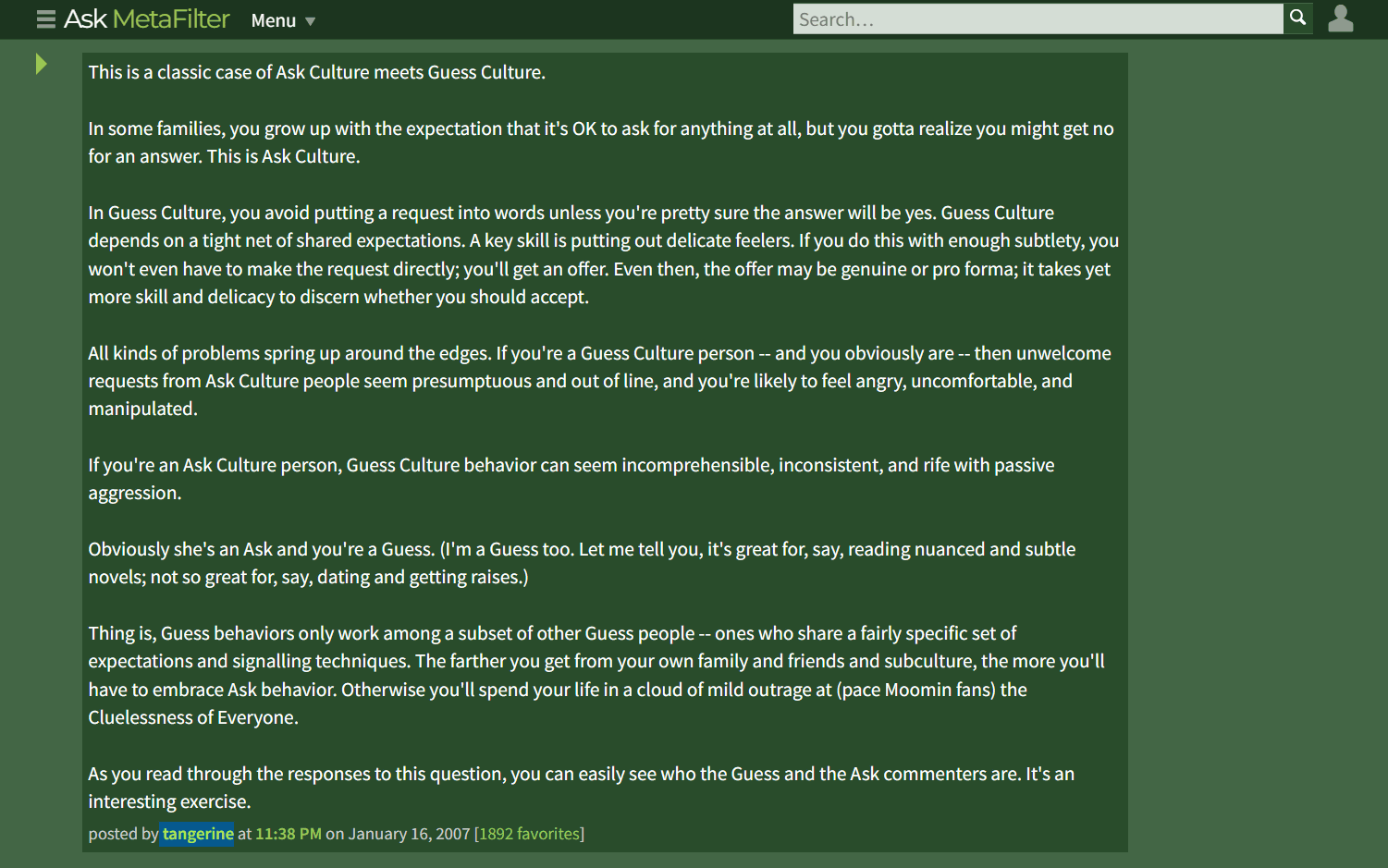
In an Ask Culture, you are free to ask for anything, but are willing to accept a no as an answer. In a Guess Culture, you only ask when you are sure the other person will say yes, and it's important to subtly gauge their reaction before doing so.
A Guess Culture employee, or Guesser, subtly checks the other person's feelings and availability without placing a burden on them, hoping that the other person will read the mood and spontaneously say, 'Please come to our place if you'd like,' without even having to ask first. However, it's difficult to tell from the outside whether the request comes from a genuine feeling of welcome, or just a polite gesture that makes it difficult to refuse, so the Guesser must carefully determine whether it's okay to ask for help, while also assessing the other person's true feelings so as not to damage them.
To the Guesser, a direct request from the Asker may seem brazen, leading to anger, discomfort, and a sense of manipulation. Conversely, to the Asker, the Guess Culture's behavior may appear inconsistent, passive-aggressive, or even pessimistic.
Tangerine speculates that 'the poster is a Guesser and the person who requested it is an Asker,' and states that the Guesser's etiquette works within a limited range of people who share the same etiquette, but the further away you are from family, friends, and groups you belong to, the more likely you are to behave like an Asker.

Oliver Berkman of The Guardian argues that while it's not as simple as who's right, when an asker and a guesser meet, it can easily lead to unpleasant misunderstandings. He argues that even at work, when a boss asks for an advance on a deadline, the asker might be expecting something to be rejected, while the guesser might take it as an expectation or an order.
Berkman further points out, 'For example, British and American people are confused about business in Japan, which has a Guess Culture, but conversely, they tend to perceive Russians as rude because Russia has a strong Ask Culture.'

Libertarian blogger Julian Sanchez argues that Guess Culture's polite, indirect approach is often a way of intentionally maintaining ambiguity. He explains that in intermediate levels of intimacy, the distance between people hasn't yet been determined, so asking too directly can come across as rude, as it seems like you're forcing the relationship to be black and white. On the other hand, he adds, when the relationship is more clearly defined, like with close friends or strangers, people tend to be more direct in their requests.
On the other hand, Jonathan Chait of The New Republic asserted that 'Guesser is wrong and Asker is right.' He argued that asking can only determine what the person asking wants and what the person receiving the request can undertake, and that a culture that relies on guesswork is a breeding ground for dissatisfaction.
Austin Frucht of The Incidental Economist also argues that because the person making the request needs a yes or no answer differently over time, and the person receiving the request is also more or less willing to respond, it makes sense to act as an asker in some situations and a guesser in others.
Related Posts:








in Note, Posted by log1i_yk