Why is a mission to place a radio telescope on the far side of the moon important to astronomy?
Lunar Radio Telescope to Unlock Cosmic Mysteries - IEEE Spectrum
https://spectrum.ieee.org/lunar-radio-telescope
In 1979, Jack Burns, a recently graduated astronomer, traveled to the Very Large Telescope Array ( VLA) , an observatory in the high desert of New Mexico, to study radio jets and quasars in the Milky Way's distant reaches. Radio telescopes tend to be built in high altitudes and desert areas, where the skies and air are clear and there's less interference from electronic devices. However, even the VLA at the time faced interference challenges, as Earth's protective atmosphere and ionosphere block large parts of the electromagnetic spectrum.
Meanwhile, Burns was approached by Wendell Mendel, a planetary scientist at NASA, who asked him, 'What about putting a radio telescope on the moon?' At the time, Burns hadn't even considered it seriously, but in 1984, he was asked to speak at a conference on future lunar observatories, and his thinking about space radio telescopes changed. After that, Burns worked for NASA and the Department of Energy for 40 years, submitting more than 500 peer-reviewed papers on radio telescopes while also promoting projects to put radio telescopes on the moon.
Finally, in 2026, the LuSEE-Night radio telescope is scheduled to be launched on the far side of the moon. 'Even after all these years, we still have ambition,' said Burns, 73, a professor emeritus at the University of Colorado, Boulder. 'We're trying to understand what we can do by stepping onto lunar soil and using these radio telescopes in places we've never seen before.'
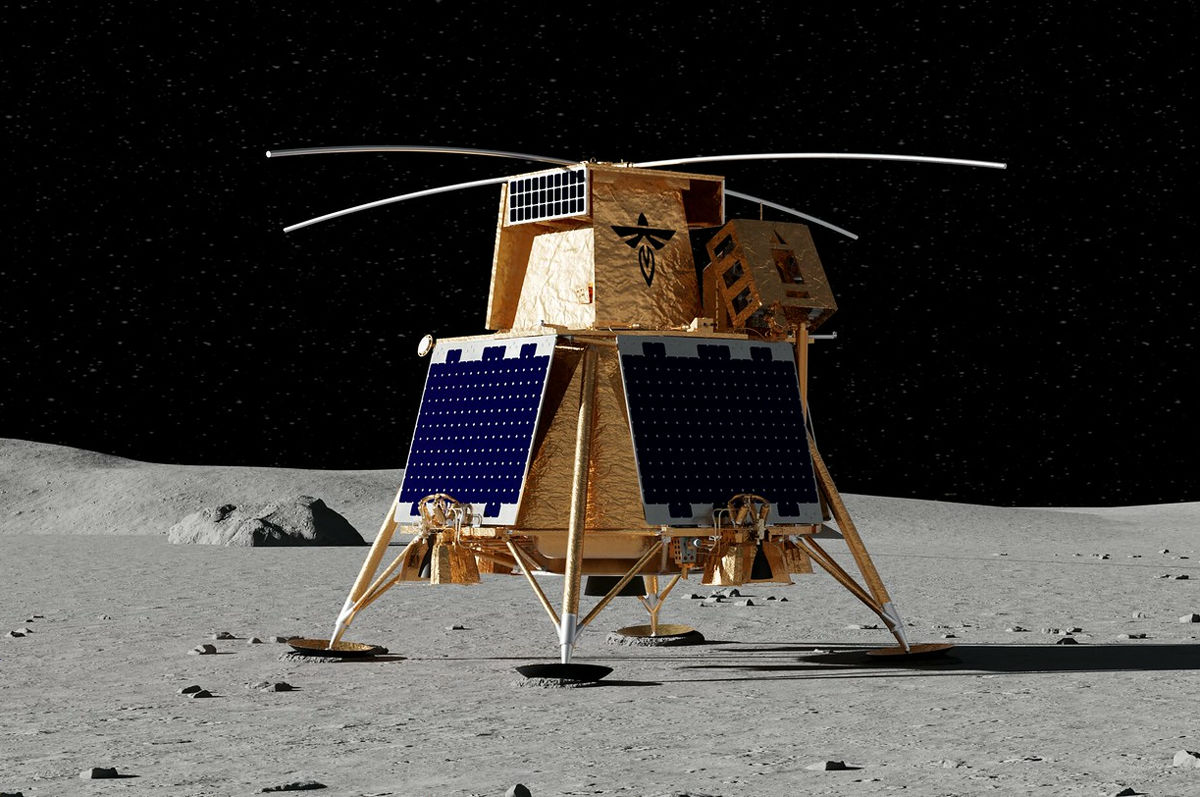
LuSEE-Night will be launched on a SpaceX rocket and then land on the far side of the moon aboard the Blue Ghost lunar lander, a lander developed by the American private space company Firefly Aerospace. Firefly Aerospace's Blue Ghost successfully landed on the moon in March 2025, becoming the second privately operated spacecraft to do so , and this will be the second mission to include the launch of LuSEE-Night.
by Firefly Aerospace
A radio telescope on the far side of the Moon could provide clearer images of dark matter, dark energy, neutron stars, and gravitational waves, potentially helping to solve some of the greatest mysteries in space science. For example, Burns hopes that it may offer clues about
One challenge in studying these mysteries is that very old or very weak radio waves are easily drowned out by Earth's communication networks, power grids, radar, etc. Also, signals from the early universe are very low frequency and largely blocked by Earth's ionosphere, making them difficult to observe with Earth-based radio telescopes.
That's why the far side of the Moon is attracting attention. Because the Moon always faces the same direction toward Earth, it's always protected from radio interference emitted by Earth. Additionally, when the Sun sinks below the lunar horizon, the far side of the Moon is completely shielded from Earth's radio waves during the 14-day night, making it electromagnetically darker than anywhere else in the solar system. Hallinan explained, 'At very low radio frequencies, noise associated with the solar wind appears. The only place within 1 billion kilometers of Earth that escapes this noise is the night side of the Moon. When the solar wind blows through with great force, it creates a cavity where we can hide from the noise.'
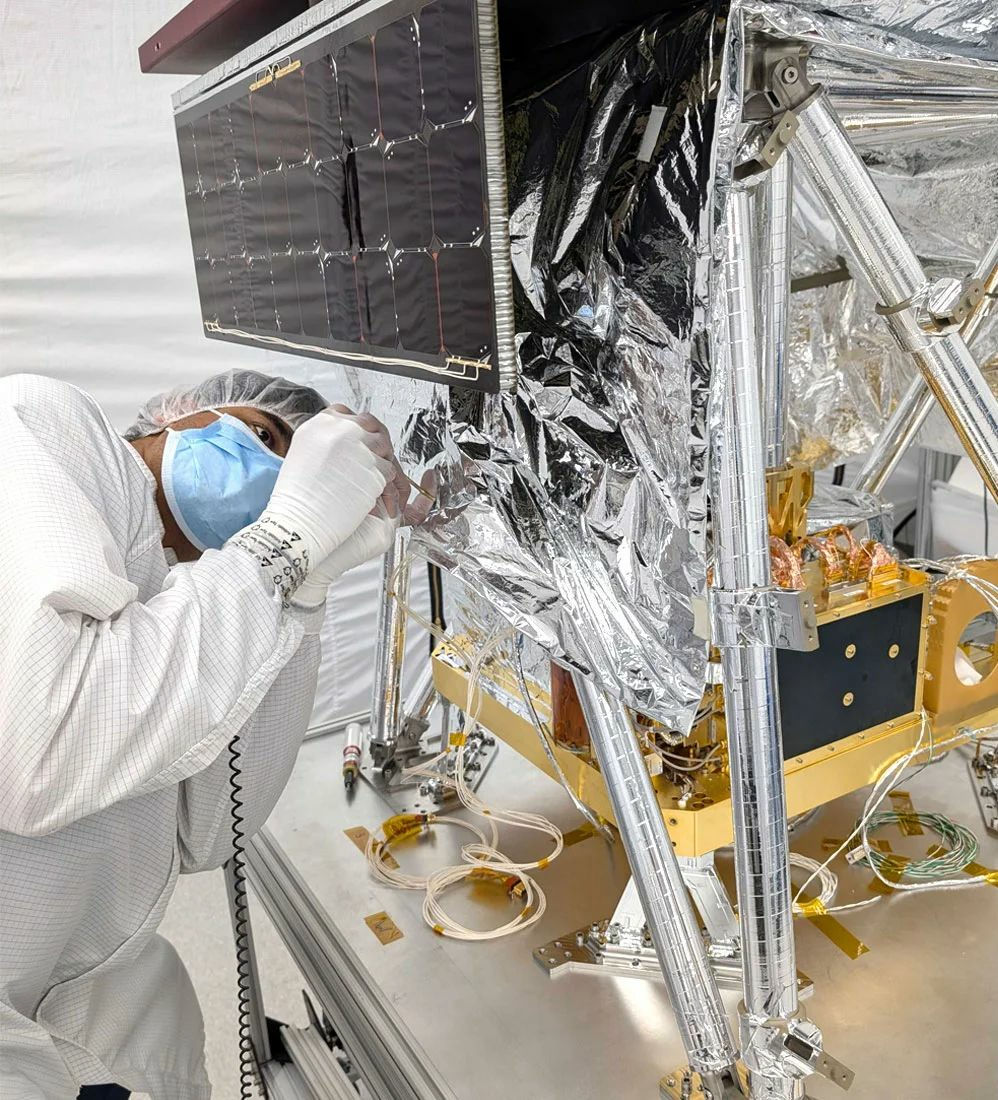
LuSEE-Night has two dipole antennas mounted on a small turntable, each facing in opposite directions. The antennas are made of a beryllium copper alloy, which provides high conductivity and stability while also being able to withstand the extreme temperature changes of the Moon. Each antenna can extend up to 6m in length.
The turntable sits atop a box containing embedded support equipment with a volume of just under 1 cubic meter, and its total weight is kept to less than 120 kg. Radio waves generated in the early universe are nearly isotropic , meaning they can be received equally well in any direction regardless of the antenna's orientation. However, radio waves emitted from specific galaxies or interstellar gas clouds are likely to arrive from specific directions, so by rotating the turntable, it is possible to distinguish between old and new radio waves.
by Space Sciences Laboratory/University of California
Blue Ghost Mission 2, including the launch of LuSEE-Night, is scheduled to land at a landing site on the far side of the Moon after sunrise. After landing, the probe will spend two weeks inspecting and photographing the probe, conducting experiments with other Blue Ghost instruments, and charging the LuSEE-Night battery pack using solar panels. After the sun sets, all power will be turned off except for the LuSEE-Night receiver and minimal support systems to ensure observations are as interference-free as possible.
A key aspect of LuSEE-Night's mission is to withstand the extreme temperature changes on the far side of the Moon while continuing its observations. To insulate LuSEE-Night from heat during the day, a multi-cell parabolic heat dissipation panel is installed on the exterior of the instrument case, and a large-capacity battery is used to keep it warm at night. Of LuSEE-Night's launch weight of 108 kg, approximately 38 kg is a 7160 watt-hour lithium-ion battery, whose primary role is to generate heat at night. The battery is charged by solar panels during the day, but even the critical spectrometer is periodically powered down at night to ensure the battery's charge does not fall below 8%. IEEE Spectrum points out that 'it is better to lose even a little observation time than to lose the entire instrument and be unable to recover.'
If LuSEE-Night proves successful, it will also spur interest in more ambitious lunar radio telescopes. Burns, Hallinan, and others have already secured initial funding for FarView, a radio telescope array consisting of 100,000 dipole antennas spread across an area of roughly 200 km² . FarView will use aluminum extracted from lunar soil, and assembly could begin as early as the 2030s.
What are the prospects for the 'FarView' project to turn the moon's surface into a giant radio telescope? - GIGAZINE
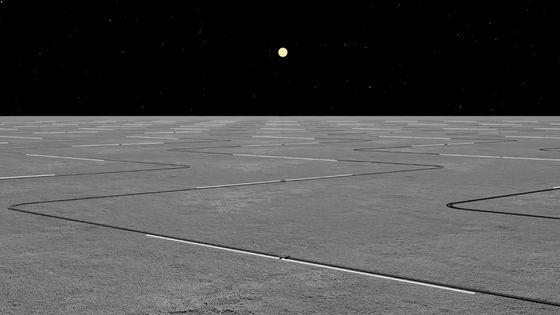
Burns, who has been a tireless advocate for the establishment of a lunar observatory throughout the tenures of 10 NASA administrators and seven U.S. presidents, acknowledged to IEEE Spectrum that the journey to a lunar observatory has taken longer than expected, but added with a positive note: 'Just think about it: we can actually study cosmology from the surface of the moon.'
Related Posts:

in Science, Posted by log1h_ik