Shipments in China fell 1.6% year-on-year due to a decline in demand caused by rising smartphone prices
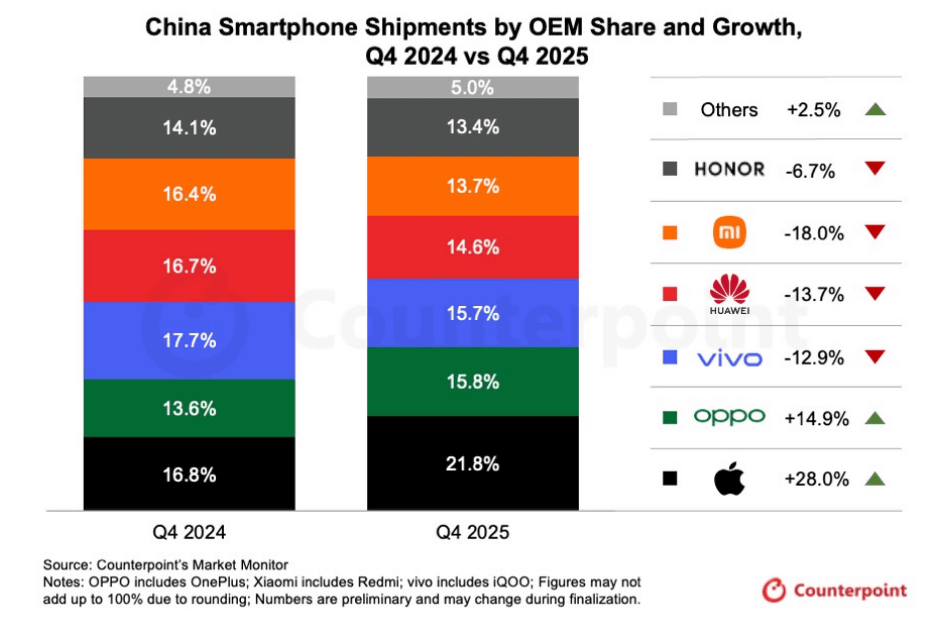
Market research firm Counterpoint Research has announced that smartphone shipments in China will decline 1.6% year-on-year in the fourth quarter of 2025. The main factor behind this decline is attributed to rising product prices due to a memory shortage, which has dampened consumer demand.
China Smartphone Shipments Slip 1.6% YoY in Q4 2025; Apple Leads With 22% Share
Nvidia (NVDA) Supplier Micron (MU) Says Memory Shortage to Last Beyond 2026 - Bloomberg
https://www.bloomberg.com/news/articles/2026-01-19/micron-says-unprecedented-memory-shortage-to-last-beyond-2026
Smartphone shipments in China fell 1.6% year-on-year in the fourth quarter of 2025. According to an analysis by Counterpoint Research, the main factor behind this decline was rising product prices caused by a severe memory shortage, which suppressed consumer demand.
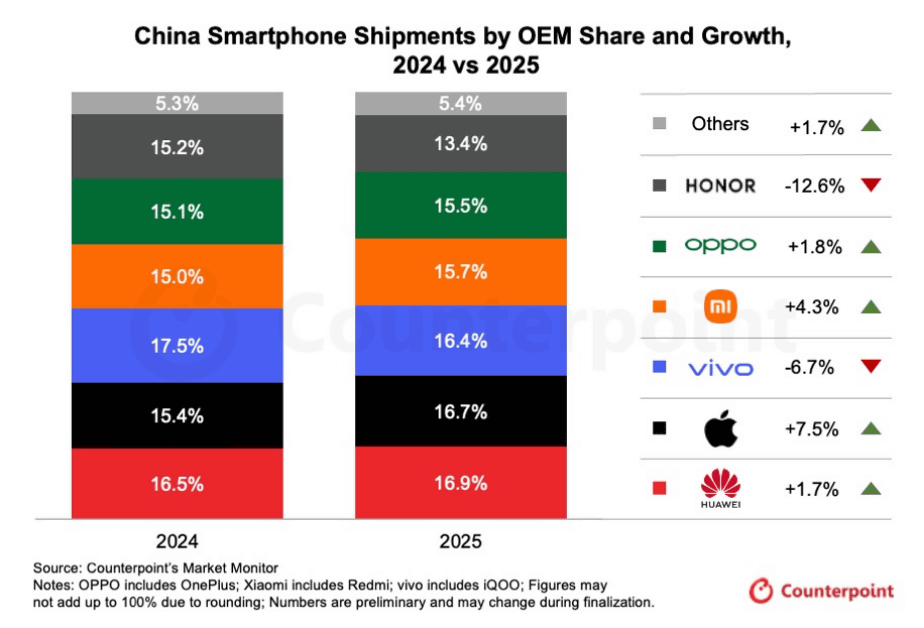
Looking at the full year of 2025, smartphone shipments are expected to decline 0.6% year-on-year, and remain lower for most of the year, except for the first quarter, when government subsidies temporarily boosted demand.
Looking at smartphone shipment share in the fourth quarter, Apple, thanks to the strong performance of its iPhone 17 series, took the lead with 21.8%, achieving outstanding growth of 28.0% compared to the same period last year. However, in terms of growth rate of shipments, many major manufacturers suffered significant declines in shipments due to the impact of rising memory costs, with Xiaomi down 18.0%, Huawei down 13.7%, and Vivo down 12.9%.
Looking at the market structure for the full year of 2025, Huawei ranked first with a 16.9% share, but shipments began to decline in the second half of the year due to rising memory costs, forcing manufacturers to optimize their product portfolios, such as by reducing low-margin product lines. The major companies' market shares throughout the year were closely spaced: Apple with 16.7%, vivo with 16.4%, Xiaomi with 15.7%, and Oppo with 15.5%, and they are engaged in fierce competition while facing the common challenge of rising costs.
Smartphone manufacturers are facing serious memory cost increases, forcing them to take measures such as scaling back certain low-end product lines that are unprofitable. The future outlook is uncertain, with memory prices predicted to rise by a further 40% to 50% in the first quarter of 2026, followed by an additional 20% increase in the second quarter. In response, major Chinese manufacturers such as Xiaomi, Oppo, and Shenzhen Transcend Technology have lowered their shipment targets for 2026, with Oppo reportedly cutting its initial forecast by as much as 20%.
Accelerating this memory shortage is the surge in demand for high-end semiconductors for AI infrastructure. According to semiconductor manufacturer Micron, the entire industry's production capacity is being allocated to manufacturing the high-bandwidth memory required for AI accelerators, resulting in an unprecedented supply shortage of general-purpose memory for smartphones and PCs. Manish Bhatia, Micron's executive vice president of global operations, described the situation as 'unprecedented,' noting that high-bandwidth memory (HBM) for AI accelerators is consuming a significant portion of the industry's supply capacity.
This supply shortage is expected to continue beyond 2026, and Micron has decided to discontinue its Crucial-branded memory business, which was targeted at consumers, in order to prioritize supply to strategic enterprise customers such as NVIDIA.
Micron to withdraw from consumer memory storage business, Crucial brand memory and SSD shipments to be halted in February 2026 - GIGAZINE

To address the severe supply shortage, Micron is rapidly expanding its manufacturing capacity in both the US and Asia. Near Syracuse, New York, a $100 billion project is underway to build four DRAM factories, each the size of 10 football fields, with operations expected to begin by 2030. Micron is also building a new factory in Boise, Idaho, with production slated to begin in 2027, and expanding its existing facility in Virginia.
These investments are being driven by U.S. government support, including a $6.2 billion grant in 2024, with the goal of moving 40% of DRAM manufacturing to the U.S. Additionally, Samsung is acquiring an existing Taiwanese factory for $1.8 billion, with plans to begin DRAM production in the second half of 2027, shortening the time to market.
Related Posts:






in Hardware, Smartphone, Posted by log1i_yk