The claim that the human brain has a language network with AI-like mechanisms
AIs such as ChatGPT and Gemini are capable of natural, human-like conversations and complex tasks, leading some to believe they have human-like thinking. However, the general consensus is that the mechanisms of AI thinking are completely different from those of the human brain. Meanwhile, Evelina Fedoronko, a researcher at the Massachusetts Institute of Technology, has reported research findings that suggest the human brain has a language network similar to large-scale language models (LLMs), pointing out that the human brain has similarities to AI.
The Polyglot Neuroscientist Resolving How the Brain Parses Language | Quanta Magazine
https://www.quantamagazine.org/the-polyglot-neuroscientist-resolving-how-the-brain-parses-language-20251205/
In the field of neuroscience, it was generally believed that 'language processing and non-language processing in the brain share a common mechanism, and that language processing is a prerequisite for complex thinking and reasoning.' However, Fedronko's research has shown that 'there are selective areas in the human brain responsible for language processing,' and that 'language processing operates through a mechanism different from other forms of thinking .'
Fedronko calls the language-processing area of the brain the 'language network.' After MRI scans of approximately 1,400 people, he found that most people have a language network in three areas of the frontal cortex. He also found several language network areas in the middle temporal gyrus .
In addition, in a study of subjects who lost their language ability, it was confirmed that the subjects were able to solve addition and subtraction problems and logic problems, infer what others are thinking, and appreciate music, even though they could not use language. It was also observed that in healthy adults, different areas of the brain are activated during language processing and non-language processing. Based on these research results, Fedoronko concluded that 'language processing and non-language processing use different brain regions, and thinking is independent of language.'
Furthermore, the language network manipulates language by learning 'linguistic regularities' and 'relationships between words.' This mechanism is very similar to large-scale language models that learn linguistic regularities and output sentences.
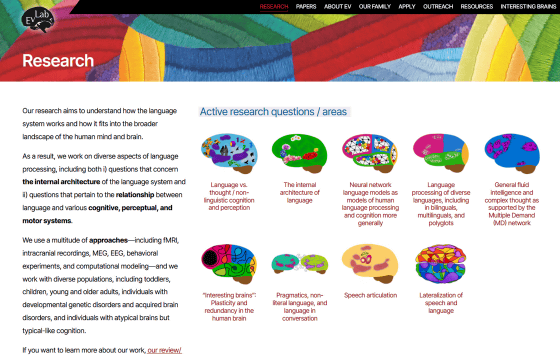
Mr. Fedoronko's research results are summarized on the following page.
Research — EvLab
https://www.evlab.mit.edu/research
Related Posts:






in Science, Posted by log1o_hf