NASA's James Webb Space Telescope observes lemon-shaped exoplanet with inexplicable atmospheric composition

by NASA, ESA, CSA, Ralf Crawford (STScI)
NASA's
A Carbon-rich Atmosphere on a Windy Pulsar Planet - IOPscience
https://iopscience.iop.org/article/10.3847/2041-8213/ae157c

NASA's Webb Observes Exoplanet Whose Composition Defies Explanation - NASA Science
https://science.nasa.gov/missions/webb/nasas-webb-observes-exoplanet-whose-composition-defies-explanation/
PSR J2322-2650b is an exoplanet discovered in 2017. It orbits the pulsar PSR J2322-2650, located 750 light-years from Earth. Pulsars typically emit electromagnetic waves at intervals of a few milliseconds to a few seconds, and these waves are only observable when pointed directly at Earth, like a lighthouse beam.
PSR J2322-2650 is expected to rotate at a rapid rate of about 300 times per second, emitting primarily gamma rays and other high-energy particles that cannot be detected by the James Webb Space Telescope's infrared observations. This means that PSR J2322-2650 will not obstruct observations, allowing scientists to closely study the neighboring object, PSR J2322-2650b.
'This pulsar system is unique in that we can observe the planet illuminated by its host star, while the host star itself is completely invisible,' said study co-author Maya Bereznay, a doctoral student at Stanford University.
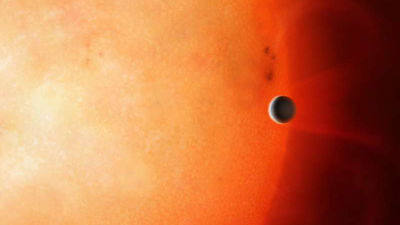
Below is an artist's impression of PSR J2322-2650b orbiting the pulsar. The central pulsar has a mass about 1.4 times that of the Sun, but its diameter is estimated to be only 10-20 km, exerting extremely strong gravity. As a result, PSR J2322-2650b, which orbits the pulsar at a distance of just 1.6 million km, has a shape that looks like it has been stretched into a lemon shape by gravity.
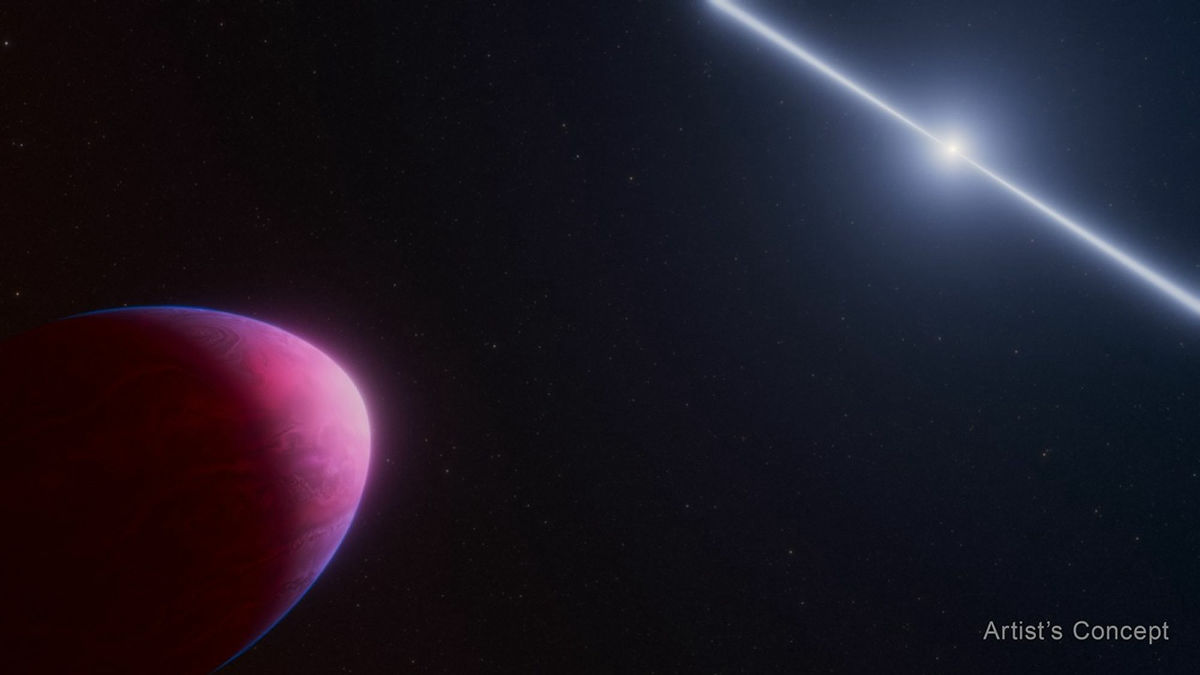
The research team analyzed the emission spectrum of PSR J2322-2650b throughout its orbit and found that it has a unique atmospheric composition, primarily composed of helium and molecular carbon. This atmospheric composition has never been observed before, and it is possible that clouds of soot float in the atmosphere, and carbon clouds condense to form diamonds deep within the planet.
'The pulsar this planet orbits is completely unusual. It has a mass comparable to the Sun, yet is only the size of a city,' said Michael Chang of the University of Chicago, lead researcher on the study. 'PSR J2322-2650b's atmosphere is a new kind of planetary atmosphere that no one has seen before. Instead of the molecules water, methane, and carbon dioxide typically observed on exoplanets, we detected molecular carbon, specifically C2 and C3 .'
The temperature of PSR J2322-2650b is so high, between 640 and 1,700 degrees Celsius, that if other atoms were present in the atmosphere at this temperature, carbon would bond with them. It is thought that molecular carbon exists despite this because there is almost no oxygen or nitrogen to bond with. Astronomers have studied about 150 planets in and outside the solar system, but they have not found any other planets where molecular carbon can be detected.
The research team points out that it is extremely difficult for a planet to have an extremely carbon-rich atmosphere like PSR J2322-2650b, and that this does not fit any known planet formation mechanism. 'It's good that we don't know everything,' said Roger Romani of Stanford University, co-author of the paper. 'We want to learn more about this strange atmosphere. It's great to have mysteries to solve.'
You can see an animation of PSR J2322-2650b orbiting the pulsar in the YouTube video below.
Exoplanet PSR J2322-2650b Orbiting a Pulsar - YouTube
Related Posts: