Transparent leadership trumps servant leadership

Chris, a software engineer living in Sweden, said that after becoming a manager, he was groping around trying to learn how to behave without knowing how to behave. He read many books about 'servant leadership,' but he still felt that it didn't make sense to him. He now advocates a new approach called 'transparent leadership.'
Transparent Leadership Beats Servant Leadership
https://entropicthoughts.com/transparent-leadership-beats-servant-leadership
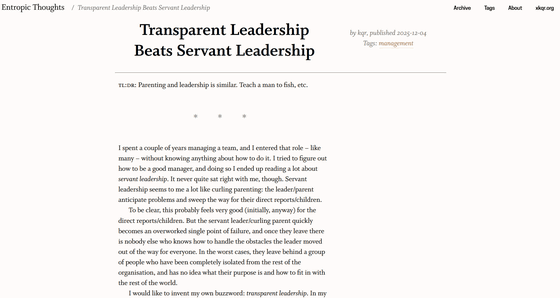
Servant leadership is a philosophy in which leaders prioritize supporting and serving their members, rather than issuing orders from above, and seek to achieve organizational results by creating a comfortable working environment and encouraging growth.
Chris, a Swedish software engineer, said that when he started his career as a manager, he read many books on 'servant leadership' while learning the role by trial and error. However, he couldn't shake the feeling that servant leadership resembled 'curling parenting,' where parents proactively remove all obstacles in their children's path.
Servant leadership is comfortable for subordinates, but it can lead to overwork and the risk of the leader becoming a single point of failure, leaving the team unable to deal with obstacles in their absence. In the worst case scenario, Chris points out, the team may become isolated from the organization and lose sight of their purpose.

With this awareness of the issue in mind, Chris has proposed the new concept of 'transparent leadership.' Chris defines a good leader as 'someone who coaches members, connects people, and teaches systematic problem-solving techniques.' He also believes it is important to intentionally eliminate yourself as an intermediary by sharing the organization's values and principles, enabling subordinates to make autonomous decisions, and directly linking supply and demand. The goal is to gradually transfer responsibilities and train successors, ultimately creating a situation where the organization can 'run even without you.'
Chris also spoke about the behavior of obsolete managers, arguing that instead of increasing their workload by fabricating reporting tasks and bureaucratic procedures, they should return to solving technical problems. By doing so, managers can maintain their skills and earn the respect of their subordinates, functioning as a 'high-performance reserve force' rather than simply filling in the paperwork.

Chris's opinion has also been criticized, with some saying that 'true servant leadership also aims to foster subordinate autonomy, and is the same as transparent leadership.' Chris himself says that he is not opposed to true servant leadership itself, and agrees with the theoretical definition. However, he is concerned that in reality, the misunderstanding that 'leaders act like servants who take on tedious tasks on behalf of their subordinates' is widespread.
Chris sees the problem as a common practice in the workplace, where managers take on the boring and difficult parts, allowing subordinates to focus only on their own narrowly defined work in a Taylorist manner. Chris pointed out that as a result, the mistaken understanding that leaders should act like servants tends to spread, and argued that 'we need to prevent subordinates from confining themselves to a narrow range of work and emphasize transparency as a practical approach.'
Related Posts:








in Note, Posted by log1i_yk