The journey of Seauto, a rapidly growing startup that offers an automated pool cleaning robot at a bargain price

In homes with home pools, the cost of pool cleaning has become a problem due to rising labor costs, so in recent years there has been a growing demand for 'automatic home pool cleaning robots.' 36Kr, a Chinese technology startup media outlet, reports on
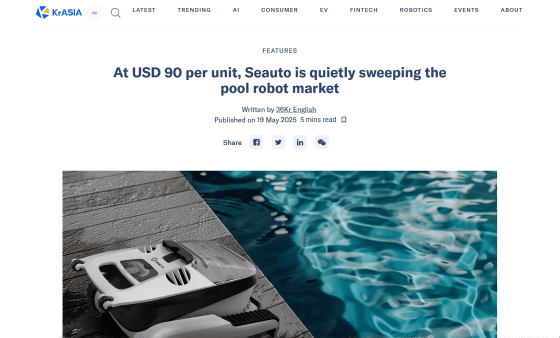
At USD 90 per unit, Seauto is quietly sweeping the pool robot market
https://kr-asia.com/at-usd-90-per-unit-seauto-is-quietly-sweeping-the-pool-robot-market
Since few homes in Japan have home pools, many people may not recognize the term 'automatic home pool cleaning robot.' However, this market has existed for over 40 years, and global sales of automatic home pool cleaning robots are expected to reach $1.018 billion (approximately 158 billion yen) by 2024.
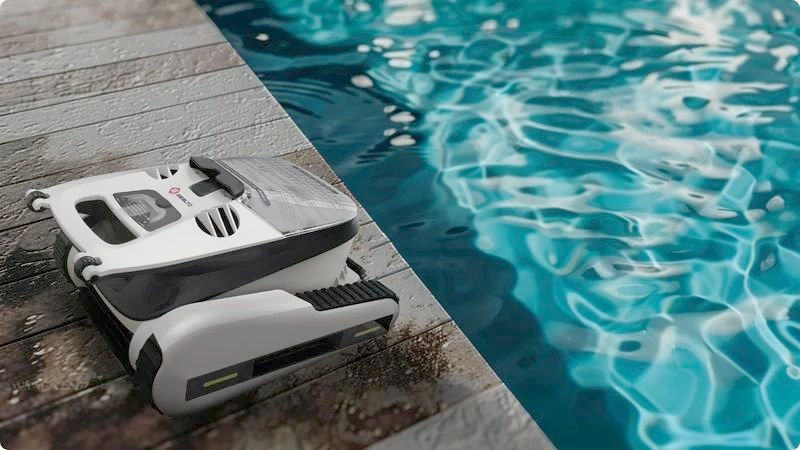
Based in Shenzhen, China, Seauto is a startup founded in 2021 that specializes in automatic cleaning robots for home pools. It operates primarily in North America and Europe, selling its products for between $199 and $399 (approximately ¥31,000 to ¥62,000), significantly cheaper than many international manufacturers.
Seauto's sales reached $14 million in 2024, just three years after its founding, ranking fourth in sales in its category on Amazon. In the first quarter of 2025, the company achieved shipments that exceeded those of the entire year of 2024, and succeeded in turning a profit.
'At the moment, the cost per unit is less than $90 (about 14,000 yen). Even if we lower the price further, there is still room to make a profit,' Seauto founder Teng Zhuoming told 36Kr in an interview.
While many competitors have moved from robot vacuum cleaners to automated pool cleaning robots, Deng's background is different. After graduating from university, Deng worked on chip design at SMIC and MediaTek, before joining
By 2019, Deng had turned his attention to consumer goods, and saw potential in the field of automated cleaning robots for home pools. He applied to a startup competition that year, but was rejected for funding due to reasons such as 'the category was not attractive' and 'there was a lack of Amazon sales data.'
But Deng didn't give up. He rented a 70-square-meter office in Shenzhen, assembled a small engineering team, and independently developed an automatic home pool cleaning robot. While China is home to numerous motor manufacturers, none were suitable for home pool cleaning robots. Therefore, he developed his own brushless DC motors, gearboxes, sensors, and other components. To improve production efficiency, Seauto uses locally sourced parts and adopts an automated design to reduce labor costs and keep the cost per unit low.
Seauto's robot focuses on the basics of pool cleaning: removing sediment, leaves, and dirt from pools between 18 and 80 square meters. Despite its compact size, it has a larger dirt tank than many of its competitors, and its return rate is said to be just 2-3%, well below the industry standard.
In an interview with 36Kr, Deng said, 'Considering what these robots can do, the price should be around $300-$400. That's the upper limit. Unless they actually improve their cleaning capabilities significantly, any price higher than that is just an ' IQ tax '.'

While many growing startups have increased their employee numbers to 200-300, Seauto has a slim staff of just over 40. Most of Seauto's funding is invested in engineering, with Deng stating, 'The underwater environment is simple. There aren't many viable technical solutions.'
Pool cleaners typically use cabled devices to vacuum up debris, but automating this process requires addressing issues like underwater navigation and signal interference. Because there are no clear visual features underwater that cameras can capture, Seauto developed its proprietary 'Ultra Short Base Line (USBL) acoustic positioning system,' a technology used in submarine guidance and offshore oil exploration. This system enables Seauto's autonomous cleaning robot to achieve real-time underwater positioning.
Seauto not only sells its own automated pool cleaning robots, but also supplies parts to brands it has launched in collaboration with other companies. 'We're getting a flood of reservations. New customers are contacting us, but we can't handle them. We're just trying to fulfill orders from existing customers,' Deng said, highlighting Seauto's success.
Related Posts:
in Note, Posted by log1h_ik