Guidance on when to use AI
While AI is convenient, there are concerns that we may become overly reliant on it and that it may take over important human activities, leading to calls for regulation. On the other hand, some
Will AI Replace Human Thinking? The Case for Writing and Coding Manually
https://www.ssp.sh/brain/will-ai-replace-humans/
'AI is a good thing, and everyone uses it, but you should still try to learn and think about your technology. I think there's a very good chance that AI will make us unhappy. It's good to use AI, but we shouldn't use it for every task,' Spaty said. According to Spaty, AI doesn't learn on its own, and someone needs to add knowledge and new insights to it. While it's useful for creating historical summaries and charts from data, it's not recommended for writing or coding.
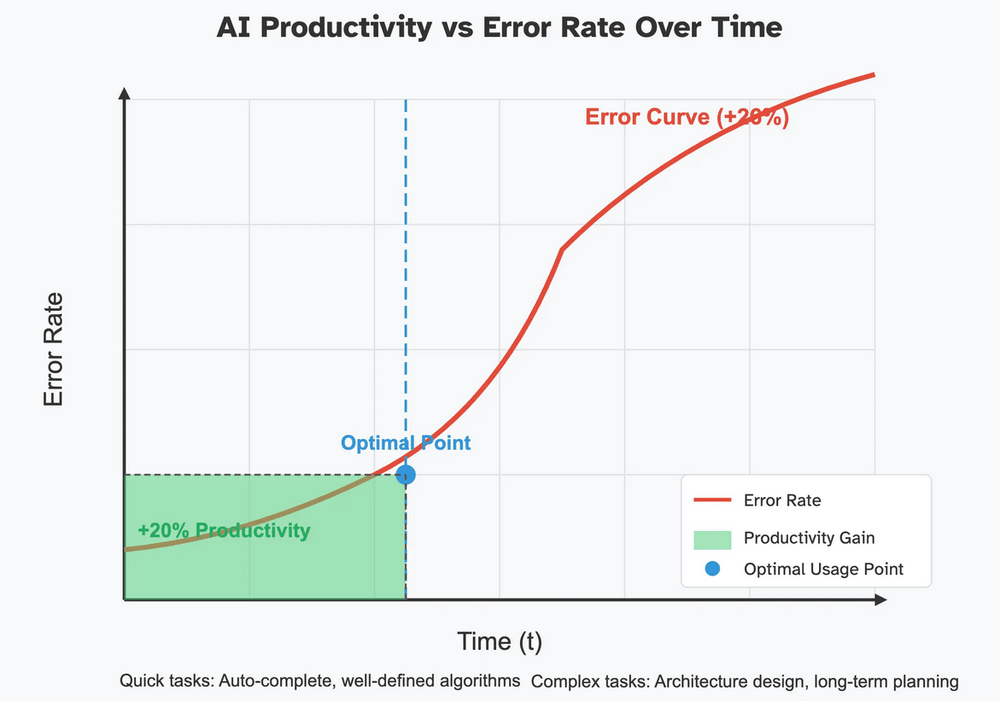
Below is a graph with the horizontal axis representing time and the vertical axis representing the amount of errors, showing that 'the more AI is used, the more errors occur.' While AI can be used for short-term tasks, if it is necessary to repeatedly adjust and correct long-term architectural decisions in the future, errors caused by using AI will continue to increase. Mr. Spaty pointed out.
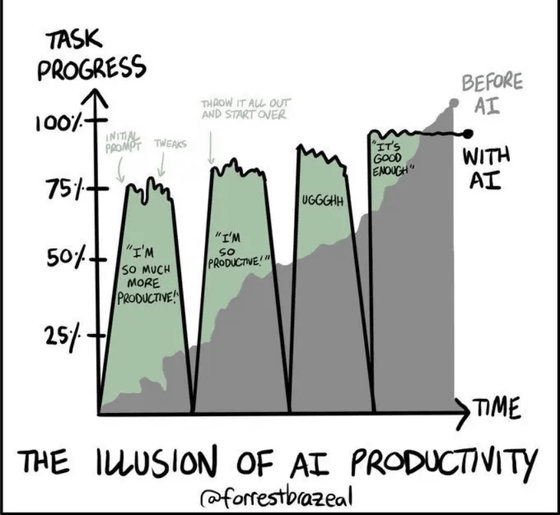
Below is a graph created by software developer Forrest Brazeale entitled 'The Illusion of AI Productivity.' The horizontal axis represents time, and the vertical axis represents task progress. Before AI was introduced, progress was steady as shown in gray, but with AI, progress became jagged as shown in green. This shows that while AI can process up to 75% of tasks at lightning speed, making you feel 'super productive,' if you find dissatisfaction or problems with the results or prompts, you have to restart from scratch, ultimately leading to a compromise.
For this reason, Spaty explains that it is important to distinguish between AI use cases, citing the following diagram. The diagram below was shown in a blog post by Thomas Ptacek discussing AI use cases, with the horizontal axis representing the 'fun' of the task and the vertical axis representing its 'importance.' The top right represents 'fun and important tasks,' the top left represents 'important but boring tasks,' the bottom left represents 'tasks that are neither important nor fun,' and the bottom right represents 'fun but unimportant tasks.'
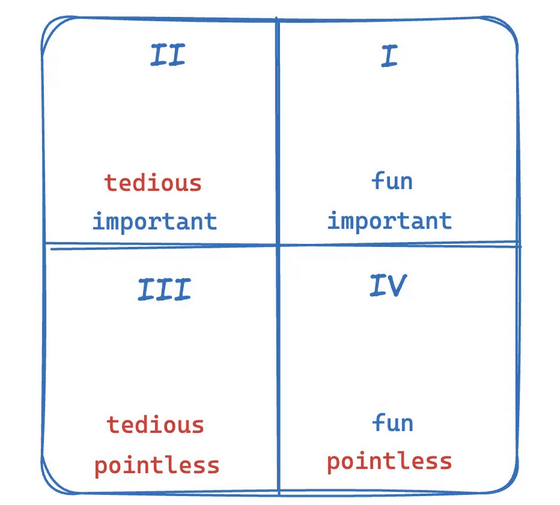
If AI is used for each task, actively using it for 'fun and important tasks' and 'fun but less important tasks' will hinder the 'fun' aspects. On the other hand, using AI for tasks that are not fun will likely increase productivity. In particular, automating 'important but boring tasks' that involve repetitive work or tedious administrative processes with AI can significantly reduce time and mental costs.
Spaty also points out that AI has 'no soul.' Even if an AI generates good text, if it has no soul, no one will want to read it, Spaty said. He also points out that the time it takes for a conversational or translation AI to respond is so short that it takes away the joy of thinking and learning.
The issue raised by Spaty has also been discussed on the social news site Hacker News. One user suggested that 'to reduce reliance on AI, it would be good to have a mode where AI can train human operators while it is working.' While this would take longer in the short term than if the AI were to process things alone, in the long term, human capabilities would also improve in a balanced way, meaning that the impact would be minimal even if power, the internet, or AI models were to completely fail.
Another user pointed out that the 'AI vs. non-AI' debate is a bit off the mark, and engineers are stuck in the old paradigm of 'perfect' algorithms. According to this user, the graph quoted by Spaty, 'AI solves most tasks quickly, but the final fine-tuning is difficult,' is correct, but since human corrections can reduce the time by more than half compared to processing the entire task by hand, we should think of it as 'AI + humans.' While programming and writing, which do not require perfection, may no longer be human work, he argues that humans will be indispensable in areas that require quality beyond what AI can produce, creating a 'Minotaur-type' combination of humans and AI.
Related Posts: