Will using ChatGPT make me stupid?

In recent years, the number of people using chat AI such as ChatGPT on a daily basis has increased, and some people rely on ChatGPT not only for quick research or work assistance, but also as a friend or confidant. Meanwhile, Aaron French, an assistant professor in the Department of Information Systems at
Is ChatGPT making us stupid?
https://theconversation.com/is-chatgpt-making-us-stupid-255370
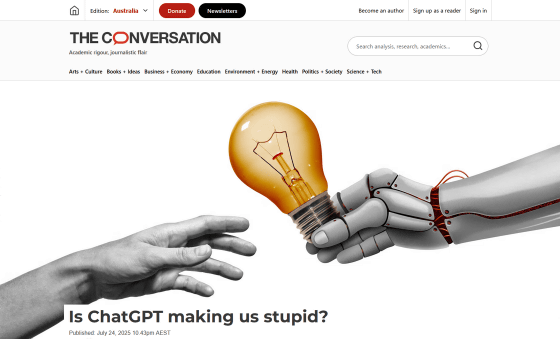
In 2008, The Atlantic published a provocative article titled ' Is Google Making Us Stupid?' in which author Nicholas Carr argued that technologies like search engines were eliminating the need for people to remember or learn, thereby reducing our ability to think deeply and retain knowledge. However, at this stage, users still needed the ability to interpret search results and understand their context.
At the time of writing, the rise of generative AI tools like ChatGPT has enabled internet users to outsource not only their knowledge but even their thinking to AI. Generative AI tools don't just collect information; they can also analyze it and summarize it in an easy-to-understand way. 'This represents a fundamental shift,' French says. 'Generative AI is the first technology that has the potential to replace human thought and creativity.'
This raises the question: 'Will generative AI like ChatGPT make people stupid?' French argues that as more and more people begin to delegate cognitive tasks to generative AI, it's worth considering what we gain and what we lose by adopting it.

Generative AI is changing the way people access and process information. It provides clear, elegant answers within seconds of inputting instructions, and is undeniably efficient, regardless of their accuracy. It is already causing significant changes in the way people work and think, with many no longer scrutinizing sources of information or dealing with ambiguity.
But this convenience comes at a cost. As people become more reliant on AI to complete tasks, their ability to think critically, solve complex problems, and engage deeply with information may decline. While research on this point is limited, passive consumption of AI-generated content risks diminishing intellectual curiosity, reducing attention spans, and
To better understand this risk, French suggests considering the Dunning-Kruger effect , which describes the phenomenon whereby less competent people tend to overestimate their abilities because they don't know what they don't know, while more competent people know what they don't know and therefore have less confidence in their abilities.
This framework can also be applied to generative AI: relying on ChatGPT or similar to repeatedly generate content on a particular topic can lead users to mistakenly believe they are knowledgeable about the topic when in fact they understand nothing at all. While some users remain stuck in what French calls the 'mountain of idiots,' others use AI as a cognitive augmentation tool to actually deepen their understanding of the topic.
French argues that generative AI should not be used to replace human intelligence, but rather to extend it. For example, rather than asking ChatGPT something and being satisfied with the response, we can use ChatGPT's response as a starting point to open up new thoughts, further expanding our own knowledge and abilities.

'In other words, it's not whether people use generative AI that matters, but how they use it,' French said. 'Used uncritically, ChatGPT can invite intellectual laziness: users may accept its output without questioning its assumptions, seeking alternatives, or conducting deeper analysis. But used as a complementary tool, ChatGPT can be a powerful way to stimulate curiosity, generate ideas, clarify complex topics, and encourage intellectual dialogue.'
Related Posts:







in AI, Posted by log1h_ik