Google limits election-related AI use, including restricting election-related queries with Bard

In 2024, many elections will be held around the world, including the US presidential election. Google has announced that it will strengthen its efforts against fraud using AI to prevent its platform from being misused in elections. This imposes various restrictions on Bard, including restricting election-related queries.
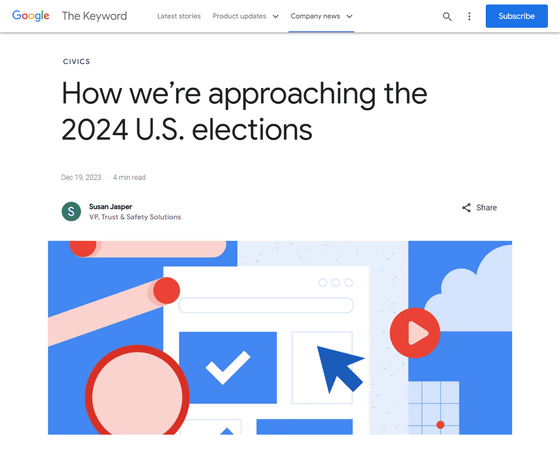
How we're approaching the 2024 US elections
Supporting the 2024 United States election - YouTube Blog
https://blog.youtube/inside-youtube/supporting-2024-united-states-election/
Google makes a preemptive move for the 2024 election, will limit election-related queries with generative AI | Android Central
https://www.androidcentral.com/apps-software/google-to-limit-election-related-search-queries-generative-ai
Over the past few years, Google has supported numerous elections around the world. With each election cycle, Google continues to apply new training to its AI models to better protect against harmful content and create trustworthy experiences.
How does Google protect its platform in areas such as ``manipulated media,'' ``hate and harassment,'' ``incitement to violence,'' and ``patently false claims that could undermine the democratic process?'' We have a policy in place to let you know what we will do. For more than a decade, Google has leveraged machine learning classifiers and AI to identify and remove content that violates this policy, but now with advances in large-scale language models (LLMs), we can adapt faster. It seems that they are experimenting with building a highly effective enforcement system. Regarding the new system being tested, Google wrote, ``Early results show that we can remain agile and act quickly when new threats emerge.''
Google is also committed to taking a principled and responsible approach to the deployment of generative AI products, such as Search Generative Experience (SGE) and Bard, and is committed to taking a principled and responsible approach to deploying generative AI products, such as Search Generative Experience (SGE) and Bard. We prioritize testing for risk. In preparation for the 2024 election period, Google has announced that it will limit the types of election-related queries that SGE and Bard answer.
In addition, Google has introduced the following measures to prevent its platform from being misused using generated AI in election campaigns.
・Advertisement disclosure
Google will require election advertisers to prominently disclose if their ads include realistic synthetic content that has been digitally altered or generated, including through AI tools.
・Content label
In the coming months, YouTube will require creators to disclose when they create realistically altered or synthetic content, and will display a label to indicate to users that the content they are watching is synthetic. .

・Additional context
The 'Search for this image' feature allows you to assess the authenticity and context of images found online.
・Electronic watermark
Google DeepMind's beta tool SynthID will embed digital watermarks directly into AI-generated image and audio data.
During elections, people use Google to search for information such as candidates, voter registration deadlines, and polling place locations. Google appealed that it is implementing the following measures so that users can easily find the information they need.
·search
We work with partners like Democracy Works to show trusted information from state and local elections offices at the top of your search results when you search for topics like how to vote and where to vote. As with past elections, Google will work with the Associated Press to publish reliable election results on Google.
·news
Starting in 2022, Google is offering additional news features to ensure that trusted election-related news from each state appears on Google News.
・YouTube
YouTube takes appropriate steps to bring quality election news and information to our users.
·map
We clearly highlight polling place locations and suggest easy-to-use directions. To prevent bad actors from creating election-related spam on Maps, we have increased protections for content such as government buildings.
·advertisement
Google requires advertisers who wish to run election ads to go through an identity verification process and make an ``in-ad disclosure'' that clearly shows ``who paid for the advertisement.'' The results will also be published in the Political Advertising Transparency Report.
Cybersecurity risks are heightened during election periods. Google's advanced protection program is available to elected officials, candidates, campaign workers, journalists, election workers, and other individuals who are at increased cybersecurity risk during elections. Google is also expanding its long-standing partnership with Defending Digital Campaigns (DDD) to provide you with the security tools you need to stay safe online, including tools to quickly configure security features in Google Workspace. Google has already distributed 100,000 free Titan security keys to high-risk users in 2023 through partners like DDD. Google plans to distribute 100,000 Titan security keys in 2024.
Google's Threat Analysis Group (TAG) and Mandiant Intelligence help you identify, monitor, and respond to emerging threats. For example, TAG tracks more than 270 targeted or government-sponsored threat actors in more than 50 countries every day. We also publish our findings to ensure that the public and private sectors remain vigilant and well-informed. Mandiant Intelligence also helps organizations build a comprehensive election security program and strengthen security with comprehensive tools, from proactive breach assessment services to information operations threat intelligence tracking. We offer
Related Posts:


in Software, Web Service, Posted by logu_ii