What's a more effective way to study than 10,000 hours?

By
It is believed that the key to learning and mastering something is to concentrate and repeat the same content over and over again. However, research has revealed a more effective learning method that allows you to memorize things more thoroughly in a shorter amount of time than the concentrated learning method of studying the same thing for 10,000 hours.
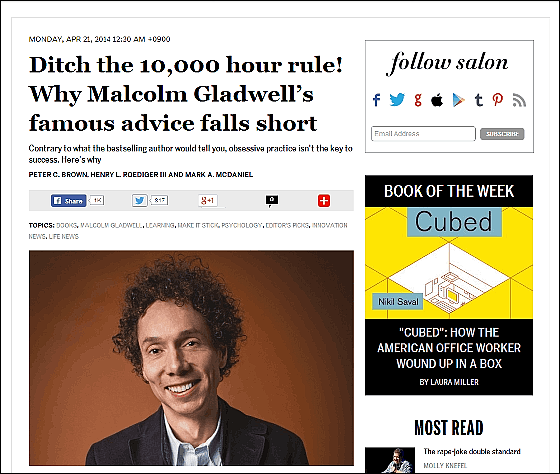
Ditch the 10,000 hour rule! Why Malcolm Gladwell's famous advice falls short - Salon.com
http://www.salon.com/2014/04/20/ditch_the_10000_hour_rule_why_malcolm_gladwells_famous_advice_falls_short/
◆Intensive learning

By
Most people believe that repetition is an effective learning method, and it is widely accepted by everyone from teachers, athletes, and corporate trainers to students. However, a research book summarizing the research of Peter Brown and others shows that this perception of 'lumped learning' is flawed, and that ' spaced learning ,' which involves learning at intervals, is more effective for acquiring knowledge quickly and effectively.
While cramming and other methods of learning have been around for a long time, it is not widely known that they lead to rapid forgetting of what was learned. Spaced learning involves different types of practice at regular intervals , which has the advantage of producing better results than cramming and requiring less practice.
◆Spaced learning

By
To demonstrate the effectiveness of spaced learning, researchers conducted an experiment with 38 surgical residents. The residents received four lessons on microsurgery , a technique for reconnecting severed small blood vessels. Half of the residents received four lessons in one day, while the other half received four lessons spaced over the course of a week. One month later, all residents completed a practical session in which they reconnected a beating aorta from a live rat. The former group not only performed poorly on all procedures, but 16% failed to reconnect the blood vessel. The latter group performed better in terms of procedure, speed, and number of successes.
The reason spaced learning is so effective is that by learning the meaning of new knowledge and connecting it to prior knowledge over a period of hours or days, the knowledge is embedded in long-term memory, strengthening its memory trace . By retrieving the knowledge in the brain after a short period of forgetting, the memory is consolidated and strengthened.
◆ Alternating learning

By Mark Longair
Research has shown that 'interleaved learning,' in which two or more separate exercises are alternately practiced to master a main skill, is also a more effective learning method than massed learning. For example, two groups of university students were taught how to calculate the volume of geometric objects, such as wedges, spheroids, spherical cones, and half cones. One group completed exercises grouped by object shape, while the other group was given the same exercises in a mixed format. Immediately afterward, the students were given a test to assess their results. The group taught together achieved an average accuracy rate of 89%, while the mixed group achieved an average accuracy rate of 60%. However, when the same students were reunited and given a final test one week later, the former group's accuracy rate dropped to 20%, while the latter group's accuracy remained roughly the same at 63%.
To memorize the process of 10, traditional centralized learning involves repeating step 1 until you remember it, then moving on to step 2, and so on until you reach step 10. On the other hand, alternating learning, which may seem confusing at first glance, involves practicing step 1 several times, then moving on to step 4, then practicing step 7 several times, then moving on to step 3, and so on, has been shown to be effective in retaining long-term memory.
◆Diverse learning

By
To study a new learning method, 8-year-old children practiced throwing beanbags into a bucket in a gymnasium. The children were divided into two groups, A and B. Group A practiced with a bucket placed 3 feet (about 91 cm) away, while Group B practiced with a bucket placed 2 feet (about 61 cm) and 4 feet (about 1.2 m) away. Three months later, all the children were given a test to throw the beanbag into the bucket 3 feet away. The results showed that the children in Group B, who had not practiced with the 3-foot bucket, performed best.
The results of this experiment were thought to be due to motor skills becoming more skilled through various practice sessions. However, further research has shown that ' multiple-modal learning ,' in which multiple practice sessions under different conditions are needed to succeed in one situation, also applies to cognitive learning. Neuroimaging studies have also shown that practice under different conditions activates a wide range of brain regions. The research team speculates that multiple-modal learning involves incorporating learning from different angles, which in turn encodes learning, increases intelligence, and allows for the acquisition of flexible expressive abilities that can adapt to various situations.
◆New learning method practiced by football teams

The above research has shown that combining a variety of practice exercises spaced apart is more effective for mastering skills than simply repeating the same thing over and over again. This seemingly complex learning model has long been practiced by Vince Dooley, coach of the University of Georgia's Bulldog Football team. His practice method begins with players accurately repeating the movements of their assigned positions on the field, and continues until the entire team can move with regularity. During this time, players must maintain the highest level of fundamental skills, such as blocking, tackling, and catching the ball, while still performing their roles.
After basic training, the players are divided into small groups by position for practice. To prevent boredom from repeating the same things over and over, they incorporate kicking game practice and change up what the opponent does in the same practice. Match-style practice is only held once a week on Thursdays, where they practice a variety of plays. During this time, the players' regular practice becomes a mental and physical rehearsal, allowing them to perform at full speed.
Dooley implemented these newly discovered effective learning methods in practice, and the University of Georgia team achieved an impressive record of 201 wins, 77 losses, and 10 ties between 1964 and 1988, winning six titles and one national championship.
In other words, if you don't feel that your regular study or learning is effective, you can acquire skills more efficiently by keeping in mind 'spacing out' and 'combining learning from various fields.' The research book by Peter Brown et al., 'Make It Stick: The Science of Successful Learning,' which summarizes these studies, is also available on Amazon.co.jp. At the time of writing, the price was 2,621 yen.
Amazon.co.jp: Make It Stick: The Science of Successful Learning: Peter C. Brown, Henry L. Roediger III, Mark A. McDaniel: Foreign Books

Related Posts: