What is a "non-existent youth" problem, and where and how is it a problem? Summary

ByManga artist
Saturday, February 27, 2010, "The second largest part 22: Reproduction of Tokyo Metropolitan Youth Protection Ordinance Amendment Full Text"Regardless of the age setting of non-existent characters such as manga, animation, games, etc. including all that the Tokyo metropolitan area is not 18 kan, by the entry" Tokyo "is less than 18 years old"Non-existent youth"It is exposed to the white day that it is trying to make the plan to regulate the same treatment by mixing with the child pornography where there is a victim, to be the Tokyo Metropolitan Ordinance It was. Not only sexual expression but also violence expression and cruel expression are out, not only minors but also adults are involved.
The biggest problem is that someone who does not know whether it is enough for credit can decide by itself that "this is OK, this is out" as I likeis. That is, "It is possible to perform arbitrary operation by extension interpretation" is the biggest problem. It is no exaggeration to say that it is the revival of the medieval witch hunt and the pre-war security maintenance law. Even if the administration says "I will not do such an operation", it is only a petty hand, unless you explicitly state that in the ordinance.
The reason why such extreme argument comes out actually is that this "non-existent youth" problem has not actually begun but actually it is a major problem that has continued for more than 50 years ago, especially comics It is because there is a historical fact that, as a result of a similar incident, "arbitrary operation by extension interpretation" was done and it was actually put in the crisis of extinction in the past.
so,"There are noises in various places but it is not clear what the hell it is in the first place, why it makes a big noise and what is the problemFor the person who says, I tried to summarize the whole picture of the problem along a certain time line. The details of the summary are as follows.
The first opportunity is the following blog.
■ February 27, 2010 (Saturday)
Outer Bank Part 22: Tokyo Metropolitan Youth Protection Ordinance Revision Proposal Full Text: Representation of the Unknown Wisdom Monetary Watcher

Not to mention the citizen's pub commerce,Pub comme (pdf) issued by the Book Publishing Association / Journal AssociationYaPub comme (pdf) issued by the Japan Publishing Union FederationEven though it was completely ignored (probably a lot of other businesses and the industry also dissented to this pub commertee), and that the target of this ordinance and the current one in Tokyo in Japan Considering the concentration, the influence of this expression restriction is that it is wrong that it extends to all industries related to expressions such as the industry of cartoon, animation, and game, of course, the entire publishing industry, the entire magazine industry, the idle industry, the movie industry, etc. In terms of net regulation, every Internet-related company is involved, and in terms of cellular regulation, even though the Ministry of Internal Affairs and Communications's introduction of mobile filtering is considered, all mobile phone carriers and content providers suffer serious damage again It is also highly likely.
A scanned full text of the revised "Ordinance on Healthy Training of Tokyo Metropolitan Youth" is published on the net.
The Prefectural Ordinance about young healthy upbringing (a reform bill) - February 24, 2010
The place where the sentence "non-existent youth" is written is like this.
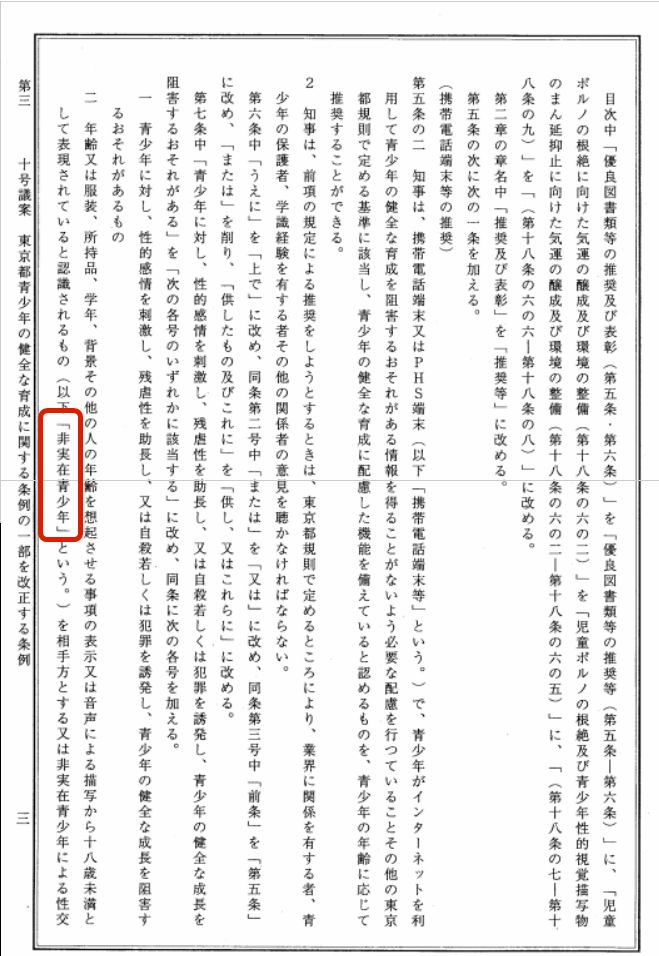
There are many places where there are problems, but the problem is particularly below.
(1) For young people, those who may stimulate sexual emotion, encourage brutality, induce suicide or crime, and hinder the healthy growth of adolescents
(Hereinafter referred to as "nonexistent youth") which is recognized as being expressed as being under 18 years of age from a depiction of age, or clothing, belongings, grade, background, or other person's remembrance of the age or voice depiction. ) As a counterparty or expressing positively as a sexual objectively in a way that can visually recognize the appearance of non-existent young people involved in sexual activity similar to acts by non-existent youth, thereby making a sound judgment on the sex of young people Those that hinder the formation of capacity and hinder healthy growth of adolescents
In short, it is that someone's judgment is subjective, and if it looks like an underage graphic & minor voice it will be out. What criteria to decide on is "appearance", there is no clear standard such as age, it is already messed up.
As this "non-existent youth", as it can be seen only by looking at the above, it is quite messed up, so at first it was treated like "This is not going to pass" for the second time and it was treated as a story, and it entered "painful news".
■ February 27, 2010
Painful news (No ∀ `): Tokyo" Define 2-dimensional characters whose faces and voices do not look over 18 years old as "non-existent youth" and regulate it

51: Cooking heater (Chiba): 2010/02/27 (Sat) 20: 15: 22.08 ID: 3rhqEo / R
I always think that it is impossible to distinguish between reality and fiction
I guess you're pointing these guys
171: Shrimp roll (Ishikawa ken): 2010/02/27 (Sat) 20: 21: 01.27 ID: idNuz4cy
First of all, please define what you want to be healthy seriously
349: Nippa (Toyama Prefecture): 2010/02/27 (Sat) 20: 28: 59.89 ID: OvXeVv6h
To think calmly, I want to know the definition of 18 years old and over
What is this stupid thing
368: Eraser (catv?): 2010/02/27 (Sat) 20: 29: 37.52 ID: 5 mPWbmYk
I regulate why there are no victims
The rationale for the theory of regulation is "You may rape a real girl by being inspired by a young lady", is not it?
Well then, let's get that source.
405: Mantle heater (Gunma): 2010/02/27 (Sat) 20: 31: 11.33 ID: uavnL0wq
Because regulations will not relax if such ordinance is made once
When it is made it ends
524: Pen (Osaka): 2010/02/27 (Sat) 20: 35: 11.59 ID: EziztB6u
Distribution throughout the country is based on the regulations of the Tokyo metropolitan area so if it is out in Tokyo it will be out in all over Japan
Because it is shut out from distribution, it will not be sold at convenience stores or book stores rather than by zoing
Only the one like net or erotic video specialty store can buy
Sales will go down and more magazines will be abolished
868: Bait (Aichi): 2010/02/27 (Sat) 20: 48: 52.64 ID: igl3fexm
Why, suggesting people by making such ordinance
"Approaching the environment where young people can be nurtured soundly"
I wonder if she is thinking seriously.
On the next day, I point out the problem that the following blog is quite easy to understand about this subject.
■ February 28 (Sun)
Talk about the dangers of expressive regulation in Tokyo Metropolitan Youth Development Ordinance Revision Plan - Nakagiri Kazusa not reading air
The most problematic here is the new article of Article 7, paragraph 2. Here, "non-existent youth" applies to all characters under the age of 18 in the end. Even if only characters under the age of 18, ie those created with imaginary persons, have sex, they are designated as unhealthy books, but that has a great problem as expression restrictions. Perhaps quite a few will be applicable even among comics which are currently serialized. Still though some people agree with regulation that it is impossible to show young people sex scenes (although this is a story not limited to young people, but that is described below), as long as this article is nothing but sex not. It is because the definition of "sex act similar act" is ambiguous. Extreme points, if there is contact between men and women, even the kiss level falls under "sex acts similar acts" and there is a possibility that they will become subjects of unhealthy books (as an aside, I think that this is the article "limbs" If it was "a figure", it means that even if the body only looks at the face, it becomes a target if it is a sexual act similar act). Even more problematic, even the definition of being under 18 years old is ambiguous. For example, someone is recognized as being expressed as being under 18 years of age from depictions of age, clothing, belongings, grade, background, or other matter reminding the age of the person, or by voice Even if it is not so, it is judged to be under 18 years of age by the subjectivity of. However, it is impossible to judge age objectively though it is not specified in the character of the creation (Elf is living for hundreds of years?). By the way, how is judgment of Katsuhiro Otomo works if it is an elderly child of work?
In other words, in addition to the problem of restricting expressions, this article is limited in scope, whether it is "sexual act" or "appearance depiction", and when there is contact between men and women extremely, it displays it at what age Even if it is out, it can be out.
However, of course there are people who judge whether "it is possible to impede the formation of a sound judgment ability on young people's sexuality and hinder the healthy growth of young people", so it seems that not all of them will be so I guess. But is the subjectivity concerning the sexual description of that person necessarily the same? Is there a possibility that there is a person who regards even a light thing as a sexual description there? And is there a possibility that it will be such that it can destroy expressions? People's criteria for judging regulations are not necessarily equal to their standards, and they may be far apart.
In the blog above, I am worried about overlapping with this "harmful comic campaign" that happened twenty years ago this trendy regulation strengthening movement this time. The details of the harmful comic movements that occurred twenty years ago are detailed on the following page.
What happened to the harmful comic movements in the 1990s - Timesteps
However, the movement was still intensified and it was just as it was to evolve to the momentum where comics other than those recommended by the Government cease to exist. It is not exaggeration. Because I felt that it was my age to be a child yet, the person who saw this in real time may have thought so seriously.
Well, there are various ways of thinking about what these were. However, it may have been positive to leave the zoning, but it may have left many negative heritage. Zoning has some unavoidable aspects because it is sometimes troublesome to show it to children personally against such an adult depiction, but the credibility of criteria such as zoning is that extreme Whether exercise makes the expression side completely unbelievable might be big. By the way it is feeling that it will lead to movement regulating the whole expressive medium seen by adults with zoning as a shield.
Even now even if there are regulatory movements such as comics, it is very likely that many overwhelming nightmare at that time will revive the memory. Discussion on revision of the child pornography law will be exchanged recently but it is not disrespectful of the person actually damaged in fact that there are many objections against this, It seems that there are many people who think that intense regulation as it is, more than it is thought that it will be done more than that (This problem is also very complicated, so many aspects that can not be said with just freedom of expression However, because it will be long, that is another opportunity). In fact, there are many cases that the regulatory promotion group at that time is currently in a leading position as a politician (this is regardless of the party).
To further investigate it, in the first place, the flow of "This comic is inseparable because it is inexcusable!" Has continued since 1955, and indeed until 2010 it has been this battle for over 55 years .
Harmful comic hoax - Wikipedia, the free encyclopedia
This "battle of people who want to draw manga and those who want to read manga" vs "people who do not want to draw manga and people who do not want to read manga" brought up in 1955Bad book exile movementYou will see a glimpse of reading the fragment of what it was like. It is very hard to believe for those who only know this era.
Regular history of manga expressions in Japan
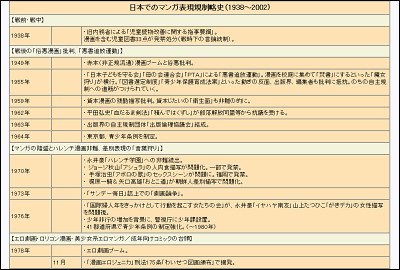
"Paper evasion campaign" by "Association for Protecting Japanese Children" "Mother's Association" "PTA". "Witch hunt" such as collecting manga in the schoolyard and making it "burning book" rampant. On the other hand, movements such as "book selection system" and "youth protection breeding bill", publishing world and editor also resist criticism. The path to self-regulation later will be established.
Another thing to understand when reading the materials at the time is that it is a messy thing to gather manga books in the schoolyard of the school and give fire, and these persecution have changed hands steadily since 55 years ago I am continuing to change.
Another thing was that "white post" was also installed.
Talk about the danger of expression restriction in Tokyo Metropolitan Youth Development Ordinance revision proposal - Red world
Young kids think that I do not know, but in the past they were called "white post" on the street corner, posts for throwing out manga were muddled, and the works of people collected by Tezuka Osamu and Fujiko Fujio collected as a show There was a time when it was turned into a burning book.
It's only 20 to 30 years ago.
This is the image of the actual white post. I installed these kinds of things and let them expell "bad books".

What is a white post - Hatena keyword
origin
The evil deed exercise from the 1950s developed into "Three Movement" (not read, show, not to sell) in 1965. As part of these three exercises, the "Sugamo Mother's Association" made it, the one that was established near the Sugamo station ticket gate (exit) on May 24, 1966 is the first one (Asahi Newspaper 1966.5.25 ). Following this, in September of the same year, "The Association of Tokyo Mothers 'Association" made 53 white posts and was set up at each station in Tokyo under the guidance of the Metropolitan Police Department Boys' Division (Yomiuri Newspaper 1966.9 .20 Evening). It seems that this movement has become nationwide is now a nationwide white post.
Promoter
A police bureaucracy (Nibera Takio Police Agency Criminal Affairs Department Security Department Juvenile section chief · then) at the 80th National Assembly said, "White post movement for not bringing out bad magazines to the house, this is Oita before Movement proceeded actively once, "answers that the establishment of the white post was advanced by the police (House of Representatives Epistemic Committee of the Bunkyo administration ... May 13, Showa 52).
Incidentally, it continues to be installed as well, and the following posts are summarized in white post images of all over Japan.
White Post Photo House

The fact that comics, games, animation and others are becoming popular as "Japan Cool" is still such a strict existence that the fact that it is not only those who admit it never.
The same thing as at the time is actually repeated regularly and it has repeated repeated clash many times so far but as a case where the network crashes after the net has spread considerably, in fact this time is the first battle and It is a situation that is not an exaggeration to say. Although you can understand that you can see the above page, manga continues to face such problems endlessly, even if it says that the strength of Japanese content industry is exactly the same as the history of this fight It is not an exaggeration. No matter how ridiculous manga it is, its existence is allowed because of desperate resistance by great past manga artists and publishers.
In other words, one part of the "black box that I could not see until now" such as what happens when conflicting values conflict with each other, and what kind of movement is piggybacking on such movements, It is precisely the situation that it is now becoming a situation that can be witnessed in the immediate future.
Well, as I returned to the time axis, in March, because I was too abusive and too constitutional to violate the Constitution, everyone thought that "there is no such thing passed", "you are stupid" or " I was watching the movements of the side trying to regulate expression all the time because I am worried that the Tokyo Metropolitan Youth Protection Ordinance revision bill originating from the "non-existent youth" will truly pass through Congress"Anti-Otaku Diet Members List" memoA summary site by administrator appears.
■ March 6 (Saturday)
Summary site of Tokyo Metropolitan Youth health development education revision issue
http://mitb.bufsiz.jp/
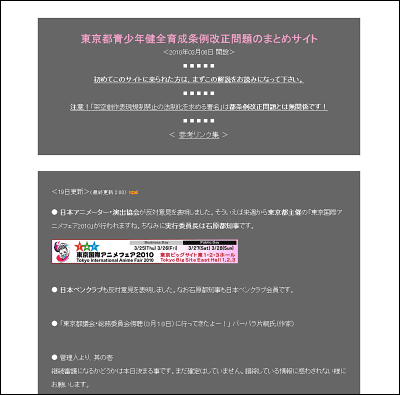
And next day, the regulatory proponents who are trying to pass the amendment regulations for youth protection ordinance including this "non-existent youth" are neither a story nor a joke but that they are "serious", they are Associate Professor of International Japanese Studies, Meiji University · Fujimoto It turns out by summary by Yuka's mixi diary and spreads ripples. As an argument, since there is a great danger that the ordinances that can lead to such expression restrictions will not be deliberately deliberated, and that they will be passed through in the same way as other cases, so if actions are not taken place I feel like I can not.
■ March 07, 2010 14:38
【Important】 Regulation of the metropolitan ordinance "non-existent youth"

And as almost all of the publishers concentrate in Tokyo, what this law goes through has the same effect as the national legislation was made.
Nevertheless, strangely, even in the net, even in Mi Mike's diary and ML, this problem is hardly talked about decently. Perhaps because of too ridiculous provision many comments like "half laughing", everyone thinks "I think that this kind of ridiculous regulation, I should not pass. Somehow, even on the net, in addition to individual blogs and sore news There is no place to mention this in general media that is said to be reliable (such as newspaper news), and I think that everyone is thinking that it is a joke because it is not reported in the newspaper.
But, again,
Almost no doubt in the current situation, this law goes through!
When the draft was announced on February 24, the citizens can say an opinion until 25th (that is, only one day).
Questions in Parliament are only allowed on March 4 (representative question) and 5 (general question), which must also be submitted several days in advance. (Even parliamentarians can consider about three days)
It is the most important that the examination of the agenda item at 13:00 on 18th is the vote and the decision will be done at the end of this month.
This is a group of volunteers thinking about expression restrictions and content issues such as comics and net regulationsContent Culture Study GroupOrganized by the same March 7 held "Emergency meeting! What will be the Metropolitan Ordinance! Is it? - On the revision of "the Tokyo Metropolitan Young People's Health Ordinance Ordinance" and the "In-House Assembly seeking Discussion on Careful Amendment of the Child Pornography Prohibition Act""According to the following site that is reporting the situation at that time,Simply put, it seems that it is not a very secure situationBy saying that, it turns out that it is quite a crisis situation.
■ 2010-03-07
■ [Regulation theory] I tried going to "Emergency meeting! What happens to the city regulations !?" · Part 1
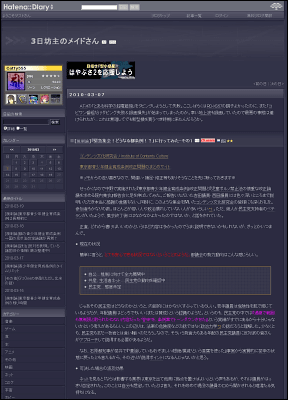
· The Tokyo Metropolitan Government has independence that has not received budget aid from the country, and the influence on other prefectures is tremendous.
- Again, Tokyo seems to have a strong tendency to "pass a new law ahead of the country".
· In fact, there are many prefectures that want to issue similar ordinances. Chiba is the lead.
· If Tokyo passes, there is no doubt that it will spread to the whole country at once.
· If the number of prefectures that pass through to a certain scale increases, the country will take similar steps in keeping pace with it.
As long as the "Ordinance for Sound Development for Youth" has many problems such as child poisoning, ideological control, simple possession control, etc., I think that this is no longer the case with "development of youth health". Rather, it can only be thought that there is a strong possibility that national regulation can be done anything under the name "for young people" like China.
In addition, the following sites also summarize the matter of this meeting in bullets, important points are pointed out.
■ 2010/03/08 19: 01
There was a gathering on 3/7 at the content culture study group.
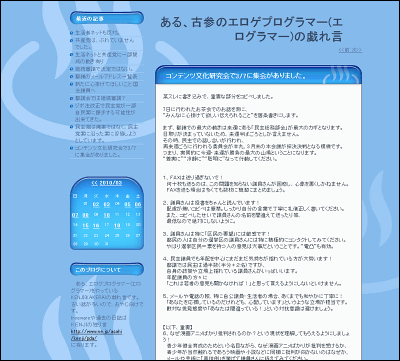
【Important】
6, Why are you being criticized only for cartoon animation? Let's make you understand the current situation!
While nominating for youth health development, why only cartoon animation is criticized,
Why is criticism similarly not directed to movies and novels that young people will naturally touch?
Try to appeal to the lawmakers by giving "concrete examples" to mails and letters.
Even the Governor's "Season of the Sun" is OK,
Especially good are those that have high degree of recognition, pornography and artistic praise.
From this point, on Twitter, this "non-existent youth" problem will rapidly gather attention rapidly and become a fuss.
Non-existent youth - twitter search
Togetter - Conclusion "About the Tokyo Metropolitan Youth Protection Ordinance Revision Draft (" Non-Present Youth "Regulation)"
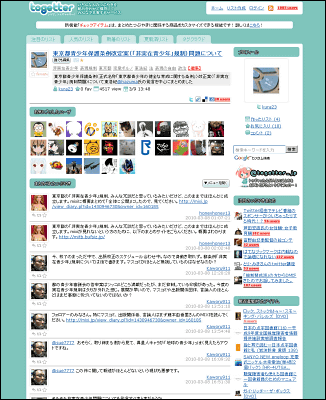
The next day, on March 9, since the revision bill for the young people training regulation touches upon the regulations of the Internet and mobile phones, did you have marked it before, or what was the request that the mountain article was made I mean, "ITmedia" which is one of the biggest Internet-related news media, is posted and posted.
■ March 09, 2010 21:57 on March 10
Tokyo metropolitan youth education ordinance revision bill (1/2) for cartoon animation "non-existent youth" - ITmedia News
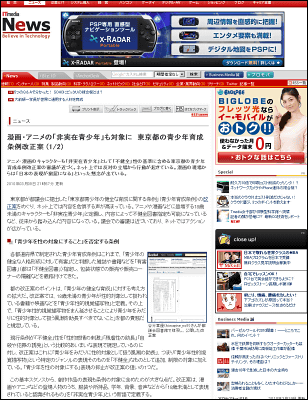
Especially excellent is the last page of the second page, a non-fiction writer from a comic editor, Mr. Junji Hotta, seeking comments, and has the following contents.
Tokyo Metropolitan Youth Development Ordinance Revised Plan (2/2) for Manga / Anime "Non-Present Teenagers" - ITmedia News
If you divide the world into white and black, and you delete the black one, the thought that things get better is very dangerous. If there are trends that have negative influences on young people, it is not fiction, it is the reality itself. It is not a cultural country's way of doing this real society itself better, no matter how detonated it is not to eradicate unpleasant fiction without any verification being done Cow.
Regarding the amendment this time, I feel a clear distrust of character expression rather than understanding of otaku culture. Originally, God of cartoons, Osamu Tezuka said that if you had a doctorate in medicine, you thought that biased prejudice to manga would fit. Mr. Akira Nagai says that bashing at "Harenchi Gakuen" (starting in 1968 series) was enough to feel even the dangers of his own.
After the collapse of the bubble, after 10 years lost, the Japanese society who has completely lost confidence in the field of business knows that the character expression is being evaluated abroad, it has become popular with "cool Japan" etc. It was. And it seemed that prejudice, criticism like once used to be down. However, it is remarkable that there are still prejudices of old-fashioned prejudice in the community where people gathered to a certain ideology or those who have narrow vision towards culture. Shall I say that you saw Nessie swimming around in the Tama river in the daytime.
The next day, there will be an organization expressing opposition about the revision proposal of the "Tokyo Metropolitan Young People's Health Ordinance Ordinance" that has launched "non-existent youth". A comic market operated by borrowing the entire building of Tokyo Big Sight every August and December (in the previous C77, 510,000 people visited in 3 days) is operating "Comic Market Preparation Committee"Doujinshi magazine spot sale meeting liaison meeting" to which many doujinshi sale spot sale is subscribed.
■ March 10, 2010
Nationwide Doujinshi Immediate Sale Liaison Meeting - About the revision proposal of "Tokyo Metropolitan Youth health fostering ordinance"
If this revision proposal goes through, it is expected that our coterie activity will have a great influence. And the situation is tight. In order to prevent this revision, we need to deliver our voice directly to the member of the city council.
Below are the contact information of the Tokyo metropolitan officials and the notes on sending opinions. Participating organizations of the Liaison Committee, as well as those interested in this issue, please take concrete action.
Further next day, at Nikkei Business Online, a column will be posted that points outstandingly about this case.
■ March 11, 2010
The concept of "non-existent youth" is not like adults. : Nikkei Business Online
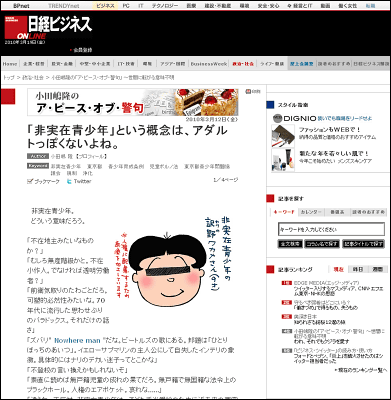
It is a matter before discussion that child pornography work is uncomfortable for many people, it is understood. Everybody does not want to put such things in school libraries.
However, when it comes to regulating it, it causes a troublesome problem in a separate frame. It is there that is a problem right now.
People who oppose the regulation are not expressing doubts on the ethical grounds of regulation, but rather concerning the evils that regulation will bring. Is not it excessive to use Napalm bullets to combat cockroaches? When. Do not misunderstand here.
Minutes of the special subcommittee of the "Tokyo Metropolitan Youth Problem Council", which is an attached agency of the Tokyo Governor who made a suggestion for the revision proposalHereWhen you read, you can see that the members of the committee gradually lose their calm while spreading malicious child pornographic work on the desk as a material.
If you are talking in the premise that these things can be accessed even by elementary school students via the Internet, mobile phones, etc., the discussion will become extreme.
But it is the same in real society, but there is a considerable distance between "being reachable" and "stepping on".
Even in the real world, elementary school students can visit Kabukicho, and if you buy a bus ticket (Passm?) You can even get off at Shinjuku 2 - chome. However, there is no one saying that "purify Kabuki-cho" or "burn 2-chome burned". Hmm? Ishihara governor said that? Then start over. There is no one who thinks to erase the reality town because it is so harmful for young people as long as you are not a human being.
After all, for obvious obscene material, laws to judge already are in place.
It is not only a rooftop shop but also a possibility of harmful measures to invent new levels of contraindications that are not in time for the operation.
"As new types of metamorphosis seems to extend beyond the current law, there is no legal ana to make a new law to judge it."
And they may be thinking.
I think it's different.
Two things, "Napalm bullets are used to combat cockroaches," and "There is already legislation to judge for obvious obscene items" are actually clear and easy to understand contents. The sentences are overall light and easy to read, rich in wits, and highlight the essence of the problem.
In short, it is always the same as a signature, bringing out something extreme, "There is such an extreme thing! If you think with my common sense it is uncomfortable! It can not be patience! There are bad manga and bad games or bad animations in the first place There is a problem! Before circling around the world censors everything in advance and check it, let's exclude good comics, good games and good animation except it! Everything else can not even be present in this world! Let's fade away from the front! If you can not lose it is prohibited by law! You must have taught that the law has to be kept! Definitely defend! Because you make it to the law, you disappear and disappear! "
As reasons that these big moves are repeated almost every ten years, those who had strongly promoted expressive control at the time (= the position of parents with young children) had children of elementary school, It is inferred that children will become high school students and university students as they progress, and it will be burning down with the meaning of regulation becoming undetectable. Then when the fire gets burned down again, the next new generation emerges and repeats the cycle "regulated by law! Uncomfortable! I do not like it!
Every time this cycle comes out, I want to make a celebratory body to regulate and check expressions, I want to earn a simple score Even a police agency and others are involved and something extreme example And plausible materials are presented and it is burning as "to regulate it is useless!"
As to why the National Police Agency will come out here, it will be clarified on the following day by Mr. Hosaka Exhibitor 's blog, the former House of Representatives member.
■ March 12, 2010
Acceleration of "movement of non-existent young people and creativity regulations" in Tokyo Metropolitan Ordinance - Journal where Hosaka exhibitor Where Where
In fact, the secretariat of the Blue Coalition is the Youth Division of the Tokyo Metropolitan Youth / Security Countermeasures Headquarters, and it was the young people and security office headquarters that formulated the revision bill. The director and the youth department manager are police agency carriers and are said to be registered in the Tokyo Metropolitan Government via the Metropolitan Police Department. It is cool that the regulatory agencies have eroded administrative agencies. It is dangerous to give authority to such a department as proposed by the revised ordinance this time.
The factual relationship is uncertain but the police bureaucracy moves to try in the Tokyo metropolitan government because the National Assembly does not move due to the revision of the child pornography law, and in connection with Internet regulation, the Ministry of Public Management and the Ministry of Public Management It is said that there is a battle of the National Police Agency aiming for expansion. If it is, the Tokyo Metropolitan ordinance revision is just an impure plan.
In addition, the core members who made a draft revision of this "non-existent youth"Tokyo Metropolitan Government Youth Problem Council"It was discovered as follows as well that Mr. Hosaka was furious.
Recently, the number of mails that the Tokyo Metropolitan Youth Ordinance has become tough is increasing. Mr. A, who is deep in the issue of "Child pornography prohibition law" and "expression restriction", got a post for "Where where diary". When I read it, a scholar who led this discussion in the Tokyo metropolis said to me, "I am a photographer of Miyazawa Rie's artistic and beautiful, are you still prohibiting?" Saying " I also knew that you were forging such as .... 15, 6, you want to see so much? "" You can not wait until 18 years old? "
Although it is cowardly, such as forging things that distort the facts and not being able to refute, I will attach the minutes to the end, so I'd like to check it out.
It is the "Tokyo Metropolitan Youth Problem Council", which is made up of a newly created coined word "non-existent youth" to promote expressive regulation, which is short for "Ao-koza", but it constitutes this council Members' remarks are quite bad, and we have repeatedly said that it is unexpected that the problem remarks are kept in minutes as a mountain even until here, and the following pages are very detailed. People who are frankly minded that they are so self-righteous that they are not conscious of any problems with doing such remarks, they are justice and their common sense is the common sense of the world.
"Otaku opposed to regulation is a cognitive disorder" (Tokyo Metropolitan Youth Problem Council) - "Anti-Otaku National Diet Member List" memo
First is Bath Sense Research Institute / DirectorOyabi NanakoMr.
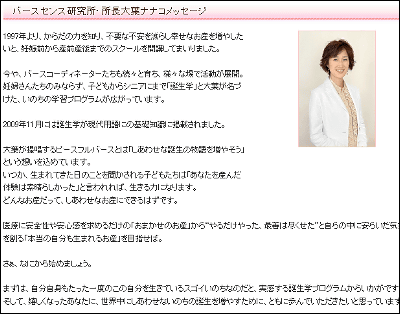
Awful cartoon enthusiastsI have a disabilityCan we not mainstream the recognition that it is?
It is violence whatever you thought cartoonists sent out a tremendous number of protest mails to people who are trying to regulate them.There is also no need to show the basis of regulationsIt is about violence.
Gender identity disorderIf you are releasing people who prefer sexual violence cartoons against children because they are born as well as being born,Is not it necessary to mainstream the view that they are causing cognitive impairment?
To themThere is cognitive impairmentIf you know that it is violent,Can argue the argument that whether law can be regulated even though there is no evidence. I would like to think about such measures.
It is violence to send protest mails, people who like manga are cognitive defense reserve forces, ignoring what people like such manga disregard and say that they can regulate laws without evidence . By the way, everything except the quoted part is in this condition.
Next is Tokyo Metropolitan Primary School PTA Association PresidentTaro ShintaniMr.
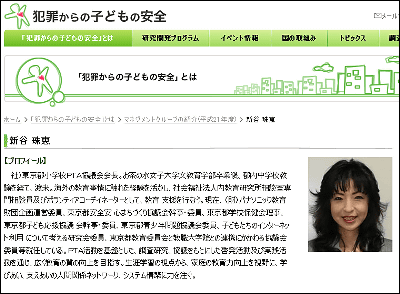
It is not a story that young people do not have to see it, since it is a cartoon, there will be no victims. Even if it is seen by an adult, there are a lot of people who committed a crime based on it.Anime culture and lolicon culture absolutely foster sexual crime. If you can not rely on self-regulation, you should create a regulation mechanism.
I will also make proper regulations for magazines and the book industryIt also means that malicious publishers will be culled out. In order to make use of a sound publisher,The malicious things will penalize and erase themIt is good for the industry because the mechanism that it is.
In general, the expression of female contempt has been pretty accused. Those children who are not presently being insulted by adults or sexually treated deny the human rights and personality of the child so it is natural that they condemn it.I can not understand why it is permitted as a child who does not exist. This is the same as female contempt.
I think there are lots of detailed discussions,Why do you have to think about who you are arguing with?. Whether to place emphasis on unpleasant and dangerous things to children and public welfare,gunI think that I should take it to the latter.It is impossible to convince that the fact that consideration to minority was too much, that ordinary things were denied and not go through..
Other developed countries have regulations that take child rights into consideration. It is a wonder that only Japan is not going to develop laws.There is no need to show explanations and survey data to manga artists groups Regulations are commonplace. In justicegunIt is good to say it.
The above is not Ton Demo 's remarks collections or stuffing, but seriously people gathered about this kind of things gathered and created the "non real existence youth" this time. "Anime culture absolutely promotes sexual crime" is only the development of distorted ideas of this person completely, and "The fact that consideration to the minority too much, it is denied that ordinary things are denied" "Explanation It is natural for this person to say that "Regulation is natural as it is unnecessary to show survey data and so forth", this person is the norm of this person himself, this person presses his own values on everyone other than himself That's why. At the end of the phrase, he said, "Why do you have to think about people who are arguing at all?" When you come this far, you can only see it as a kind of dangerous idea no matter how you look, but represent the Enlightenment French philosopher "Voltaire"I am not in agreement with your opinion, but according to the right to say it, let's preserve it even though it is life," this is also a subjective opinion lacking one objectivity Let's recognize.
Next is Professor of Mejiro University Human Studies Department of Psychological CounselingAyako UchiyamaIn the case of Mr.
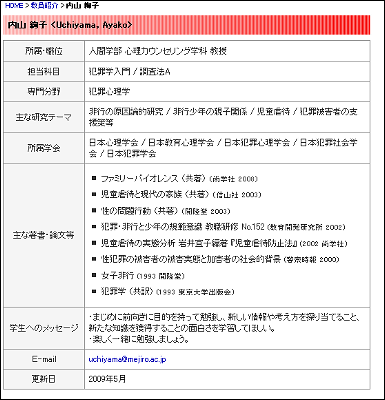
Sexual depictions to children who do not exist do not take into consideration the human rights of children. Thinking of a young child whose sexual understanding is remarkably lacking as a sexual subject itself is a very lacking consideration.Even manga that sexually targeted children who do not exist, it is possible that a real child can be, so please do not draw.
Such "Hate Speech"In other words, it is necessary to defuse or stimulate violence or discriminatory behavior on the grounds of" race, ethnicity, nationality, religion / thought, gender, sexual orientation, disability, occupation, social status, economic level, It is understood that the draft regulation should not be taken as the ordinance at the time of choosing the person who carries out the word action. It is not necessary to make it a rule common to society as a whole because "I do not like it".
I think that if you write so far you will gradually understand, "Only my own values are correctIn order to justify what he is doing, a discrimant who believes that "a fox borrowing the tiger's prize" established laws and ordinances and got a back shield, Japan That is what it is trying to exploit the virtue of people "obey the decisions". In the first place, "Following it as it decides as a rule" is limited only when most people benefit by observing that rule. Rules, laws, and ordinances must be such things in themselves, they are not used for emotional satisfaction of someone else, much less their own ideas are obvious It is impossible for fascistic people trying to scatter extreme ideas that do not allow any differences in values, such as they say. Trying to decide rules that may have a negative influence on most people itself is criminal and is not allowed.
By the end of March, Kyodo News reported on this matter on March 12th.
■ 2010/03/12 17: 57
Regulation of uncontrolled manga child pornography Metropolitan ordinance revision plan, opposition also - 47 NEWS (Yona no News)
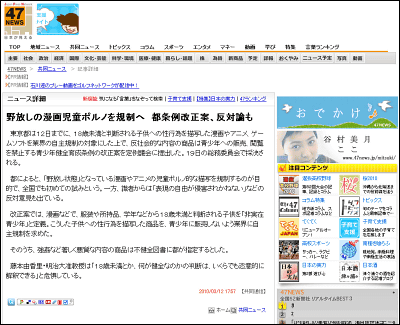
According to the city, the purpose is to regulate child pornographic depiction of manga and animation which are "uninjured state", the first attempt in the whole country.
Yukari Fujimoto, Associate Professor of Meiji University, fears that "any judgment as to whether it is under 18 years old or not, can be arbitrarily interpreted".
In addition to this proposed amendment to the ordinance, the Tokyo Metropolitan Federation of Women's Associations (Tokyo Women's Association), Professor Yasuo Hasebe of the University of Tokyo, Ms. Noriko Ohka, Internet Education Analyst, Mobile Content Review and Operation Supervision Organization (EMA), EC Network , Telecommunications Carriers Association (TCA), Telecom Service Association (Theresa Cooperation), Japan Internet Provider Association (JAIPA), Mobile Content Forum (MCF), CANVAS.
■ 2010/3/12 18: 51
Opposing the Tokyo Metropolitan Youth Health Development Ordinance, private groups and experts expressed their opinions - INTERNET Watch
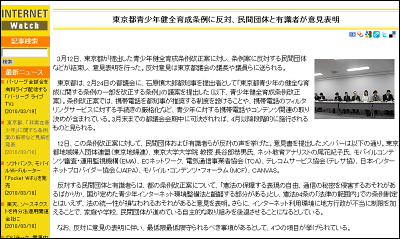
On the contrary, four items are cited as there are matters that should be kept to a minimum at the minimum as the opinion is expressed.
1. For speech and expression activities, ordinances that should not be arbitrarily engaged by the public authority including the capital and what should be done
2. Ordinances and ordinances that allow private organizations and activities with diverse purposes and functions
3. What should be the ordinance that guarantees the right for users and business operators to choose from various standards
4. Amendment of ordinance and amendment of ordinance within the scope of law such as constitution and youth Internet environment improvement law
The opposition members of the ordinance amendment dictates that cooperation between private organizations and governments, local governments, parents, schools, and communities is indispensable, and when regulations such as ordinances are strengthened uniformly, the private sector's efforts are atrophied , It shows the view that it will be unbalanced. Regarding revising the ordinance, we respect the voluntary efforts of the private sector to the utmost, and seek careful deliberation considering whether or not it is necessary to amend the ordinance.
■ March 12, 2010 at 19:32
Recommended by the capital "Youth Mobile" Recommended · Filtering Enhancement Youth Development Ordinance Revision Plan (1/2) - ITmedia + D Mobile
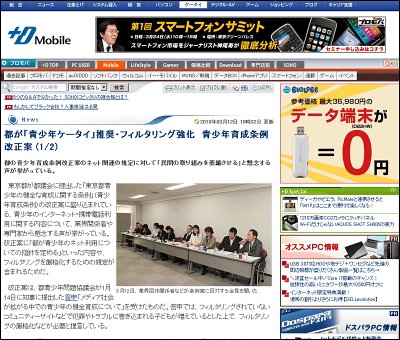
Although the Tokyo Metropolitan Government is thin with respect to the net, "There are many elderly members who know the air towards the Second World War, and the idea that freedom of expression and secret of communication is more than anything to do" (Deputy Director General of the Community Division Mr. Miki Nagata of Mr. Nagata) said that he agreed to the opinion.
And on the Monday of the next week, on March 15, "Non-President Young people regulation opposition meeting" will be held.
■ March 15th, 2010
Painful news (No ∀ `): Topics say that writers list against the regulation of 2-dimensional child pornography in the city is too great
■ March 22, 2010 22:30
"Culture will perish" - Miyakata Ordinance "Nonexistent youth" Chibutotsuya, Mr. Toru Nagai and others feel a sense of crisis - ITmedia News
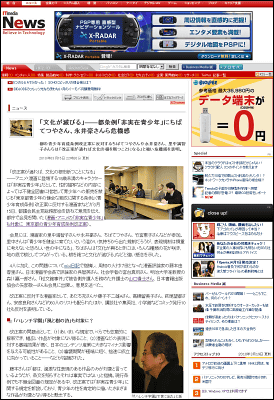
As a manga artist opposing the revision proposal, about 60 people such as Mr. Adachi Kimi, Fujiko Fujio A, Takahashi Rumiko, Hagio Tomochi and Yasuhiko Yasuhiko were distributed as well as comic issues such as Kodansha, Shueisha, Shogakkan, etc. 10 The company also announced its opposition.
Mr. Fujimoto pointed out that "Miyako seems to be targeting only works with severe sexual expression, but it is not a fact if lighting the provision." Even under the current regulations, there are provisions on unhealthy books, we are concerned that various revised plans will have provisions on "non-existent youth" and that various works that positively describe the sex of young people could be subject.
Mr. Miyatai said, "The theory of simple adverse effects that content depicting young people's sexual acts adversely affects adolescents has been academically denied," and "I will see the content acceptance context It is best to control. " Criticized as "negligent to jump into supremely good expression regulation suddenly without taking the best measures".
In the ordinance, under 18 years old is defined as young people, but in Japan, women can marry at the age of 16, and in the situation that nearly half of high school third graders are experiencing sexual experiences (Mr. Miyatai), high school student sexual activity If the work that depicted positively was the target, the effect of atrophy to expression is high. "For those who are doing normal things, you will get a message saying" you are doing something bad "and side effects are great" (Mr. Miyata)
"Although there seems to be an implicit premise that it is possible to distinguish between good manga and bad manga on the regulatory side ..." - Morikawa pointed out that the idea itself is wrong. Many cartoonists depicting young sex acts and manga artists depicting coterie magazines are often awarded for "Media Arts Festival" at the Agency for Cultural Affairs, and it is said that environments that allow for a variety of expressions are expanding the comic artists' fields "There is little consideration of side effects when the revision bill passes," he said.
More detailed comment content can be referred to from the following. There are many reasons that are easy to understand.
■ March 15th, 2010 at 5:54 pm
Coderanoblog 4: Non-existent youth regulation against opposition rally
· Mr. Satoshi Ogawa, manga artist
Young people will sexually stimulate anything in the first place. I used to be an unhealthy fantasy with Lucy and Ben in English textbooks. I will make all kinds of middle and high school and high school students materials of delusions. I do not want freedom of human delusion and freedom to share it. It is wrong to punish it by law.
Once an elementary school student was educated on emotion at Professor Nagai 's Harenchi Gakuen etc. Such things can be found in the present kids.
In addition to that, various famous cartoonists are making remarks, but the content of remarks of Associate Professor Miyagawa Kaichiro of Meiji University is worth reading.
· Meiji University Associate Professor Koichiro Morikawa
Otaku, rotten girls are honorific and honorable to hide it. There is something like a habit of pretending to be an ordinary person. I understand it well, but I need to explain it at the appropriate time. Failure to explain the effort may have caused this.
The Ministry of Land, Infrastructure, Transport and Tourism decided to make manga animation into the country 's export industry in 18 years, but in the end the report was made with think tanks as 67 million yen.
People who are not familiar with manga seem to think that it is a question of how to make use of Pokemon in autumn leaves. But Akihabara is excited by doujinshi and erotic. There is an image that can divide good manga and bad manga, and there is an idea that poor manga gathers bad people.
If it eliminates malignant people, it is said to be good for export. But then, it will result in a loss of competitiveness as essence. Competitiveness is the amount of competition population underlying. The pyramid has a higher peak at the base. It supports richness.
Comiket is done twice a year. 550,000 people visit in 3 days. Otaku is thought to be a man, but women account for 70%. A unique expression has been made. Amateurs begin to write manga with a masterpiece and distribute them to like-minded people. The basic is Ero Paro.
The main characters of existing manga are often less than 18 years of age by definition. Although it is estimated, it is probably Eroparo who is under 18 years old, 30% of the issue number of doujinshi, 50% of the number of copies.
Specifically, what is it? Rei Ayanami is 14 years old. Artist who won the Agency for Cultural Affairs Media Arts Festival is also from Eroparo. After receiving the award, he is using Erotico using Ayanami Rei. Pros often write doujinshi.
This author is a skillful person and also makes prototype of figure. Some people should crack down on copyright infringement, but this figure is sold at Evangelion's official store. There is a mutual dependence relationship. Since this is already established, there is no need to take the trouble of administrative intervention.
There is the possibility of destroying the relationship of mutual dependence if the writer who made the work of erotic affixed a label such as unhealthy and could not explain to the sponsor.
When saying erotic manga, old people seem to think of erotic movie. However, those who created eroticism of the pattern of girls' manga have won the Media Grand Prize and others. There is also a reality that writers who changed the tide of manga for women make commercial debut with erotic manga as a medium.
When erotic manga is removed from the market as unhealthy, the pyramid structure collapses.
For the above contents, an article listing more concrete name and detailed contents is posted on the following page.
"Non-existent youth problem" event report! What is the problem with regulation? - Entertainment - Latest News - Rakuten woman
In short, although it is quite common, it is impossible to delete only the minus aspect and leave only the plus side, and everything has plus and minus aspects, but I do not like it so much and I do not like it People who take out the things that will bring out the most grudge and antipathy from the things and show them to everyone, people who watch manga · game · animation · hang them up as criminal reserve troops and put up the flag of Nishiki, this is the It is a way of doing things, but you should think that such childish values are coming when it is time to show that it does not pass.
In addition, the following Q & A answers are also very helpful.
Novels are not included in Q visual alone. Has there been a logical explanation that typography does not enter from Tokyo?
A Limiting to this range is inherently rational. Visual for non realities. Because novels have to be read, it takes time and labor, so if there is no net, it is not only that. Illustration will be a problem.
Since there is already a library of movies etc. in Article 8, No. 1, it is not limited to visuals. There is already a novel. Plus to add a positive affirmation of sex under the age of 18 was added. It means that the visual is particularly bad this time. For example, the Tale of Genji etc can be an unhealthy book designation.
Q I suppose that people in the type should not make noise, but what do you think?
A Freedom of expression is eroded from weak points. If this can be regulated it will spread as well if this is also good. It is the person who does not know the history to say such a thing. Regulators never say this is secure.
Q adult game has been self-regulating for years.
A It is said that it is useless even if we try self-regulation efforts. However, there are also two types of self-regulation. Regulation that we will be told consent uniquely and regulations that thought of the future by ourselves. If you do self-imposed restrictions, you are getting more and more engrossed. There is no way it can be said that the recipient side likes or dislikes it. I would like the efforts of literacy such as politics.
Even if you forcibly make an unreasonable and unreasonable ordinance, "apartheid(Racism discrimination policy of South Africa that prefers white people and isolates blacks in a bad environment and also prohibits men and women of different races from marrying, and different racial sex It is obvious that it punishes that it becomes a romantic relationship and the United Nations is said to be "a crime against humanity") ".
To create a new coined word "non-existent youth", to regulate to "for education" or "for children" or "for a safe and healthy society" is not "for education" Not for 'but for' a safe and healthy society ', but simply rejecting things you do not like and disliking, it is only forcing others to do so. Rather, "protecting freedom of expression" protects the healthy development of society and young people, and if there is no freedom of expression, it is possible to transmit and write on the Internet like this You will not be able to do anything.
What kind of world are you dreaming about the people who want to regulate, as a matter of their own ideals and becoming healthier?
The state of this interview is written here and there, but the following is easy to understand.
People standing in front of the door of 'Darkness of Expression' - Hosaka Exhibit Where Where Where
There is a capital of Tokyo Metropolitan Government in one part of the Tokyo Metropolitan Government. As you walk through the courtyard, you see a matrix on the second floor. It is an urgent meeting held urgently that it is imminent that the "youth health regulation ordinance" that "the young people health promotion regulation" is subject to the vote decision by the city council general affairs committee, "targeting works including sexual expressions in which the" non-existent youth "appears in the world of manga and animation It was the figure of the people who gathered. At 2:00 p.m. from the Tokyo Metropolitan Assembly on the 2nd floor meeting room "On March 15, 2010 Tokyo Metropolitan Government revises regulations for youth health development regulations and considering the" regulation of non-existent young people "(Organized by the association to think about the youth health promotion ordinance · Yukari Fujimoto) was held.
The chair of the venue was not enough shortly, and those who participated in the standing filled up ruglyly. As a facilitator Mr. Takashi Yamaguchi attorney, "We lost in last year's general election but because Mr. Hosaka who worked hard on this problem came to the venue," suddenly introduced, greeting without any preparation. "There has been a long time before the vote that people who are discussing without any knowledge of laws and ordinances are known to the general public so many people gathered today and teachers who are in the field of expression also Regarding the regulations related to two-dimensional creation (manga, animation), especially in the discussion of the "Child pornography prohibition law" in the National Assembly " Outside "things. It is strange that the Tokyo metropolitan government will rush through discussions of the National Assembly and rush through the ordinance. "
In addition, there are also scenes where you can see some of the reasons why such big problems are not being reported on newspapers and television.
Yomiuri Shimbun demonstrates the problems of regulations on the city and manga - livedoor news
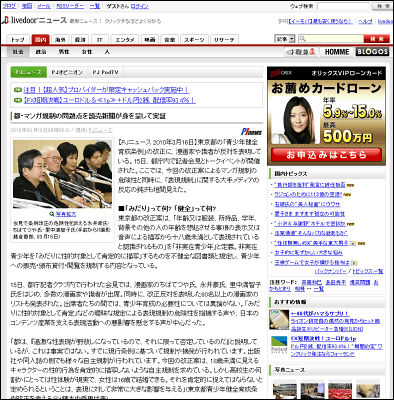
Yamaguchi said at an event after the press conference.
"The reporter of Yomiuri at the previous interview, saying that Professor Nagai's" Harenchi Gakuen "is okay with this amendment (venue, haha.) That being able to make such remarks is a statement of the revision bill It is also about how arbitrarily it can be decided, honestly, if I feel that it is likely that the "Harenchi Gakuen" will somehow become like this provision, I can say confidently as a lawyer But (Prof. Nagai) about that point (Venue, LOL and applause) "
Yomiuri Shimbun articlesは、<都青少年・治安対策本部は「すべての性描写が規制されるわけでなく、大人への流通も制限されない」として、漫画家の創作活動には影響しないと反論している。>とする都側の言い分を掲載した。しかし、都の言い分に対する山口弁護士の会見コメントは一文字も紹介していない。【了】
Although we have demonstrated on our own what "arbitrary" is unfortunate, but without the Internet, such ordinance was quietly enacted before anyone knew, And then I was advertised extensively and I knew how terrible the appearance of the media called the Internet would be if I thought that it was supposed to have been "banned! This is also prohibited! I will. Ten years ago, twenty years ago, and fifty years ago, there were no means of stopping the runaway of the people standing on the side of power, and I was performing the messy things in a straightforward way. If there is something called the existence value of the Internet, it is exactly like this that exposed the case like this time to the bottom of the white day. If the Internet is regulated, these truths are in the darkness and it must have been too late by the time all is known.
The value of the Internet is exactly to destroy such a messy thing, and it is often said that the Internet is the medium of destruction, but what is being destroyed is that such a "non-existent youth" like " It is unreasonable itself. Until now, such unreasonable things, my own values are correct, and low-level thinking of dealing with human beings who crushed from those values was under way, but I will not pass it anymore. Because it is unreasonable "real thing" comes out on the Internet, it is nothing else. This is the strength of the Internet, and indeed it contains "real things", which is a strong cause. In the world where unreasonableness goes all the way up, the bad money expels good money, but the real value of the Internet from now on to create the world where the real thing will win in the end is the true value of the Internet, this fight just started now, now It is almost certain that there is no doubt in recognition that it will go on endlessly from.
If you studied world history, you can understand, but there is nowhere in the world history until now that the truth has not been exposed in the end. The truth is revealed at the end of the last. No matter how hidden it is, whether it is lied or stopped by unreasonable power, "real thing" is strong because it actually happened.
Talk back, and on December 17, Google, Microsoft, Rakuten · Mobage's DeNA · Golf Digest Online announces the opposition against the youth ordinance revision bill on the same day.
■ March 15th, 2010
Internet Business Innovation Research Consortium :: Opinions concerning the revision of "Ordinance on the sound development of Tokyo metropolitan youth"
■ March 15th, 2010
【Rakuten Co., Ltd.】 Company Information - Our Views on the Tokyo Metropolitan Government's Youth Enhancement Ordinance Revision Plan
The number of companies and organizations that expresses further opposition from here will increase. On the next day, Kyoto Seika University holding a manga faculty and an international comic research center will publish an opinion paper.
■ March 16th, 2010
Kyoto Seika University: Information: Notice from the university: [Press announcement] Opinion concerning Tokyo Metropolitan Government for youth health development education revision

1) The new concept submitted by the proposed amendment "non-existent youth" is unclear in its object and may be arbitrarily interpreted. In addition, the grounds for considering the sexual description of "non-existent youth" as "unhealthy" immediately is weak, and many works are labeled "unhealthy books" regardless of their contents It is possible.
2) As far as judging from the minutes of the Tokyo Metropolitan Youth Council, etc., the process leading up to this revision proposal, those who consider the opinions of the surroundings, such as publishers and experts, as well as those who are the parties It is hard to imagine that it is. The essence of the problem is related to freedom of expression guaranteed by the Constitution and there is no doubt that such regulation will be done without sufficient evidence and argument.
3) Although the proposed amendment is a matter of the Tokyo Metropolitan Ordinance, Japanese publishing houses are concentrated in Tokyo, many events related to comics and animation are held in Tokyo. Therefore, this revision proposal is not a problem only in Tokyo but a problem affecting the expression in the whole country. We should not leave the root in the expression culture of Japan by making hasty ordinances.
On Wednesday, March 17 (Wednesday) of the next day, an opposing statement will be announced one after the other.
■ March 17th, 2010 at 19:35
Comic Natalie - "Non real existence youth" from the comic industry one after another
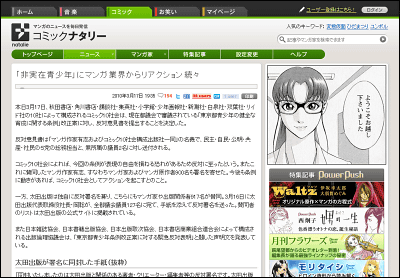
A comic 10 society consisting of 10 companies today, Akita Shoten, Kadokawa Shoten, Kodansha, Shueisha, Shogakkan, Shonen Wakkanen, Shinchosha, Shinchosha, Shitenna, Futabasha and Liedo today, is currently being debated at the city council. We decided to submit dissent opinion against the revised ordinance concerning healthy development of youths in Tokyo.
According to the comic 10 society, the current regulation leads to opposition because there is a risk of damaging freedom of expression. Also, volunteer comic strip authors who supported this, namely 900 manga authors and manga authors were signed. If there is movement in the ordinance in the future, it will cause action as comic 10 society.
On the other hand, Ota Publishing volunteered opposed signatures, and 917 people agree with manga artists and publishers. Otaka Satoshi President and CEO Oka Sato sent a signature to 127 members of all the city council members on March 16 with a letter signed in opposition. The list of approvers is posted on Official Website of Ota Publishing.
The publication ethics council composed of the Japan Magazine Association, Japan Book Publishing Association, Japan Publishing Association, Japan Book Collection Commerce Union Federation announces a statement entitled "Expressing Deregulation to Tokyo Metropolitan Youth Ordinance Reform Proposal" doing.
The meaning of what this is about is posted in Asahi Newspaper.
■ March 23, 2010 23:39
Asahi.com (Asahi Shimbun): 4 municipal cartoon / animation regulation draft publication expresses urgent opposition - culture
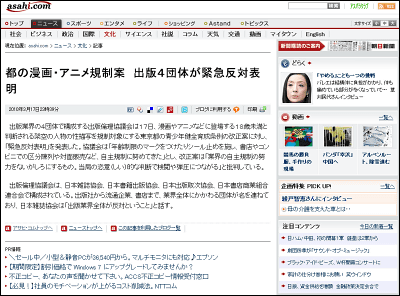
The Publication Ethics Council consists of the Japan Magazine Society, Japan Book Publishing Association, Japan Publishing Association Association, Japan Book Store Commerce Association Federation. From the publisher to distributors and bookstores, the associations involved in the whole industry are named, and the Japan Magazine Association says that "the entire publishing industry is the opposite."
In other words, all industries that make publishing a business are against this "non-existent youth". Furthermore, the movement of this day continued, at last the library announced the view, and expressed a will to oppose quite strongly as "should be deleted".
■ 2010/03/17
The Japan Libraries Association - About the "ordinance revising a part of the ordinance concerning healthy development of Tokyo metropolitan youth"
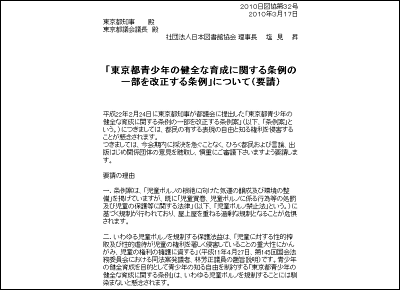
In the ordinance draft, as a "non-existent youth", creative articles such as comics can be regulated as unhealthy books (Article 7-2, etc.). This is a regulation that is not related to the protection profit and loss of the child pornography prohibition law cited earlier and is a regulation which the current child pornography prohibition law does not adopt to suppress excessive regulation, it is deleted from the draft regulation It is a regulation that should be used.
Six. The draft regulations newly establish "the possibility of severely hindering the formation of a sound judgment ability on young people 's sex" (Article 7-2, etc.) as the designated standards for unhealthy books.
Formation of ability to judge children's sex is a parent's primary responsibility, not administrative or police. Article 18-1 of the Convention on the Rights of the Child "Parties shall make best efforts to ensure recognition of the principle that parents are jointly responsible for child rearing and development Parents or, Parents shall have a primary responsibility for child rearing and development "and that standard should be deleted.
Not only this, but an opposing opinion will emerge from the animation industry. This is quite unusual. It is unusual or unprecedented level.
■ 2010/03/17
Japan Animator / Director's Association (JAniCA) - Opinions on the Tokyo Metropolitan Youth Health Development Ordinance Revision Plan

If you look at the ordinance indeed, "voice" is also subject to regulation, and voice actors that can only be heard under the age of 18 can be annihilated.
Also, even the "Tokyo Penn club" belonging to Tokyo governor Shintaro Ishihara also announced the opposite.
■ March 18th, 2010
Japan pen club statement - against the strengthening of expression restrictions by the revision of the Tokyo Metropolitan Youth Ordinance
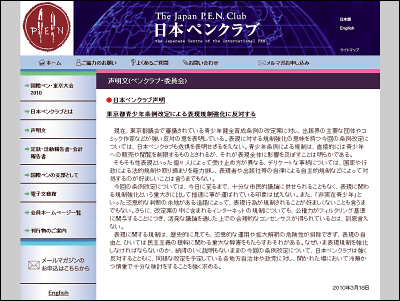
Currently, major organizations and comic writers of the publishing world have strongly expressed opposition to the draft revision of the youth health development ordinance deliberated at the Tokyo Metropolitan Assembly. Regarding revision of this regulation which has a meaning of strengthening the regulation on expression, Nippon Penn club is obliged to express concern. Restrictions by the youth regulations are to directly restrict sales and browsing to young people, but it is obvious that this will affect the whole expression.
In the first place, it is preferable to eliminate legal restrictions and crackdowns by the state and administrative departments as much as possible, and to deal with delicate matters that differ in how they are received by individuals, such as sexual expressions, by voluntary restrictions by autonomy of authors and publishers Needless to say.
Regarding this revision of the ordinance, we can not wipe out the impression that things are carried away quickly, compared to the seriousness of regulation strengthening related to expression, without being given to sufficient civil arguments until today. Also, it goes without saying that it is not preferable that the expressive behavior is regulated by coined words that have room for arbitrary judgment, such as "non-existent youth". Furthermore, regarding the regulation of the Internet included in the revision proposal, it can not be said that reasonable consensus has been obtained through active discussion about the fact that public authority is involved in filtering standards.
From the historical viewpoint, regulation on the expression can not eliminate the danger of arbitrary operation and expansion interpretation, and there is a possibility that freedom of expression and serious adverse effects related to the basis of democracy may result. Regarding the current revision of the ordinance without any satisfactory explanation as to why express expression regulations should be strengthened now, the Japanese Penn club strongly disagrees, as well as local governments and political parties scheduled to revise similarly , I strongly urge you to consider calm and carefully and thoroughly in the open space.
Whether it was pushed by such movements or aimed at calming, Thursday, March 18, the Tokyo Metropolitan Government announced the view on interpretation of the ordinance draft on "non-existent youth" on the net.
【PDF file】 Tokyo Metropolitan Government Youth Development Reform Plan
It is entirely up to the excuse excuses and can only be read as if there is no lie that can not be read, and I do not know who wrote it, but clearly saying "incoherent". For example, the explanation about "non-existent youth" is as follows.
This provision, as a setting of the work, concerning the age, grade, uniform (clothes), school bag (belongings), depiction of the school going to school (background), explicit and objective ① display or (2) , Narration), it is a provision for limiting it to those clearly recognized as under 18 years of age, limited to the maximum possible considering freedom of expression.
Despite the absence of such explicit and objective support, it can not be subject to subjective reasons such as "young looking" or "young voice", so arbitrary operation is impossible.
(For example, even a depiction visually perceivable by an infant is not applicable if it is set to "be over 18 years old" etc.)
In addition, in the unhealthy book designation system for the purpose of restricting viewing to adolescents and autonomous regulation system, authors are not regulated, creative acts, publications, distribution to adults are free, "censorship, repression Criticism that "leads to the decline of manga and animation industry" is not hit.
Interpretation will be changed by the background and human beings as much as possible. That is why we will make it clear so that interpretation can not be changed as we like. In short, it is just a "mouthfeit", and when I interpret it out of this interpretation, someone involved in this insanely amended revision of the Tokyo metropolitan area will be buried in prison Without it, we will not be held responsible. In other words, because I can say as much as I like irresponsibly, I say it is funny to say the right thing. "Why do not clearly specify the above contents in the article?That's all the answer. By leaving a lot of room to be interpreted as you like, you can see through the intention to operate ordinance on anything you like. It is definitely an abuse of power,PSE problemYaRevision of Firearm Sword LawIt is a situation that is extremely irresponsible for them to say that contents are different considerably in what we were talking about before enforcement and acting in the same way.
The world is wide and complicated, and there are no "ordinary people" anywhere. So, the area that people can decide arbitrarily must be reduced as much as possible. That is the law and the ordinance is the same.
Despite this terrible regulatory opposition campaign has occurred, why the "Tokyo Metropolitan Youth Problem Council" that created a new coined term "non-existent youth" and created a revised bill to promote expression restriction is pretty Can you be on your face? The reason for that is that political agencies and others are on the back for the favor for the regulation, so it is politically overwhelmingly strong, regulating a variety of things by all kinds of expansive interpretation, and it became a situation to go back to Japan before the war Because it is judged that it is better. This point is pointed out here and there, but the following page is easy to understand.
The identity of the police bureaucrats who are pushing the "non-existent youth" regulation - "Anti-Otaku Diet Members List" memo
[Continuation deliberation] Revision plan of ordinance concerning healthy development of Tokyo youth 【Battle is not over】: Lawyer Takashi Yamaguchi speaks a lot
The "revision" of the previous Tokyo Metropolitan Youth Health Development Ordinance was in 2004. Actually, after the revision of the 2004 regulation, the department responsible for the youth regulation was transferred from the conventional Lifestyle and Cultural Affairs Bureau to the newly established Young People and Security Response Headquarters. Efforts on youth issues came to be treated as security problems based on crackdown from welfare response. Yes, the unhealthy book system came to be carried out from the viewpoint of "crackdown on things that disturb public security" from the system based on welfare consideration for young people at this time. There are officials who have been dispatched from the National Police Agency to the Youth / Security Safety Headquarters and the Youth Division within the headquarters. They are driving the creation of this "revision" draft.
As for what kind of exactly is this, "to pre-censor all expressions" is to say, in order to censor the enormous expression, the bill advances towards the direction that the police OB should set up a celestial organization That is why. In easy-to-understand cases, adult videos and pachinko and so on are so. For the sake of our own interests, we are trying to ignore everything, including the rights and intentions of many others. This is not a conspiracy theory, but what is happening in reality, and we plan to post a separate interview article on GIGAZINE as part of such police situation.
In the first place, it is fundamental to expression activities to do "expressions that should not be done with reality", no matter how you regulate expressions, people can not be deleted as they are human beings. Also, although this is true "normal", humans will perish unless they have sex. The fundamental desire of three generations of human beings is appetite, sleeping desire, libido, each one is made to remember a sense of crisis when each is threatened, if you do not eat, you die, you do not sleep, you die, and sex If you do not make a child, human beings will perish. Although it may be said that it is the survival of the human species itself, submitting a revised plan such as this "non-existent youth" as a shameful face shame, denying sexuality is abnormally cleanliness How do people with very few values have sex education for their children at the same time?
Also, since people can draw 'living' and 'dying', Japanese contents are developing, 'living' is sexual, 'death' is violent expression or It is a cruel expression.
Actually these acts are already subject to criminal regulation and there is not much meaning to further restrict expression. It is just a likes and dislikes, a problem of physiological aversion. It is fundamental that it does not want others to acknowledge because it is not admitted, and it is only harm to think of replacing personal hatred as public interest. I got the most extreme case and said, "Horohara, there is such thing! I have never read any other things, but it surely looks something like this! I can not forgive!" And justify my personal pursuit I am just asking for consent.
The biggest problem in the current metropolitan ordinance is that the municipal administration can independently decide "good or bad expression", and as a background there is a short-term "anti-regulation" = "transformation treated labeling It is a strong consciousness that it is based on the strong conscious that it intends to threaten and exclaim what is not recognized as our own values. Therefore, unfortunately, so-calledZoningAnd self-regulation do not fundamentally solve. As an extreme example, in the case of the latest net example, 18 non-compliant goods are sold on Amazon, and it is supposed to be guided to the confirmation button page in order to access the product page In other words, it is zoning by placing it on the "other side". However,"Togetter - Conclusion "Midnight's Fiery Theory on the" Nonexistent Youth "Problem"As you can read, it is also true that some people can not forgive their existence in the first place.
Considering the article posted in the past of GIGAZINE itself, "Grilled pork"It should be very easy to understand. Whether the grilled pork is disgusting or tasty is the "problem of the recipient", it is by no means a problem of the whole of the pig itself. The threat of regulators and the fear of regulators are extremely controversial.
People who approve of regulation basically wish "I do not want to see, I want you to keep them away from them", I can not recognize that it is a problem of my personal taste preference, "public That's why I believe in thinking that it is a problem. Clearly speaking, it is a feeling close to cult religion. It is only forcing my children to hide behind their hobby preferences and I have to keep fighting forever unless I enlighten these people. Regulatory approval and regulatory promotion factions can only withdraw the bill even if it goes out, so it is possible to withdraw or withdraw the bill any number of times, whereas if the proposal opposes once the plan goes through at that point "End" "The end".The one that waits for the regulation is like this one-pieceis. Considering all these circumstances, it is impossible unless we manage the group such as "regulatory approval / regulation promotion", which can not be solved by simple zoning and self-regulation, and conversely the "regulatory approval / regulatory promotion" group Regardless of their regulations, their anxiety will not be resolved. Because, although it did not come out this time, the final destination to reach the regulation and to reach is the regulation of 'freedom of inner'. You can tell by looking at the world history, but human beings seem to be like beasts who want to grab power and start to runaway in groups and want to infringe the freedom of innerity in a blink of an eye.
So, what should I do?
The only solution is "education". About sexual things, about violence, about politics, about laws, about the net, in short "the front and back of this world" and "the real appearance of the world", more basic things are taught in school's compulsory education In doing so, the manga / game / animation is a simple picture, that is, a fictitious creation, which means that there is a growing awareness that it is different from the reality. The fundamental solution is time consuming and troublesome, so why would you make it realistic as belonging to a personal desire to disappear and disappear from front of you as a "rule" as a public rule? It is also funny and it is an abuse of power.
Since it has come down to the 21st century, I would like to aim to solve fundamentally from the viewpoint of "education" taking more time for public welfare, not such a barren "non-existent youth" .
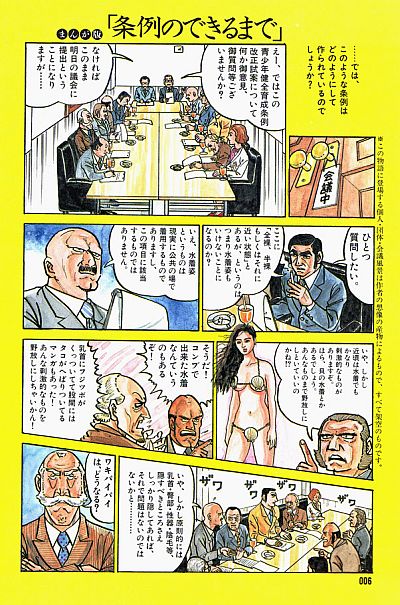
· Bonus(Uncut · All color full version is released online)
Comic book · Before ordinance can be made (1992 work): Takekuma memo
Related Posts: