Anthropic has announced the 'Model Hardware Standard,' a common standard for enabling AI to control microscopes and robotic arms.
Anthropic has released a research preview of the 'Model Hardware Standard (MHS),' a common standard for AI to operate physical equipment such as microscopes and robotic arms. It is said that using MHS will make it easier for AI to handle equipment from different manufacturers and types in a common way.
Previewing the Model Hardware Standard \ Anthropic
Model Hardware Standard
https://www.modelhardwarestandard.com/
Model Hardware Standard: AI operating physical equipment - YouTube
While automation in laboratories and factories has been practiced for some time, the operation methods and programming interfaces for microscopes, robotic arms, and measuring devices differ from manufacturer to manufacturer. This has made it necessary for experts to create custom programs to combine multiple devices, posing a major obstacle to automation. According to Anthropic, setting up and integrating equipment can take weeks or even months, making the burden of automation particularly heavy in research settings where experimental procedures change frequently.
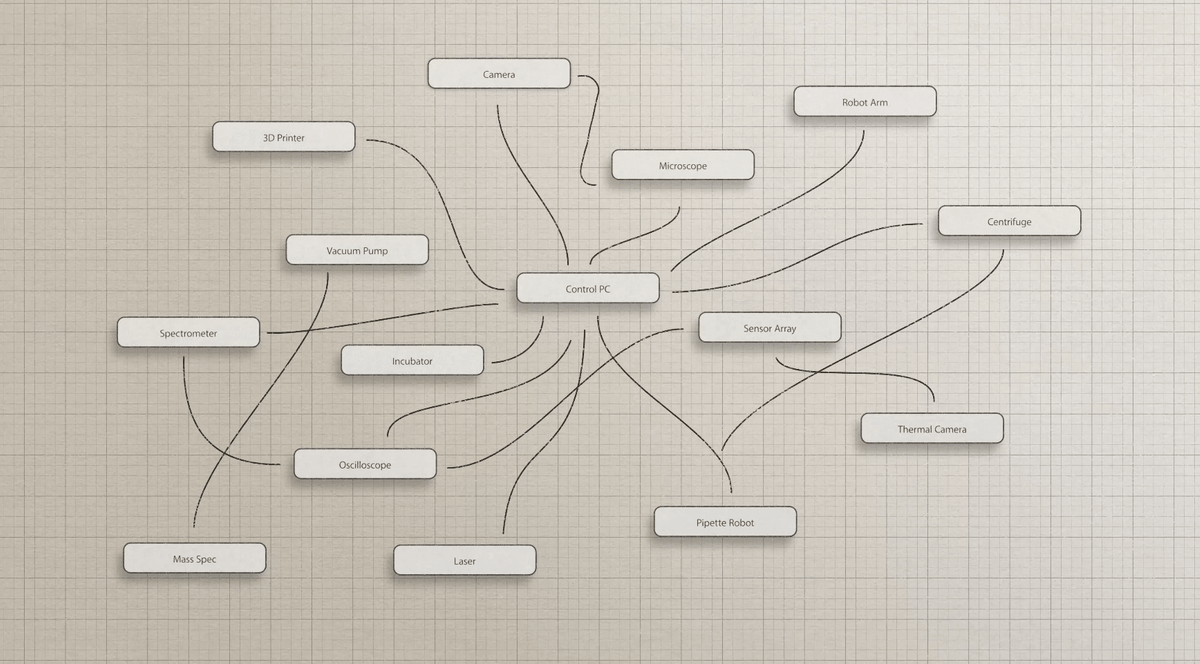
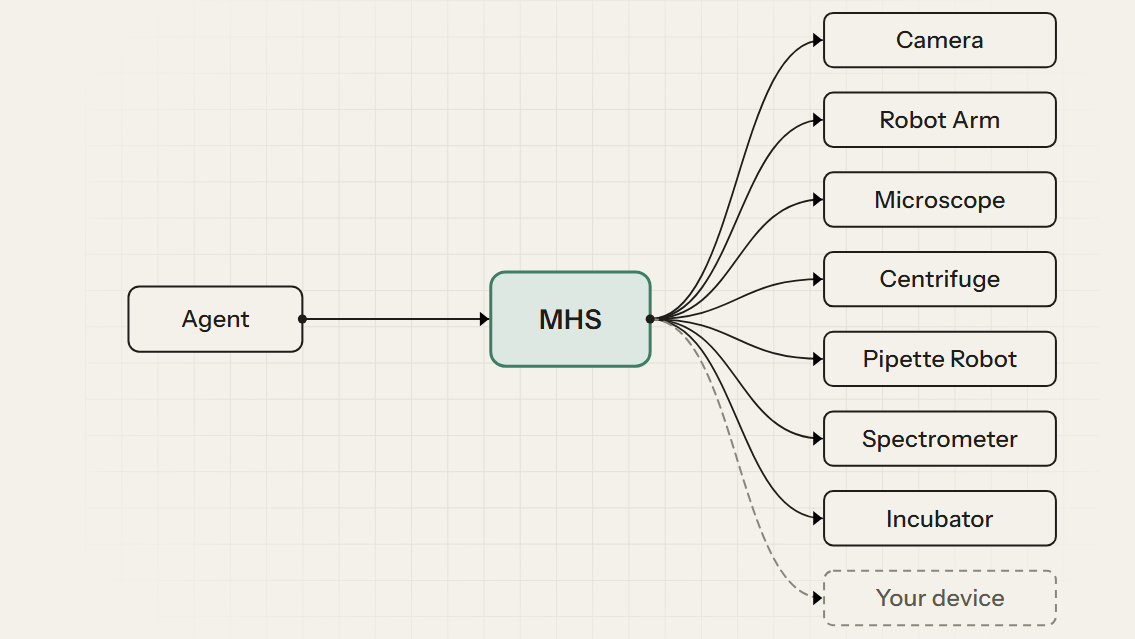
The MHS announced this time is a system that absorbs the differences between devices and allows AI to handle them in a common way. For example, operations such as 'reading the temperature,' 'changing setting values,' and 'moving the robot arm' can be handled in a unified format, reducing the effort required to prepare dedicated cooperation programs for each device.
Furthermore, MHS can communicate information such as 'device characteristics and operating range' and 'safety limitations' to the AI. The aim is to reduce the amount of work researchers have to do writing detailed control programs by enabling the AI to understand the device's description and then operate it accordingly.
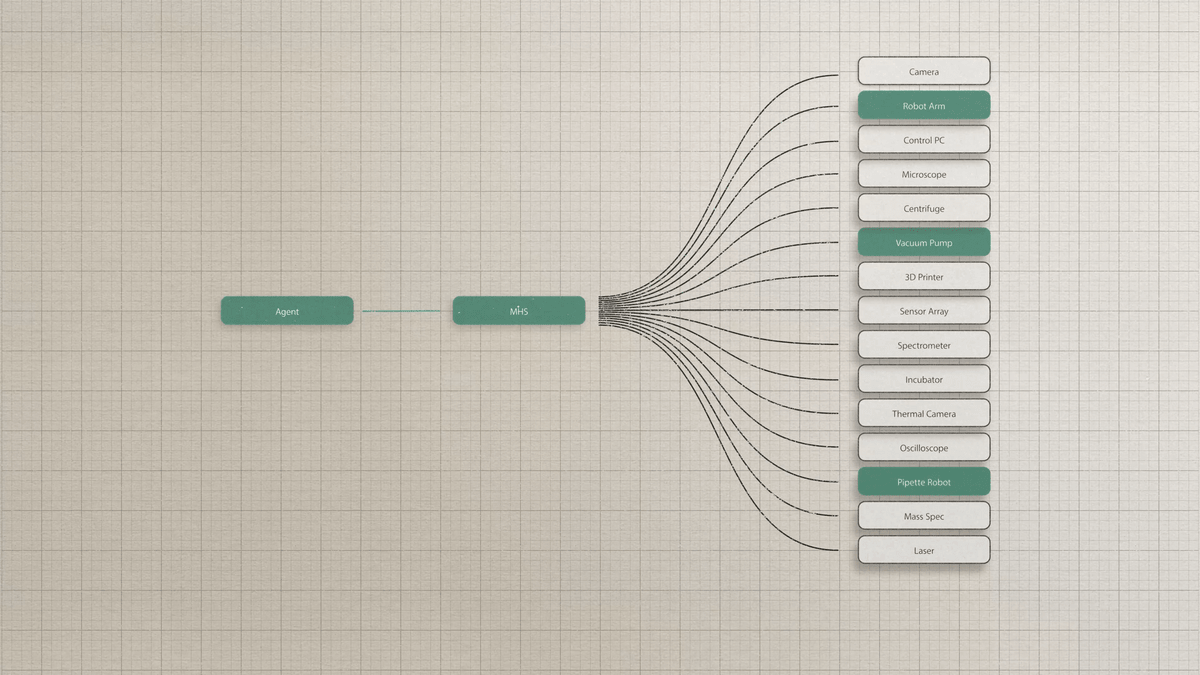
The image below illustrates how Claude operates multiple research devices via MHS. By communicating the experimental details to the AI, the system allows for the coordinated operation of liquid processing equipment, robotic arms, measuring devices, and other components through MHS.
Anthropic is also conducting demonstration experiments of MHS in cooperation with research institutions and companies. In these demonstration experiments, Claude is being used for tasks such as adjusting research microscopes, automating experimental equipment, and repairing lasers used in quantum computers, and there have been reports of adjustments that were previously done manually being processed in a short amount of time.
On the other hand, there have been reports of cases where the AI was unable to properly understand the state of the real world, such as when Claude failed to adequately assess a physical problem caused by bubbles generated during an experiment, requiring advice from a human expert.
At the time of writing, MHS is available as a research preview, and Anthropic is currently working with research institutions and equipment manufacturers to verify its safety. Anthropic has stated that it plans to open-source MHS in the future to make it available for use in a wide range of AI and equipment.
Related Posts: