What is 'thermodynamic computing,' which aims to save power by utilizing 'thermal noise,' which was once considered an enemy of computers?
Heat causes atoms and electrons to move irregularly, resulting in small fluctuations in the voltage and current of circuits. These random fluctuations are called ' thermal noise ,' and are suppressed in conventional computers because they disrupt calculations. However, research is progressing on 'thermodynamic computing,' which utilizes this thermal noise in calculations. This has the potential to perform the processing required for AI and scientific calculations with less power consumption and heat generation than conventional computers, but at the time of writing, the principles are still being verified using small-scale prototypes and simulations.
Thermodynamic Computing Advances with Design and Training – Berkeley Lab News Center
https://newscenter.lbl.gov/2026/03/05/thermodynamic-computing-advances-with-design-and-training/
Thermodynamic Computers Go With the (Energy) Flow | Quanta Magazine
https://www.quantamagazine.org/thermodynamic-computers-go-with-the-energy-flow-20260715/
In modern computers, if thermal noise causes 0s and 1s to be swapped incorrectly, the calculation results will be corrupted. Therefore, semiconductors are designed to reliably switch signals using far greater energy than the fluctuations caused by ambient heat.
However, protecting signals from thermal noise requires a lot of power, and this consumed power is ultimately lost as heat. Cooling is also a major problem in processors with densely packed components, so the conventional approach of thoroughly suppressing thermal noise has limitations in terms of energy efficiency.
Thermodynamic computing reverses this concept, using such small amounts of energy that thermal noise becomes noticeable to power circuits, and utilizing the random state changes caused by heat itself in its calculations. It's like a computer that designs the direction and path of the flow to guide it to its destination, rather than using a large force against the flow.
If we liken energy states to terrain, low-energy, stable states correspond to valleys, and high-energy, unstable states correspond to mountains. In thermodynamic computing, just as a ball placed on a slope naturally rolls to a lower point, we design circuits so that the state corresponding to the answer to the problem we want to solve becomes the lowest-energy valley, and we utilize the process by which the system moves towards that valley while being affected by thermal fluctuations.
Thermodynamic computing can be broadly divided into two types: 'equilibrium' and 'non-equilibrium.' Equilibrium computing is a type that calculates results by reading the state of a system after it has settled into a stable state over a sufficient period of time. For example, each component of the matrix for which you want to find the inverse matrix is set as the strength of the connections between circuit elements. Then, in a circuit that has settled into thermal equilibrium, you can design the system so that the value obtained is the inverse matrix of the original matrix simply by measuring how much the voltage fluctuations due to thermal noise are linked. In other words, instead of a normal computer executing many calculations sequentially, the calculations are left to the process by which the physical system naturally settles down.
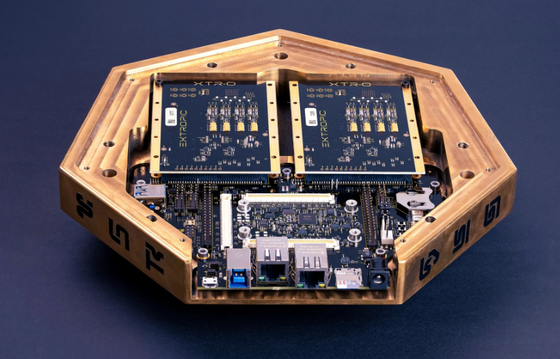
However, equilibrium-type problems have the challenge of being difficult to predict when the answer will be obtained, as the time it takes for the system to reach equilibrium varies greatly depending on the problem being solved and the circuit structure. There is also the possibility of getting stuck in another 'valley' along the way, which could take a long time to return to the correct state.
One approach that is attracting attention is the non-equilibrium type, which uses the movement of the system before it reaches an equilibrium state in its calculations. The non-equilibrium type embeds the calculation results not only into the final stable state, but also into the 'trajectory' of how the circuit state changed over time.
An object in a non-equilibrium state will try to move in the direction of lower energy, but will be constantly pushed in the opposite direction by thermal noise. Such motion can be described by Langevin dynamics , and if the circuit is operated with sufficiently small power, similar random changes can be produced in voltage and current.
In a non-equilibrium system, the circuit can be adjusted so that 'the state at a certain time has elapsed becomes the answer.' Therefore, the advantage is that you don't have to keep waiting for a system whose equilibrium state is unknown, and you can read the result at a predetermined time.
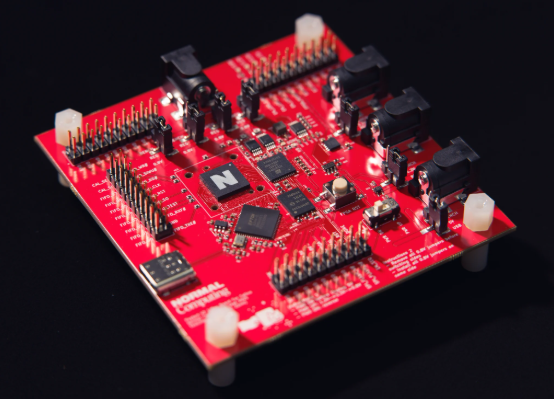
Normal Computing , which is working on the development of a working thermodynamic computer, has developed a balanced prototype that connects multiple RLC resonant circuits , which combine resistors, capacitors, and coils. By applying random electrical signals to each circuit and adjusting the strength of the coupling between the circuits, this prototype can perform operations such as calculating the inverse matrix.
However, this prototype did not operate solely on naturally occurring thermal noise within the circuit; instead, it used an external random number generator to produce random electrical signals to replace the thermal noise, which were then input into the circuit. Since generating random numbers and inputting signals also requires power, this experiment did not confirm that the entire prototype was more power-efficient than conventional computers.
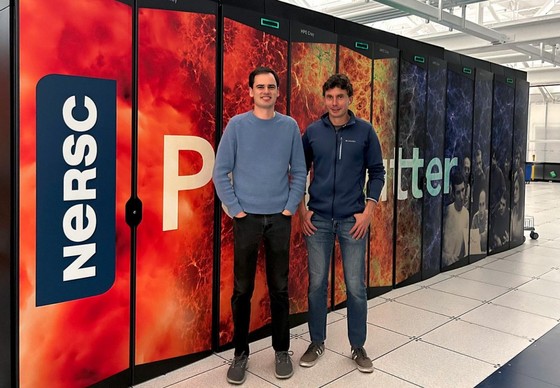
Research is also progressing on applying thermodynamic computing to AI. Stephen Whitelam and Cornel Cassart of Lawrence Berkeley National Laboratory have proposed a model that uses circuits whose state changes due to thermal noise as neurons in a neural network, and performs nonlinear calculations without waiting for an equilibrium state.
In typical neural networks, 'nonlinearity,' which transforms inputs curvilinearly rather than proportionally, is crucial. While stacking multiple linear calculations will only represent the same result as a single linear calculation, adding nonlinear transformations allows for approximation of complex functions necessary for applications like image recognition.
In Whitelam et al.'s research, thermodynamic neural networks were reproduced not with actual circuits, but through computer simulations. Furthermore, genetic algorithms were used to adjust the connections between circuits and the input weights, training the network to output a target nonlinear function at specified times.
The genetic algorithm is a method that keeps the best-performing settings and then gradually introduces random changes to those settings to search for even better ones. In circuits that include thermal noise, the answer changes slightly each time even under the same conditions, so an exploratory method different from the learning methods used in typical neural networks is employed.
This simulation demonstrated that nonlinear calculation results can be obtained at predetermined observation times even if the system has not reached thermal equilibrium. This suggests that the applications of thermodynamic computing may expand from linear algebraic operations such as inverse matrix calculations to a wide range of nonlinear calculations handled by neural networks.
Thermodynamic computers operate using thermal noise, so even when calculations are performed under the same conditions, the results obtained will differ slightly each time. Therefore, to obtain reliable results, it is necessary to repeat the same calculation and average multiple measurement results. As the number of required trials increases, so does the processing time and power consumption. Therefore, it will be necessary to verify whether the power savings expected in theory can be achieved in actual devices.
Furthermore, much of the results currently demonstrated are based on small-scale circuits and digital simulations. It has not yet been proven whether stable learning is possible when the circuits are scaled up, whether sufficient speed can be achieved with natural thermal noise alone, or whether it is truly more efficient than conventional GPUs or AI chips.
Researchers suggest that thermodynamic neural networks could potentially be implemented using configurations that combine RLC circuits with nonlinear elements, or by using superconducting circuits. However, the proposed nonlinear models are currently only simulations, and verification with actual hardware remains a challenge for the future.
Thermodynamic computing has the potential to develop not as a universal technology that can directly replace conventional computers, but as a specialized computing device suited to probabilistic calculations, AI, optimization, and scientific simulations. It is also seen as potentially providing clues to understanding how cells process information with minimal energy. However, this field is still in its early stages, and the future of thermodynamic computing hinges on whether actual devices can be scaled up and whether they can demonstrate superior energy efficiency compared to conventional computers.
Related Posts: