Turkey enacts new cybersecurity law, allowing presidential-controlled agencies to bypass court orders and remove content.

A new cybersecurity law came into effect in Turkey at the end of July 2026. Until now, Turkey lacked a comprehensive law to address cybercrime, and had been applying multiple laws in a fragmented manner. However, with the implementation of this law, which establishes strategies and policies to strengthen cybersecurity, it is expected that clear and rigorous responses will be possible. On the other hand, there are concerns that the Directorate General of Cybersecurity, under the President, can now remove content retroactively, without requiring court orders that were previously necessary in advance.
BTK'nin yetkileri Siber Güvenlik Başkanlığı'na devredildi: Mahkeme kararı olmadan erişim engeli getirilecek - TR724
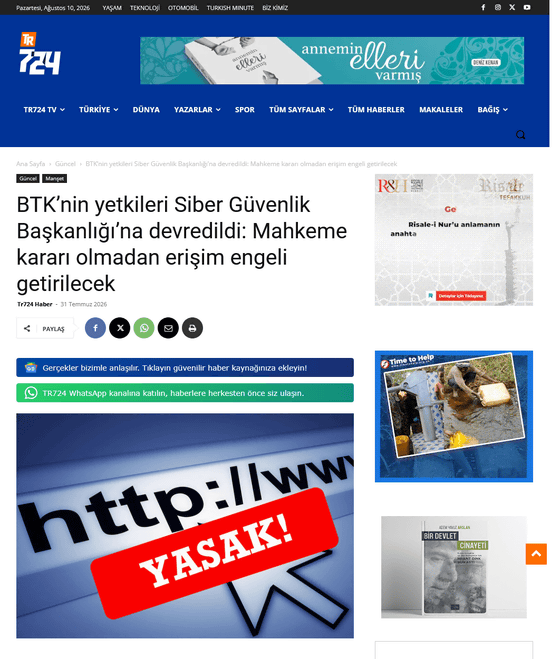
Turkey gives presidential cybersecurity agency power to order internet measures before court review - Stockholm Center for Freedom
New Turkish Cybersecurity Law Set to Enforce Strict Protection
https://www.sangfor.com/blog/cybersecurity/turkish-cybersecurity-law
The 'Cybersecurity Law No. 7545' was introduced by Turkey's ruling party, the AKP (Justice and Development Party). It was passed by the Turkish Grand National Assembly with 246 votes in favor and 102 against, and came into effect and came into law on July 31, 2026.
In Turkey, cybercrime had previously been addressed with a fragmented set of laws, including criminal law, personal data protection law, and electronic communications law, creating a need for comprehensive legislation to combat cyber risks. The passage of this new law is also believed to have been influenced by the September 2024 incident in which personal information of over 100 million people was stolen from government servers.
According to the security firm Sangfor, the purpose of the law is to establish strategies and policies for strengthening cybersecurity, and it stipulates that domestically produced and domestic products should be given priority in order to ensure cybersecurity.
In addition, the establishment of a Cybersecurity Commission is also stipulated. The commission members are the President, Vice President, Minister of Justice, Minister of Foreign Affairs, Minister of the Interior, Minister of National Defense, Minister of Industry and Technology, Minister of Transportation and Infrastructure, Secretary-General of the National Security Council, Director of the National Intelligence Agency (MIT), Director of the Defense Industrial Promotion Agency, and Director of the Cybersecurity Agency.
The Cybersecurity Committee will be given some of the authority previously managed by the Information and Communications Technology Agency (BTK), and will be able to legally access all kinds of digital information stored within Turkey if a court order is issued.
On the other hand, local media outlets such as TR724 point out that the Directorate General for Cybersecurity, which will be established in 2025 and directly under the Presidential Office, will be given immense power. For example, the Directorate General for Cybersecurity will be able to 'remove content without a court order.' Content providers are obligated to respond to the Directorate General's decisions within two hours. The decisions will be submitted to the magistrates within 24 hours, and the courts will decide whether to approve the decisions within 48 hours. Decisions that are not approved will be automatically rescinded. Businesses that fail to comply with their obligations will be fined between 20,000 lira (approximately 66,200 yen) and 100,000 lira (approximately 331,000 yen) for each offense.
Under the old regulations, a prior court order was required to remove content, and it was assumed that the content would be removed within four hours of the court order being issued.
The Turkish digital rights group IFOD (Association for Freedom of Expression), which reviewed the bill before it was passed, pointed out that the transfer of power could weaken transparency and judicial oversight. They called for restrictions affecting internet access and communications to be subject to judicial review before taking effect, and for the measures that the Directorate General for Cybersecurity can take to be narrowed.
Turkey has a low press freedom index of 27.94, ranking 163rd out of 180 countries, according to Reporters Without Borders (RSF), and it has been pointed out that access to social media has often been restricted during periods of political tension.
Turkey | RSF
https://rsf.org/en/country-t%C3%BCrkiye
Most recently, in March 2025, when Istanbul Mayor Ekrem Imamoor was arrested by authorities on corruption charges, access to X, YouTube, Instagram, WhatsApp, and other platforms was restricted for approximately 42 hours.
X (formerly Twitter) suspends accounts of Turkish dissidents in response to large-scale protests against the arrest of the president's political opponents - GIGAZINE

Incidentally, Japan's press freedom index was 62.90, ranking 62nd out of 180 countries. Norway was first with 92.72, the United States was 64th with 62.61, and Russia was 172nd with 23.15.
Japan | RSF
https://rsf.org/en/country/japan
Related Posts:








in Note, Posted by logc_nt