SK Hynix plans to invest approximately 6 trillion yen to expand its semiconductor manufacturing facilities in South Korea, building a DRAM factory in Yongin for approximately 4 trillion yen and a NAND manufacturing plant in Cheongju for approximately 2 trillion yen.
SK hynix Invests 54 Trillion Won in Yongin Y2 and Cheongju M17 to Secure Mid-to-Long-Term Production Base for AI Memory Demand – SK hynix Newsroom
https://news.skhynix.com/en/fab-facility-investment-2026/
@SKhynix will invest approximately KRW 54 trillion in new fabs in Yongin and Cheongju to secure its mid-to-long-term production base for growing AI memory demand. The investment will support expanded production of HBM, DRAM, and NAND.
— SK hynix (@SKhynix) August 7, 2026
🔗 https://t.co/UAfLZN5rXX #SKhynix pic.twitter.com/8mPXYsJG67
SK Hynix to invest $38 billion building new memory chip plants
https://www.cnbc.com/2026/08/07/sk-hynix-memory-chips-ai-prices.html
SK hynix to invest W54tr in new Yongin, Cheongju fabs - The Korea Herald
https://www.koreaherald.com/article/10834499
On August 7, 2026, SK Hynix announced that it has decided to invest 35.2 trillion won (approximately 4 trillion yen) in the 'Y2' factory in Yongin , located about 40 km south of Seoul, and 19.1 trillion won (approximately 2 trillion yen) in the 'M17' factory in Cheongju , located in central South Korea, to construct new factories in order to meet the continuing increase in memory demand in the age of AI.
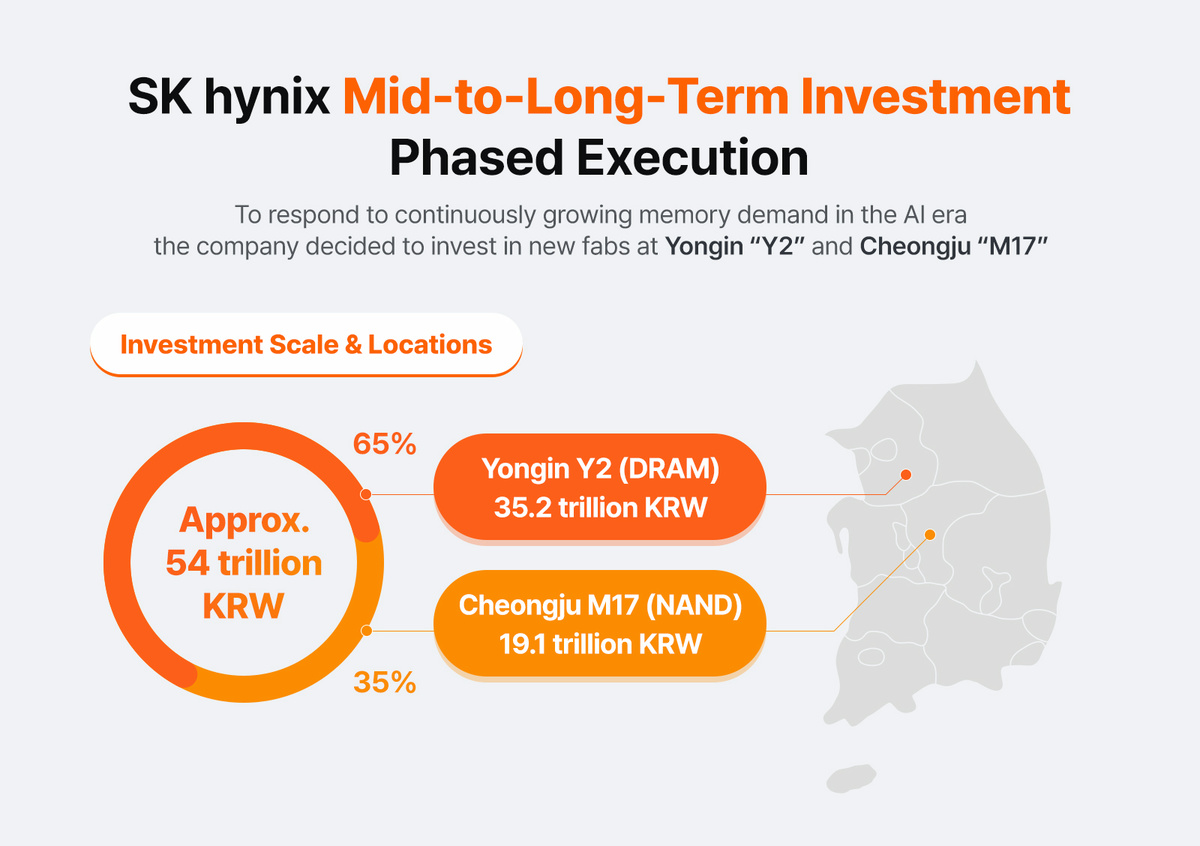
SK Hynix has a master plan to invest 600 trillion won (approximately 67 trillion yen) in the Yongin semiconductor cluster and 100 trillion won (approximately 11 trillion yen) in expanding its Cheongju production base. As of the time of writing, the company is constructing its first factory, 'Y1,' in Yongin, aiming to open
The 'Y2' plant in Yongin, whose construction has now been approved, will be the second of four plants planned for sequential construction for the Yongin semiconductor cluster. It will be built as a DRAM production base with a total floor area of 341,000 pyeong (approximately 1.13 million m² ). Construction is scheduled to begin in July 2027, with the first cleanroom opening in June 2029 to begin production of next-generation DRAM products, including high-bandwidth memory (HBM).
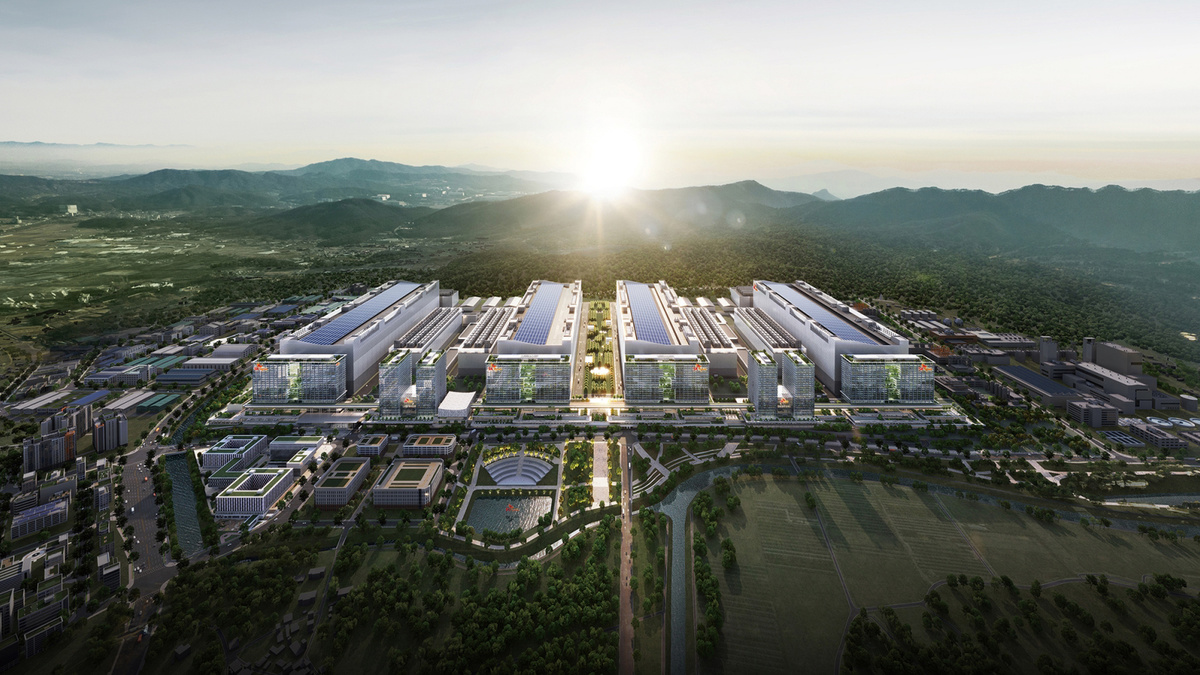
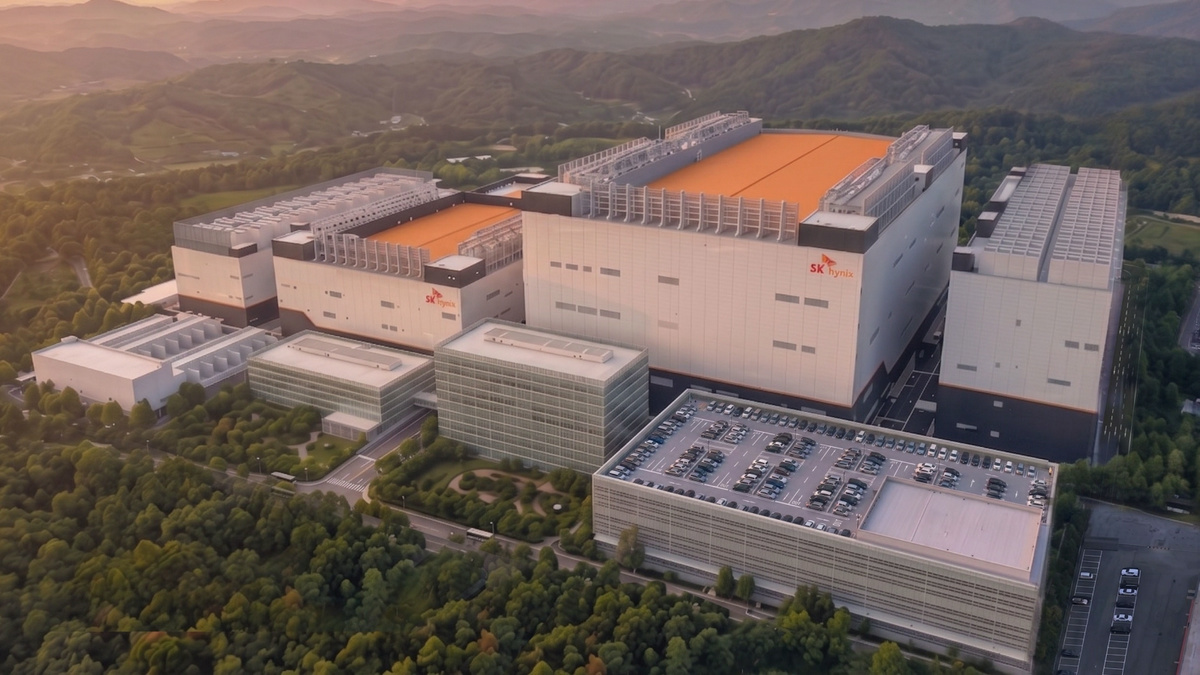
Furthermore, Cheongju already has NAND flash memory manufacturing plants 'M11,' 'M12,' and 'M15,' enabling efficient production in conjunction with existing operations. The existing infrastructure, including electricity and water, is also well-developed, making it the location for the shortest construction period for the new plant. The new 'M17' plant will be built on a total area of 206,000 pyeong (approximately 680,000 m² ), with construction scheduled to begin in February 2027 and the first cleanroom opening in December 2028. The investment period under the master plan extends until April 2031. Below is a rendering of the completed M17 plant released by SK Hynix.
Regarding this announcement, SK Hynix explained, 'In the age of AI, technological capabilities alone are insufficient. The ability to precisely supply the quantity that customers need, when they need it, is the ultimate competitive advantage. We made this investment decision after thoroughly analyzing market demand.'
A spokesperson for SK Hynix also stated, 'This investment aims to seize opportunities that come with market growth. By securing production infrastructure ahead of demand, we aim to become a leading AI infrastructure partner that contributes to a stable global AI semiconductor supply chain.'
Neil Shah, co-founder and vice president of research at market research service Counterpoint Research, said, 'While there will be no change in SK Hynix's production volume in the short term, this announcement is a plan looking beyond 2029. Looking at the broader market, expansion by multiple vendors such as Samsung, SK Hynix, Micron, and CXMT will significantly increase global supply until 2028. However, since demand is growing at an even faster pace than planned production capacity, it is unlikely that memory prices will soften until the end of 2028.'
Related Posts: