Is there a correlation between birth order and the risk of illness?

Even siblings born to the same parents and raised in the same household may not have the same physical constitution or health condition. A research team led by Benjamin Kramer of the University of Chicago investigated the relationship between birth order and disease diagnostic tendencies in over 10 million pairs of siblings included in U.S. commercial health insurance data.
Birth order and disease risk across the human phenome | Nature Health
Birth order may influence your disease risk later in life, study finds
https://medicalxpress.com/news/2026-08-birth-disease-life.html
To investigate the relationship between birth order and disease, it is necessary to isolate the influence of factors linked to birth order, such as parental age, family economic status, and changes in diagnostic criteria over time. For this reason, most previous studies have focused on one or a few diseases, and there have been very few cross-sectional comparisons of a wide range of diseases.
Therefore, the research team analyzed 5,135,006 pairs of siblings, totaling 10,270,012 individuals, based on medical insurance claims data from 2003 to 2024. They created 1,616,881 pairs of firstborns and secondborns from different families with similar genders and birth years for comparison, and also compared firstborns and secondborns from the same family to mitigate the influence of shared genetic factors and family environment among siblings.
The research team examined 569 types of diseases and found a statistically significant association with birth order in 150 of the 418 types for which there were sufficient cases. Of these, 79 diseases were more frequently diagnosed in firstborns and 71 diseases were more frequently diagnosed in secondborns, indicating that the associations were roughly split evenly.
The following graph summarizes the relationship between birth order and the diagnostic trends for each disease. The horizontal axis represents the prevalence of each disease, and the vertical axis represents the statistical value indicating whether the disease is more likely to be diagnosed in the first or second child. Diseases with a value below 0 on the vertical axis are more likely to be diagnosed in the first child, and diseases with a value above 0 are more likely to be diagnosed in the second child. The further away from 0, the greater the difference between the two. The color of the dots indicates the disease classification, and the size of the dots indicates the number of cases.
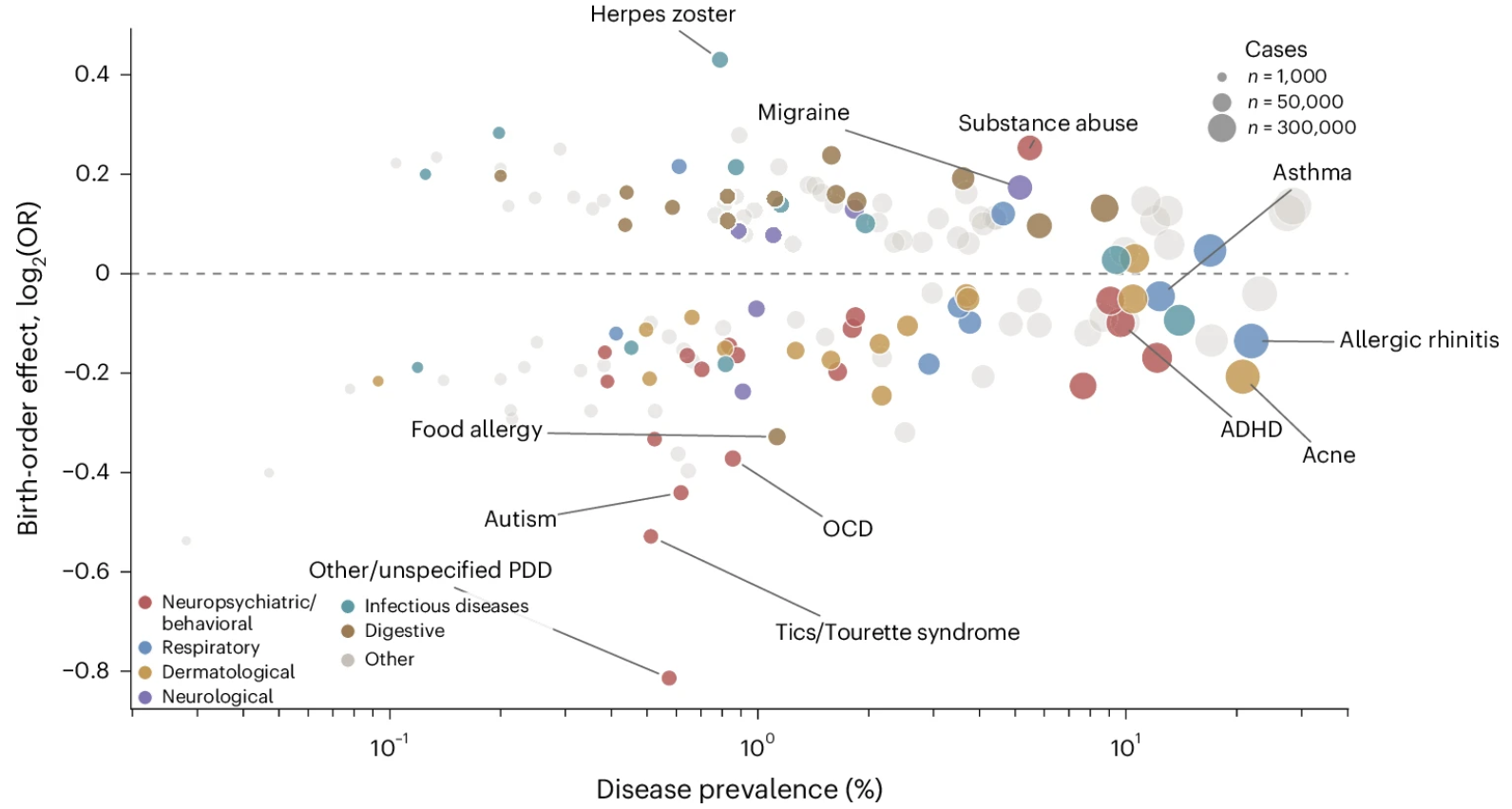
When the research team compared the likelihood of diagnosis between first and second children, they found that first children were approximately 43% more likely to be diagnosed with pervasive developmental disorder (PDD) of unknown origin, 26% more likely to be diagnosed with autism, 20% more likely to be diagnosed with food allergies, and 9% more likely to be diagnosed with allergic rhinitis compared to second children. On the other hand, second children were approximately 35% more likely to be diagnosed with shingles, 19% more likely to be diagnosed with substance abuse, 14% more likely to be diagnosed with gastritis/duodenitis, and 13% more likely to be diagnosed with migraines compared to first children.
Furthermore, in analyses comparing children from different families, 127 of the 150 diseases that showed a significant difference between first and second children also showed the same correlation in terms of diagnosis frequency between first and second children when comparing siblings from the same family.
The research team suggests that the reason why firstborns were more frequently diagnosed with allergy-related diseases is that secondborns are exposed to a wider variety of microorganisms brought into the home by older siblings from a young age, which may lead to the development of greater immune tolerance. Regarding the higher incidence of neurodevelopmental disorders such as PDD and autism in firstborns, they state that it is likely that a combination of factors, including biological differences related to the order of pregnancy, differences in parental observation, timing of diagnosis, and factors that could not be eliminated in the analysis, cannot be explained by a single mechanism.
However, it's important to note that the insurance claim data used in this study only captures diagnostic records of illnesses diagnosed at medical institutions and leading to insurance claims, and does not represent the actual incidence rate. Since factors such as healthcare-seeking behavior, timing of diagnosis, and parental age cannot be completely eliminated, this study does not demonstrate that birth order causes illness. Furthermore, the study was limited to families with two siblings who were enrolled in commercial health insurance, and the same trends may not apply to families with more siblings, uninsured individuals, or those enrolled in public health insurance.
According to the research team, the association between birth order and disease diagnosis tendency was small overall, with a median difference of around 10% between the likelihood of diagnosis for firstborns and secondborns. The research team states that birth order may be a 'slightly useful risk indicator' across multiple disease areas.
Related Posts:








in Science, Posted by log1b_ok