A common acne medication may reduce risk of schizophrenia

The antibiotic
Doxycycline Use in Adolescent Psychiatric Patients and Risk of Schizophrenia: An Emulated Target Trial | American Journal of Psychiatry
https://psychiatryonline.org/doi/10.1176/appi.ajp.20240958
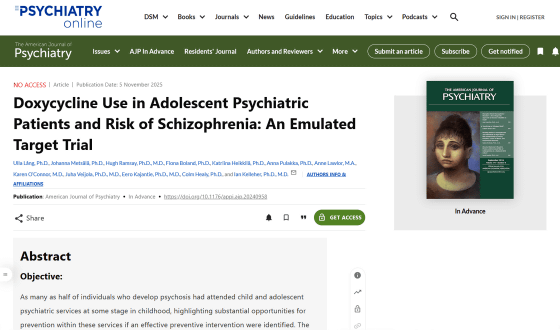
Common acne medication linked to reduced schizophrenia risk
https://www.psypost.org/common-acne-medication-linked-to-reduced-schizophrenia-risk/
Schizophrenia is one of the most devastating mental illnesses, significantly affecting not only an individual's physical health but also their social, educational, and professional lives. Although the biological mechanisms underlying schizophrenia are not fully understood, inflammation and synaptic abnormalities are the leading theories.
A process known as synaptic pruning , which strengthens only essential synaptic connections and removes unnecessary ones, is thought to play a central role in the development of schizophrenia. It is thought that in schizophrenia, this synaptic pruning process becomes excessive, resulting in the removal of essential synaptic connections.
Vibramycin, a widely used acne treatment, is known to be easily transported into the brain and has demonstrated neuroprotective effects in experimental models of neurological diseases. Previous studies have suggested that vibramycin may inhibit immune cells that cause excessive synaptic pruning.
To investigate whether Vibramycin could reduce the risk of schizophrenia in humans, Ian Kelleher of the University of Edinburgh and colleagues at the Finnish Institute for Health and Welfare used a vast dataset from the Finnish Health Register to study all individuals born in Finland between 1987 and 1997 who received adolescent psychiatric care between the ages of 13 and 18.

The study focused on young people who had been prescribed antibiotics and compared those prescribed Vibramycin with those prescribed other types of antibiotics. This comparison allowed researchers to consider the impact of the infection itself on mental health. A total of 56,395 participants were included, with approximately 29% of the participants prescribed Vibramycin.
The researchers followed these people until they reached age 30, died, or emigrated. The main item of interest was records of schizophrenia diagnoses, and the statistical model was adjusted to account for variables such as gender, year of birth, and parental education level.
The analysis showed that the estimated risk of developing schizophrenia within 10 years was approximately 2.1% in the group prescribed antibiotics other than vibramycin, while the estimated risk was only approximately 1.4% in the group prescribed vibramycin, meaning that the relative risk of schizophrenia was 33% lower in the group prescribed vibramycin.
Furthermore, it has been reported that the preventive effect of vibramycin on schizophrenia is not dependent on the cumulative dose of the drug, and that even those who received a relatively low cumulative dose benefited from risk reduction. Calculations of the 'number needed to treat' to prevent one case of schizophrenia estimated that one case of schizophrenia could be prevented for every 132-160 adolescents treated with vibramycin. Furthermore, in patients who had been hospitalized in a psychiatric hospital as teenagers, the use of vibramycin was shown to reduce the risk of schizophrenia by 40-50% compared to other antibiotics.

Commenting on the study, Dr Kelleher said: 'Nearly half of people who develop schizophrenia have previously been treated by child and adolescent mental health services for another psychiatric disorder. However, there are currently no established interventions to reduce the risk of schizophrenia in this young population, so this finding is groundbreaking.'
However, because this study was observational, it does not prove a causal relationship between Vibramycin and a reduced risk of schizophrenia. Furthermore, the group prescribed Vibramycin was older on average than the control group, and there were more women. Some researchers have also raised doubts about whether factors other than Vibramycin may have affected the risk of schizophrenia.
Dr. Kelleher also noted limitations regarding causality, saying, 'Because this is an observational study and not a randomized controlled trial, we cannot draw firm conclusions about causality. However, these results have important implications for further investigation of the protective effects of vibramycin and other anti-inflammatory treatments in adolescent psychiatric patients, and their potential to reduce the risk of developing serious psychiatric disorders in adulthood.'
Related Posts:








in Science, Posted by log1h_ik