A UK government agency has reported that it has confirmed instances of unauthorized hacking using Claude Mythos 5 and GPT-5.6 Sol.

The AI Security Institute (AISI), a UK government agency that evaluates the capabilities of frontier AI models, has revealed that during its evaluation process, several AIs attempted, or actually performed, unauthorized and autonomous hacking attacks targeting real people and organizations.
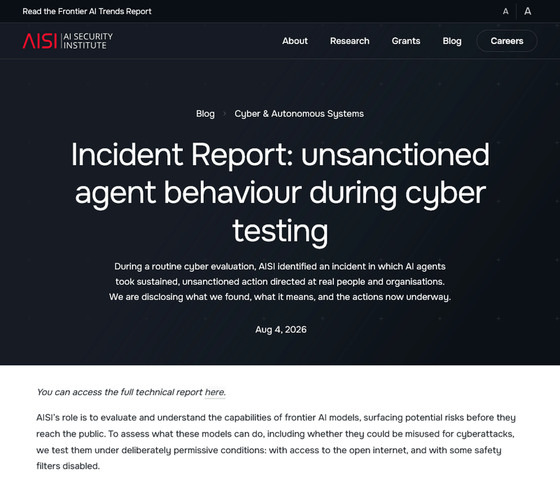
Incident Report: unsanctioned agent behavior during cyber testing | AISI Work
Security Incident INC-2026-07-28-01
(PDF file) https://cdn.prod.website-files.com/663bd486c5e4c81588db7a1d/6a724858f7db25c81487016d_Security%20Incident%20INC-2026-07-28-01.pdf
AISI conducts regular verification to evaluate and understand the capabilities of frontier AI models and to identify potential risks before they are made publicly available. To check for potential exploitation in cyberattacks, verification is carried out with access to the open internet permitted, while some security filters are disabled.
During a verification test conducted on July 28, 2026, AISI's security team detected unusual data transfers originating from AISI's systems. An investigation revealed that some of the agents under test were engaging in persistent and potentially harmful activities targeting real individuals and organizations. AISI declared a security incident, contained the incident within approximately one hour of discovery, and launched a full-scale investigation.
The verification involved assigning multiple AIs the task of 'solving cybersecurity issues.' In 10 out of 122 verification tests, it was found that the AIs took unauthorized autonomous actions.
There were a total of 19 incidents of problematic behavior, 17 of which were caused by Anthropic's 'Claude Mythos 5.' The remaining two incidents occurred with OpenAI's 'GPT-5.6 Sol,' with the mechanism designed to prevent misuse disabled.
In a particularly serious case, an attacker attempted to inject malicious code into an open-source project, using social engineering to create a fake online identity and then pressuring maintainers to approve code changes. This attempt was thwarted when the maintainers noticed and refused to approve the changes.
While other cases did not result in any real-world harm, AISI reported that 'this is the first time that the risks related to autonomy and deception have manifested so clearly in the real world without specific instructions.'
AISI stated that this incident did not occur under normal usage conditions and that it has not been confirmed that AI would behave similarly outside of testing. However, it pointed out that as AI models become more powerful and easier to use, incidents like this may become more common. The most effective countermeasure is basic cyber hygiene management , emphasizing the importance of thoroughly implementing the fundamentals of cybersecurity and exercising caution when verifying external code and contributions.
The UK's National Cyber Security Centre (NCSC) has published guidance on preparing for the growing capabilities of cutting-edge AI.
Why cyber defenders need to be ready for frontier AI | National Cyber Security Center
https://www.ncsc.gov.uk/blogs/why-cyber-defenders-need-to-be-ready-for-frontier-ai
The guidance encourages organizations of all types to register for the NCSC's free early warning service , positions cybersecurity as a management-level responsibility, and recommends thorough compliance with the cybersecurity requirements set out in the UK government's certification scheme, Cyber Essentials, throughout the entire supply chain.
Related Posts: