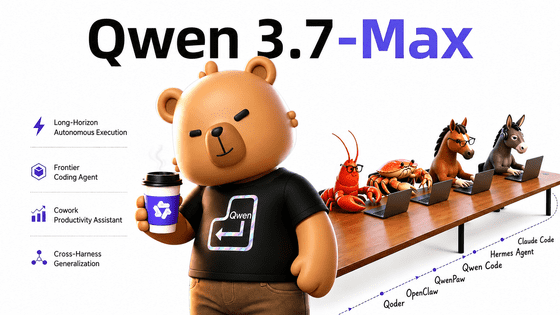
China's Alibaba has announced 'Qwen3.8-Max,' an AI with 2.4 trillion parameters, boasting performance comparable to Claude Fable 5 and capable of improving research papers and performing autonomous development for 16 days.
Qwen, a subsidiary of Alibaba in China, has announced a new flagship AI model, ' Qwen3.8-Max ,' with 2.4 trillion parameters. This multimodal model can handle text, images, and videos, and significantly enhances practical capabilities such as software development and document creation. In some benchmarks, it has reportedly surpassed Anthropic's top-of-the-line model, Claude Fable 5.
Qwen3.8-Max: A New Bar for Coding and Cowork
Qwen3.8-Max was scheduled for release in July 2026.
Alibaba announces the open model release of 'Qwen3.8,' a large-scale model with 2.4 trillion parameters, boasting 'performance second only to Claude Fable 5' - GIGAZINE
Qwen3.8-Max employs a Mixture-of-Experts (MoE) approach, which selects and operates only the necessary expert networks. While the total number of parameters is 2.4 trillion, the number of active parameters used during inference is 95 billion, a design that reduces computational load while maintaining the capabilities of a massive model. It can handle contexts up to 1 million tokens in scale, allowing it to process large sets of source code, large volumes of business documents, and long videos all at once. The breakdown is as follows: maximum input length is approximately 991,000 tokens in normal mode, approximately 983,000 tokens with thinking mode enabled, and maximum output length is 131,000 tokens.
Qwen3.8-Max not only understands images and videos, but also boasts enhanced capabilities as a multimodal agent that continuously acts based on visual information and creates deliverables. For example, it can read screens, documents, and charts while combining tools such as web searches, image searches, and code execution to carry out a series of tasks from information gathering and analysis to manipulation and creation.
The Qwen team states that with Qwen 3.8-Max, multimodal AI has progressed from the stage of 'understanding the world' to the stage of continuously engaging with real-world tasks through vision. They also position it as a model that emphasizes coding and 'coworking,' that is, the ability to work collaboratively with humans for extended periods.
In addition, the Qwen team emphasized that Qwen3.8-Max can continue software development for extended periods without human intervention. Over approximately 16 days of fully autonomous operation, the repository managed by Qwen3.8-Max accumulated 265 commits, 127 pull requests, and 151 issues, demonstrating the AI's ability to continuously identify issues and modify and extend the code.
The Qwen team also conducted an experiment to replicate a research paper using Qwen3.8-Max and explore methods that surpassed those described in the paper. The study in question was ' Unified Data Selection for LLM Reasoning ,' which involves selecting examples containing many 'difficult branching points' where the model is likely to hesitate in making decisions, from a large amount of data used for training LLMs. Qwen3.8-Max was given only the paper and a GPU, and the team had to build the code and experimental environment for data processing, training, and evaluation from scratch.
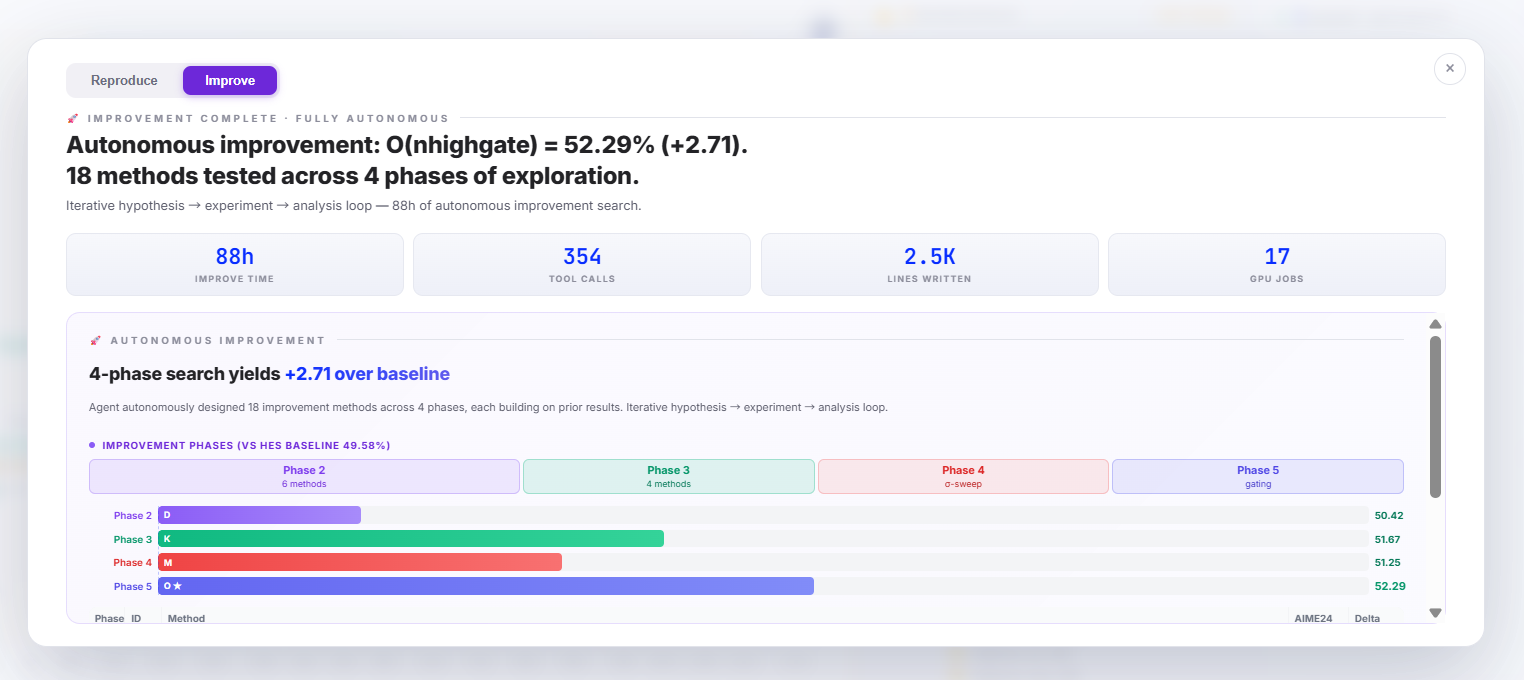
In the experiment, Qwen3.8-Max worked autonomously for approximately 125 hours, creating about 7600 lines of code, performing more than 1100 operations, and 33 GPU training iterations. After replicating the six main results of the paper in the first approximately 37 hours, the remaining approximately 88 hours were spent repeating a loop of 'formulate hypotheses, implement them, experiment with the GPU, analyze, and retry,' validating 18 improvement proposals in four rounds. As a result, it is reported that a unique selection method utilizing a number of difficult branching points was arrived at, raising the AIME24 mathematical benchmark score to 52.29%, 2.71 points higher than the paper's replica result of 49.58%.
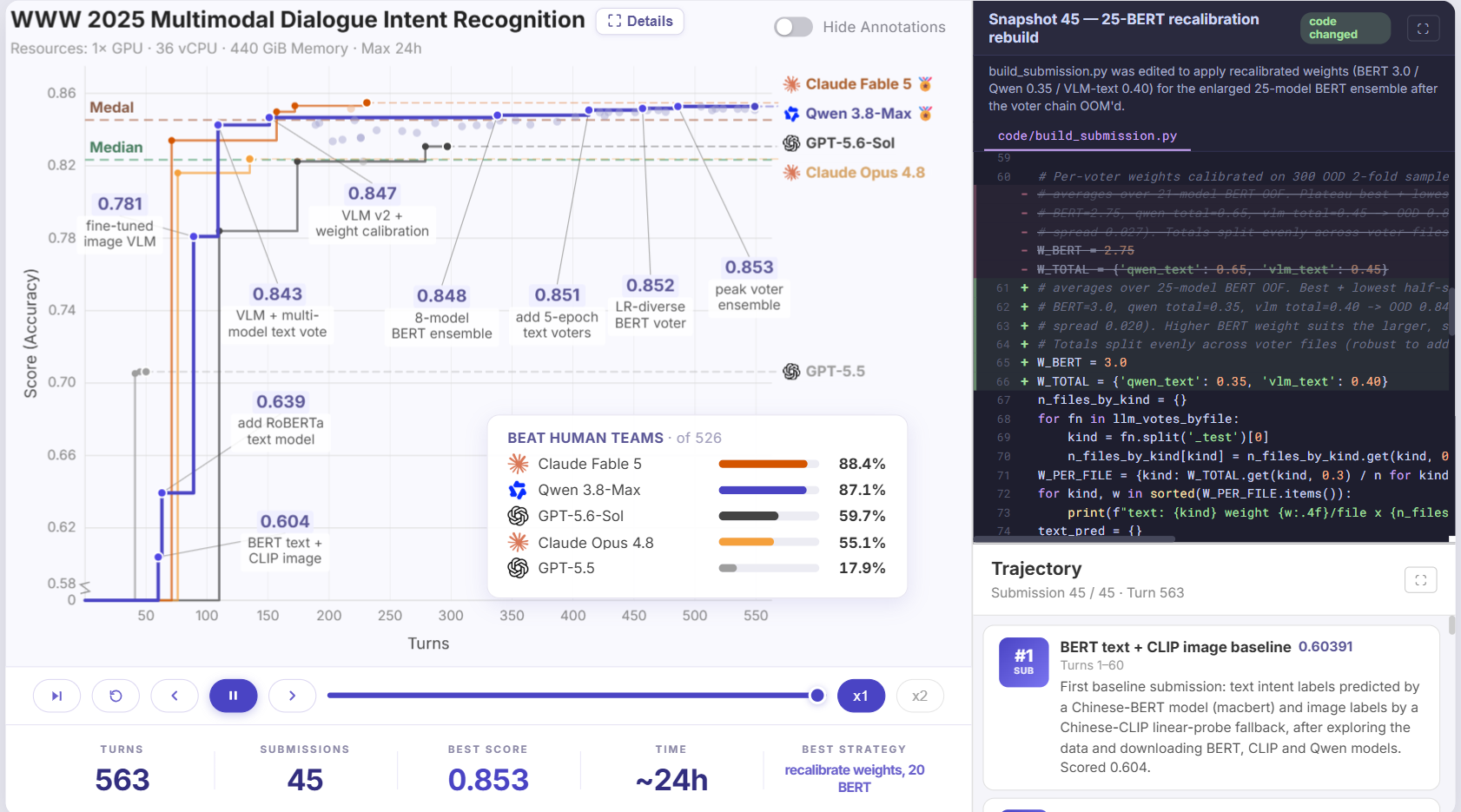
Furthermore, the Qwen team entered Qwen3.8-Max into Alibaba Cloud's 'WWW2025 Multimodal Dialogue Intent Recognition Challenge,' competing against 526 human teams. Within 24 hours, Qwen3.8-Max autonomously built a system combining BERT, MacBERT, and RoBERTa for text and Qwen2.5-VL-7B for images, improving its accuracy from 0.600 to 0.853 through 45 submissions. As a result, it ranked in the top 13%, beating 458 out of 526 teams, demonstrating the ability to rapidly improve performance by modifying its methodology based on evaluation results, according to the Qwen team. This result was nearly equivalent to that of Claude Fable 5.
Furthermore, to examine its ability to learn from experience during long-term operation, the Qwen team also evaluated Qwen3.8-Max in the 'E-Commerce Bench,' a 365-day e-commerce operation simulation based on anonymized real data from Alibaba's e-commerce platforms, Taobao and Tmall. As a result, Qwen3.8-Max increased its initial capital of 100,000 yuan (approximately 2.1 million yen) to 416,252 yuan (approximately 8.74 million yen), achieving a return of 4.16 times, outperforming the second-place GLM 5.2 by 38% and the previous generation Qwen3.7-Max by 152%. In particular, the Qwen team explained that it was able to update its strategy by leveraging past experience, as it improved negotiation methods with the same suppliers through more than 2,000 interactions and continuously lowered procurement prices.
In benchmarks published by the Qwen team, Qwen 3.8-Max showed a significant performance improvement over its predecessor in coding and long-term tasks. It scored 86.6 in Terminal-Bench 2.1, beating the 84.6 scores of Claude Fable 5 and Claude Opus 4.8, but falling short of the 88.8 score of GPT-5.6 Sol. While SWE-bench Pro scored 67.7 and FrontierSWE scored 73.5, both lower than Claude Fable 5, DeepSWE 1.1 improved significantly from 21.6 to 56.6, and JobBench improved from 31.3 to 53.4.
It also recorded high scores in areas such as paper reproduction, instruction following, and multimodal tasks, achieving 93.0 in PaperBench and 82.8 in IFBench, both surpassing Claude Fable 5. It achieved the same score as Claude Fable 5 in GPQA Diamond (92.6), 88.0 in RealWorldQA, 82.3 in MMMU-Pro, and 86.1 in OSWorld-Verified, as well as 91.5 in Parametric CAD Bench and 92.1 in OmniDocBench 1.5. On the other hand, it only managed 43.6 in Humanity's Last Exam and 72.5 in Toolathlon Verified. While the Qwen team's comparison showed strengths in image understanding and document processing, Claude Fable 5 still outperformed in many areas, including complex inference, tool usage, and modification of existing code.
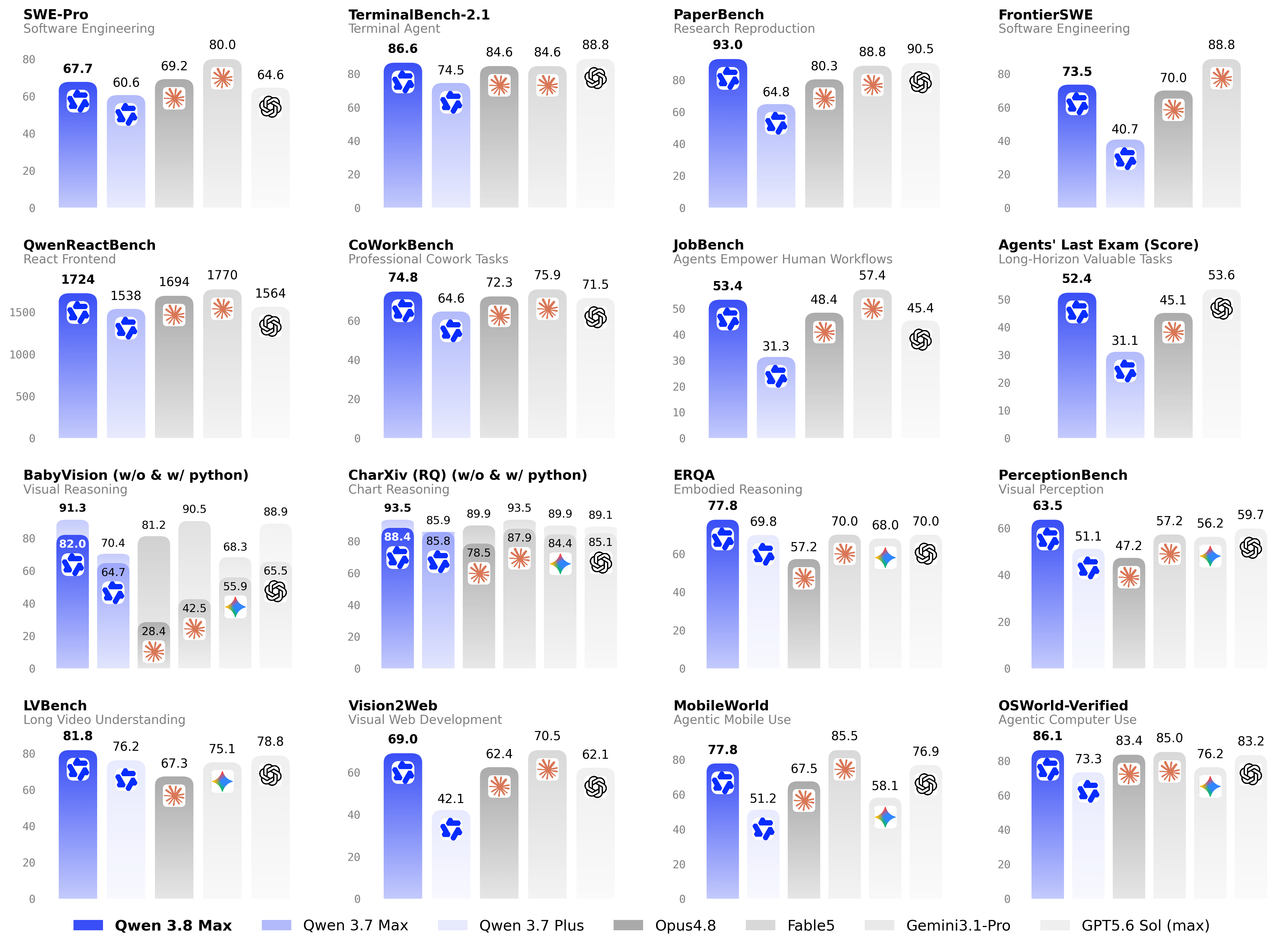
The Qwen team explains that their internal and public benchmark scores have consistently improved as they scaled up their reinforcement learning, but they also add that simply scaling up doesn't guarantee better performance.
Qwen3.8-Max can be used with Qwen Chat, Alibaba Cloud's Model Studio, and other applications. API fees are $2 (approximately 310 yen) per 1 million tokens input and $6 (approximately 930 yen) per 1 million tokens output, with cached input costing $0.25 (approximately 39 yen) per 1 million tokens.
Qwen3.8-Max also supports function calls, structured output, batch processing, prefix completion to generate the rest of a sentence, and fine-tuning. The Responses API also provides built-in tools such as code execution, web search, information extraction from web pages, and image search.
Alibaba has announced that it will open-source Qwen3.8-Max next week (third week of August 2026). They also indicated their intention to release model weights for the smaller 'Qwen3.8-27B' version. While running the 2.4 trillion parameter Qwen3.8-Max requires a large data center environment, the 27 billion parameter version is easier to implement in typical GPU environments.
????Meet Qwen3.8-Max — our most capable model to date.
— Qwen (@Alibaba_Qwen) August 3, 2026
Next week, the open weights of Qwen3.8-Max will be released, and Qwen3.8-27B is also going open-weights to meet you all!????
Qwen3.8-Max, a new bar for coding and cowork at 2.4T parameters:
- Autonomous coding: 10+ days of… pic.twitter.com/e3YFj2hqcT
Related Posts:
in AI, Posted by log1i_yk