What was 'Operation Sandblast,' the first time a submarine successfully circumnavigated the globe?
In 1960, the U.S. Navy nuclear submarine
60 Years Ago, a Sub Circled the Globe | Operation Sandblast
https://www.popularmechanics.com/military/weapons/a32009109/operation-sandblast-sumbarine-circumnavigation/
According to Popular Mechanics, submarines spent more time above the surface than below for decades. From early submarines to those built shortly after the war, they primarily used diesel engines that ran on air, requiring air to power the engines. Therefore, the basic operation involved navigating on the surface with diesel engines to locate targets, then submerging and using batteries to launch torpedo attacks.
A typical submarine had limited underwater speed, traveling at approximately 20 knots (about 37 km/h) above sea level and about 10 knots (about 18.5 km/h) while submerged.
The introduction of nuclear power to submarines dramatically changed this situation. Nuclear-powered submarines, which utilize nuclear reactors, do not require atmospheric oxygen like diesel engines, allowing them to remain submerged for extended periods. As a result, the shape of submarines changed from the squat U-boat design to a sleek hull that greatly improved hydrodynamic efficiency. The combination of a more efficient hull and nuclear power resulted in submarines that were quieter and faster than conventional submarines, capable of navigating underwater at approximately three times the speed of older vessels.
Operation Sandblast was an operation carried out by the U.S. Navy to demonstrate the superiority of nuclear power. The nuclear-powered radar picket submarine USS Triton, commissioned in 1959, was one of the largest submarines of its time, measuring 447 feet (approximately 136 meters) in length. At the same time, it was designed to sail to remote areas close to the Soviet Union and use radar to detect signs of a nuclear attack, and the Triton was also the fastest submarine built at the time.

The USS Triton departed New London, Connecticut, on February 16, 1960, following a route modeled after the circumnavigation of the globe by Portuguese explorer Ferdinand Magellan . In 60 days, the Triton covered approximately 26,723 nautical miles (approximately 49,490 km), equivalent to a full circumnavigation of the globe, and returned to New London on April 25. In total, over the 85 days from departure to return, it covered approximately 36,000 nautical miles (approximately 66,670 km).
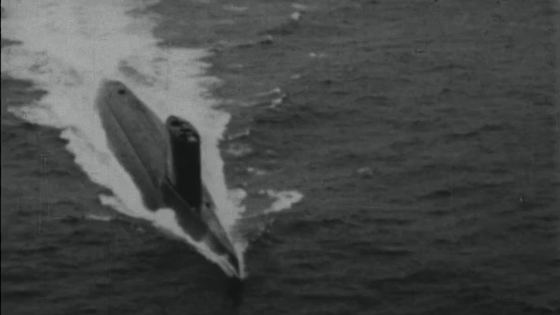
The Sandblast operation was not merely a range test; it also involved releasing observation bottles into the ocean during the voyage to study ocean currents, as well as using acoustic depth sounders and sonar to survey the seabed topography.
The significance of Operation Sandblast lies in its demonstration that submarines can transform from 'ships that only submerge when necessary' to 'ships that can operate underwater for extended periods.' Nuclear power enabled long-term submersion, and combined with hull designs optimized for underwater navigation, submarines gained entirely new operational capabilities.
The USS Triton had a short service life of only 11 years from launch to decommissioning, being retired in 1968. The Triton's bridge section has been preserved and is on display in Benton, Washington.
Related Posts:
in Note, Posted by log1e_dh