A study has revealed that radioactive material leaked from a Soviet nuclear submarine that sank at the end of the Cold War.
In 1989, at the end of the Cold War, the Soviet nuclear submarine
Status of the sunken nuclear submarine Komsomolets in the Norwegian Sea | PNAS
https://www.pnas.org/doi/10.1073/pnas.2520144123
Sunken Soviet Submarine Is Leaking Radioactive Material in The Ocean : ScienceAlert
https://www.sciencealert.com/sunken-soviet-submarine-is-leaking-radioactive-material-in-the-ocean
The Komsomolets was a Soviet-developed attack nuclear submarine. Its hull was approximately 118 meters long and 11 meters wide. In addition to its nuclear reactor, it carried two nuclear torpedoes containing a total of 12 kg of plutonium in their warheads.
In 1989, a fire broke out on board the Komsomolets while it was conducting exercises off the coast of the Norwegian Sea. The ship suddenly surfaced, its electrical system short-circuited, and its reactor shut down. Ultimately, the Komsomolets sank, resulting in the tragic deaths of 42 of its 64 crew members.
Ultimately, the Komsomolets sank to a depth of 1,680 meters off the coast of the Norwegian Sea. Early investigations confirmed that cracks had formed in the Komsomolets' hull and that seawater had come into contact with the nuclear torpedoes. From 1994, a large-scale operation was carried out to seal the damaged torpedo bay, and in 1996, it was declared that the sealing had been successful.
In 2019, a research team from the Norwegian Institute of Marine Science conducted an exploration of the Komsomolets using a remotely operated vehicle (ROV), collecting samples of water, sediment, and organisms around the hull. The 2019 exploration and parts of the sunken Komsomolets can be seen in the following video.
Vannprøver fra den sovjetiske atomubåten 'Komsomolets' - YouTube
In this study, Justin Gwin, a marine radiation ecologist affiliated withthe Norwegian Radiation and Nuclear Safety Authority , and his colleagues compiled the results of their analysis of data collected in 2019.
Even in 2019, there were reports of radioactive material leaks from the Komsomolets. The results of this data analysis have confirmed that the leaks of radioactive material are occurring intermittently from parts of the ship's hull, such as ventilation pipes and the area around the reactor room.
Radioactive isotopes and elements such as strontium , cesium , uranium , and plutonium were detected in samples of the plume of smoke emitted from the ship's hull.
The concentrations of strontium and cesium detected near the hull were reported to be 400,000 times higher for strontium and 800,000 times higher for cesium compared to typical concentrations of these radioactive isotopes in the Norwegian Sea. Furthermore, the increased concentrations and ratios of uranium and plutonium indicated that the nuclear fuel inside the reactor was actively corroding.
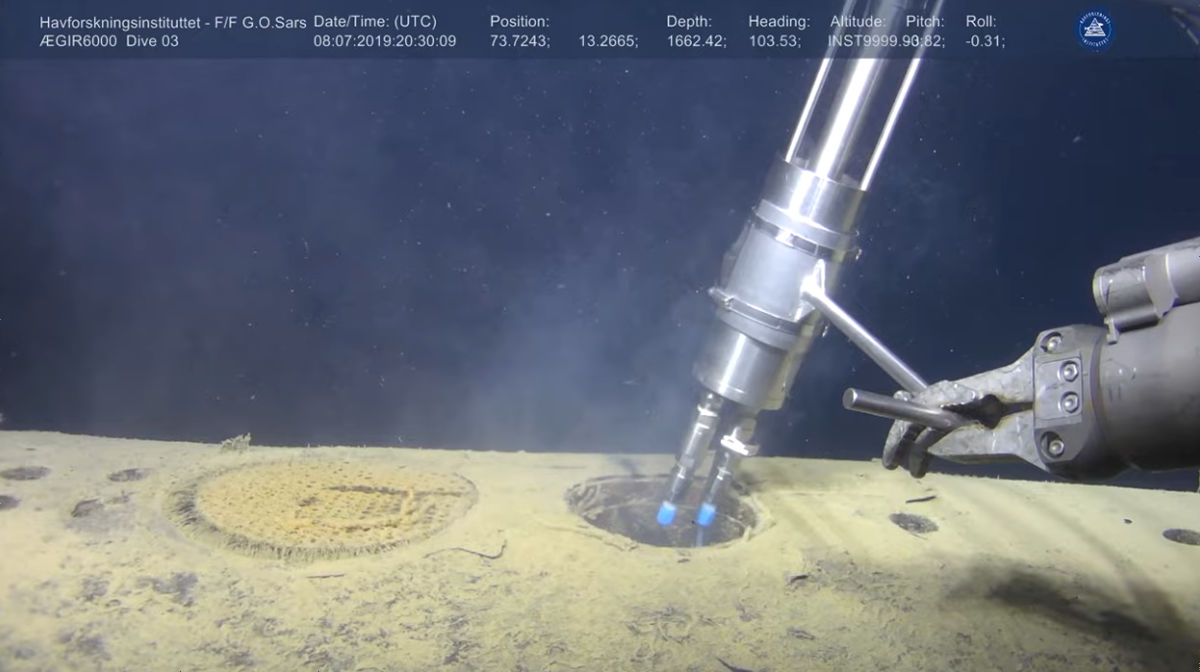
However, the radioactive contamination decreased sharply at a distance of just a few meters from the hull, suggesting that these radioactive isotopes and elements were rapidly dispersing. Cesium concentrations in samples of sponges, corals, and anemones living around the hull also increased, but there were no obvious signs of deformation or other damage.
While it is encouraging that the previously repaired areas are still holding up and radioactive contamination has been kept to a minimum, the hull will lose stability over time, potentially leading to further problems in the future. The research team argued that 'further investigations should be conducted to clarify the observed release mechanism, the corrosion processes occurring within the reactor, and their impact on future releases and the fate of remaining nuclear material within the reactor.'
Related Posts:





in Free Member, Video, Science, Vehicle, Posted by log1h_ik