The film industry has pointed out that 'Operation Offside,' which cracked down on illegal streaming of the World Cup, was successful but highlighted the limitations of domain seizures.

During
Blowing the Whistle on World Cup Piracy | RealClearMarkets
https://www.realclearmarkets.com/articles/2026/07/31/blowing_the_whistle_on_world_cup_piracy_1197454.html
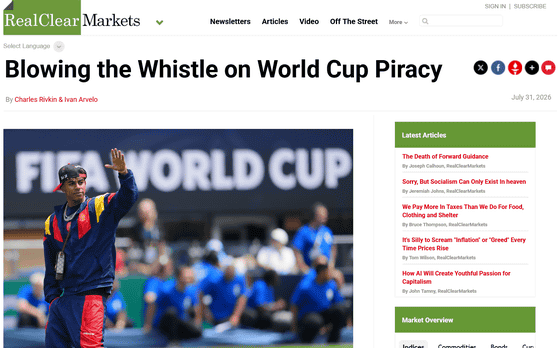
World Cup Piracy Crackdown Shows Limits of Domain Seizures, MPA Pushes Site Blocking * TorrentFreak
https://torrentfreak.com/world-cup-piracy-crackdown-shows-limits-of-domain-seizures-mpa-pushes-site-blocking/
Office of Public Affairs | United States Seizes More than 1,000 Internet Domains Used to Illegal Stream World Cup 2026 Matches | United States Department of Justice
https://www.justice.gov/opa/pr/united-states-seizes-more-1000-internet-domains-used-illegally-stream-world-cup-2026-matches
Operation Offside was a crackdown led by the U.S. Department of Justice, the Agency for Homeland Security Investigations (HSI), and the National Center for the Coordination of Intellectual Property Rights (NIPRCC), with cooperation from the MPA's anti-piracy organization, the Alliance for Creativity and Entertainment (ACE) , and rights holder organizations such as FIFA. Operation Offside focused on protecting intellectual property rights by identifying websites that were distributing content without permission and seizing their domains. A press release issued by the U.S. Department of Justice on June 26, 2026, announced the seizure of approximately 400 domains that were illegally streaming matches of the FIFA World Cup 2026.
400 domains used for illegal streaming of World Cup-related content seized - GIGAZINE

Ultimately, authorities announced that they seized more than 1,000 domains that were illegally plagiarizing and sharing FIFA World Cup 2026 matches from the start of the tournament to the final, and blocked nearly 2,000 more domains across Latin America. Some of these sites were massive, recording more than 156 million visits in July alone, before being seized. Charles Rivkin, Chairman and CEO of the MPA and Chairman of the ACE, and Ivan Albero, Director of the NIPRCC, said in a statement, 'We worked together to take swift and decisive action to ensure that fans could watch the matches safely. We achieved many victories.'
On the other hand, both men stated, 'If there's one lesson we've learned from Operation Offside, it's that the fight against piracy is never over.' They pointed out that not only the World Cup but all live events are breeding grounds for piracy, and that illegal viewing of sports causes the global sports industry to lose $28.3 billion (approximately 4 trillion yen) annually. They added that while shutting down sites can temporarily block access, it doesn't eradicate the business behind it, and that a more fundamental solution is needed.
According to Rivkin and Albero, in addition to strengthened enforcement through public-private partnerships like those implemented in Operation Offside, wise policies are also needed. They argue that since operators can resume operations by migrating to a different domain even if their domain is seized, a system is needed to block sites at the ISP level based on court orders or similar means, thereby suppressing access to illegal sites altogether.
According to TorrentFreak, immediately after more than 100 domain names were seized in Operation Offside, several major illegal sports streaming sites migrated to Iran's country code domain '.ir'. Certificate logs suggest that the '.ir' domains for pirated content sites had been acquired several years prior, but it is believed that they were used as a countermeasure against Operation Offside because '.ir' domains are difficult for US authorities to seize.

In over 50 countries and regions, including the UK, France, Italy, and Canada, systems are in place that allow ISPs to block access to pirated websites based on court orders, but the United States lacks a comprehensive site blocking system. The MPA and ACE continue to track the destinations of domains, but they reiterate that domain seizure alone has its limitations because operators can easily move to new domains.
Canada issues a site blocking order that even targets 'future piracy sites,' allowing for blocking without legal action even if circumvention is attempted through domain name changes - GIGAZINE
Speaking to TorrentFreak, Larissa Knapp, Executive Vice President and Chief Content Protection Officer at MPA, explained their efforts: 'Piracy operators frequently move domains and infrastructure to evade the crackdown. The move to '.ir' domains is one example of this tactic, but changing domains doesn't completely stop the crackdown. These services still rely on identifiable operators, hosting, distribution, payment systems, and other technical and commercial infrastructure. That's why ACE works closely with law enforcement agencies and industry partners around the world to identify the people and infrastructure supporting the operation of these criminal networks and to stop their activities.'
The MPA argues that combining domain seizures, criminal prosecutions, and site blocking can further reduce the use of illegal streaming sites. As of the time of writing, no unified site blocking bill has been introduced in the United States, but there are reports that some lawmakers are working on drafting such legislation, and future developments are being closely watched.
Related Posts:







in Web Service, Posted by log1e_dh