It has been revealed that Chinese military researchers were extracting AI models from OpenAI and Anthropic and using them in the development of domestic military systems.
A review of Chinese academic papers and patents has revealed that Chinese military researchers are using the output of major American AI models developed by OpenAI and Anthropic to train domestic AI systems to improve China's defense capabilities. While the U.S. government has imposed sophisticated chip export restrictions on China and limits its access to other strategic technologies, Chinese AI researchers are believed to have been transferring the capabilities of high-performance American AI models to smaller, cheaper Chinese models using a technique called '
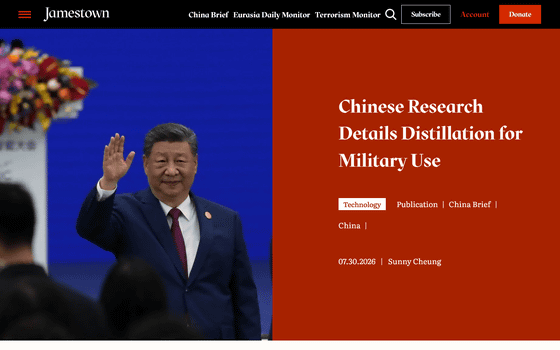
Chinese Research Details Distillation for Military Use - Jamestown
https://jamestown.org/chinese-research-details-distillation-for-military-use/
EXCLUSIVE: Chinese military researchers tap US AI models to train defense systems | Reuters
https://www.reuters.com/world/asia-pacific/chinese-military-researchers-tap-us-ai-models-train-defence-systems-2026-07-31/
Documents exclusively provided to the press by the Washington D.C.-based Jamestown Foundation show that researchers affiliated with the Chinese People's Liberation Army and other military organizations have been using the output of OpenAI and Anthropic AI models to develop and train AI models for use within China. The Jamestown Foundation stated, 'Distillation has become an essential element in the development of AI models in China. Chinese academic and industry papers published between 2024 and 2026 detail how distillation is carried out, including adversarial distillation, and reveal which organizations are involved in distillation in order to build capabilities that rival the world's best models.'
The distillation-based model developed in China is reportedly already in use or has been proposed for use in public security applications such as surveillance systems, as well as in military and cyber operations.
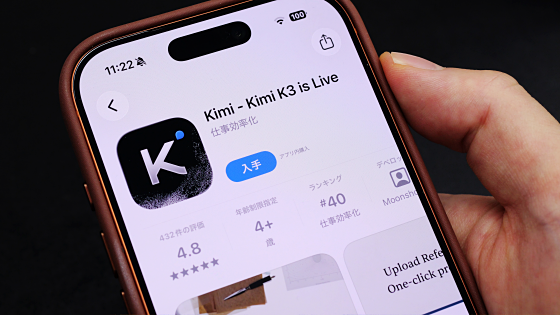
As a specific model where distillation was used, the Jamestown Foundation cites ' Kimi K3, ' released in July 2026 by the Chinese AI company Moonshot AI. Kimi K3 was said to have performance comparable to Anthropic's Claude Fable 5 and OpenAI's GPT-5.6 Sol, and it became so popular that new subscriptions had to be temporarily suspended . However, Michael Kratzios, director of the White House Office of Science and Technology Policy, announced that 'we have received information that Kimi K3 was distilled from Anthropic's Claude Fable.'
A White House official stated that the high-performance Chinese AI 'Kimi K3' was created by distilling Claude Fable - GIGAZINE
The 'distillation' technique allegedly used by Chinese researchers refers to a method of training smaller, less expensive 'student' models using the output of a large 'teacher' model. By using the answers and inference results generated by the teacher model as training data, it is possible to reproduce some of the capabilities of a high-performance AI with relatively few computing resources, thus significantly reducing development costs. However, OpenAI and Anthropic prohibit the unauthorized use of their closed AI models for distillation in their terms of service, and there is a possibility that American models are being used for distillation in China's military and public security sectors. Such misuse of distillation is called 'adversarial distillation.' There are also concerns that in adversarial distillation, the safety measures built into the original model may not be maintained.

According to the Jamestown Foundation, the academic and industrial papers they reviewed provide strong evidence that Chinese organizations are taking a problematic approach to distillation technology. Furthermore, because Chinese academic and military journals, like their Western counterparts, have an internal review and publication cycle of one to two years, the Jamestown Foundation states that the verifiable evidence of adversarial distillation was conducted on cutting-edge models from 2023-2024 and 'is just the tip of the iceberg, representing only past cases confirmed from published research, not ongoing situations.'
For example, a research team led by researchers from the Chinese Academy of Sciences conducted an experiment asking various Chinese models how they perceived themselves. The results of the experiment showed that Alibaba's 'Qwen-Max' identified itself as 'Claude, an AI assistant created by Anthropic,' and DeepSeek's 'DeepSeek-V3' responded that it was 'created by OpenAI.'
Furthermore, a case study identified by Reuters from data provided by the Jamestown Foundation states that researchers at the People's Liberation Army Unit 96941, a military intelligence and cyber warfare unit based in Beijing, used OpenAI's GPT-3.5 to process highly sensitive military source code in a published paper. According to the paper, because third-party models were unsuitable for handling classified information, the researchers used GPT-3.5 to summarize the software code and then trained a domestic model that worked perfectly within the Chinese military network based on that summary.
On the other hand, Chinese developers are refuting claims that their country's AI technology progresses because it relies on foreign models. Moonshot AI, the developer of Kimi K3, which was accused of 'distilling Anthropic's Claude Fable,' denied the allegations and claimed that it was developed using its own technology, not distillation.
Related Posts:





in AI, Posted by log1e_dh