Research suggests the brain can be rewired to achieve 'true multitasking.'
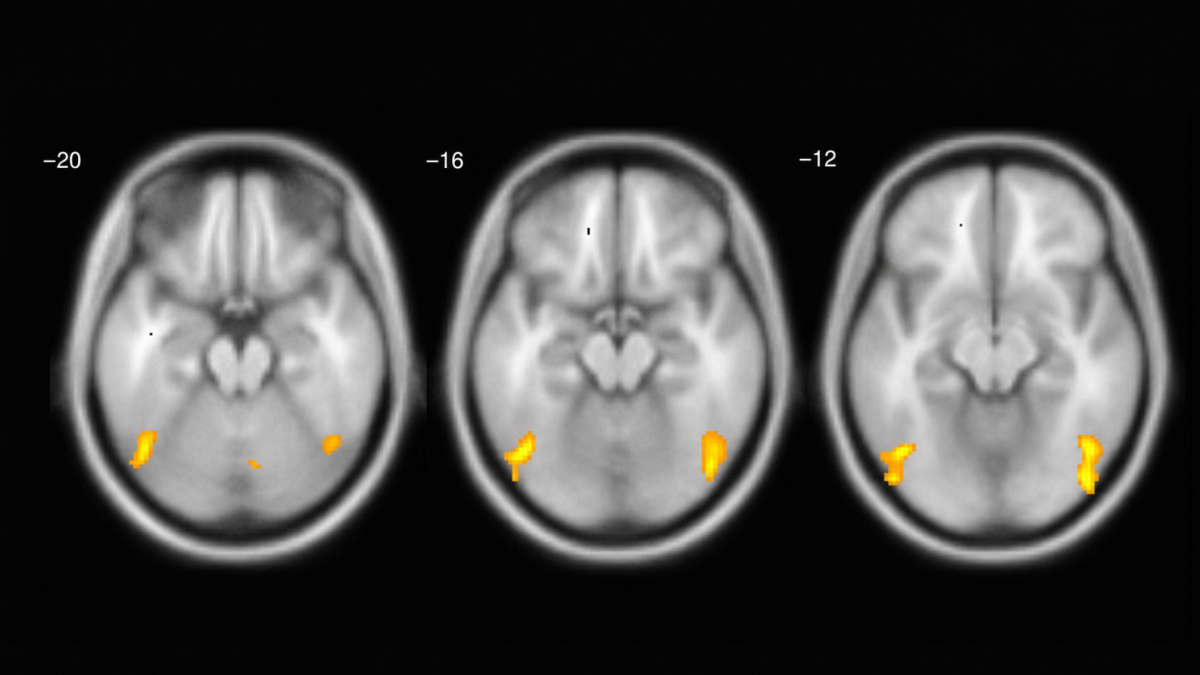
It has been thought that when the human brain works on two tasks requiring conscious judgment simultaneously, it doesn't multitask by processing multiple tasks at the same time, but rather by quickly switching between tasks. A research team led by Maximilian Riesenhuber of Georgetown University and Patrick Cox of Lehigh University investigated how brain processing pathways and the ability to work simultaneously change when a single task is practiced over a long period of time.
Extensive Experience Remodels Neural Task Circuitry to Escape the Frontal Bottleneck and Increase Automaticity of Categorization | Journal of Cognitive Neuroscience | MIT Press
Georgetown Researchers Show How Brain Rewires Itself To Enable True Multitasking | School of Medicine | Georgetown University
https://medicine.georgetown.edu/news-releases/georgetown-researchers-show-how-brain-rewires-itself-to-enable-true-multitasking/
Your Brain Can Rewire Itself to Allow True Multitasking : ScienceAlert
https://www.sciencealert.com/your-brain-really-can-learn-to-multitask-and-scientists-just-revealed-how
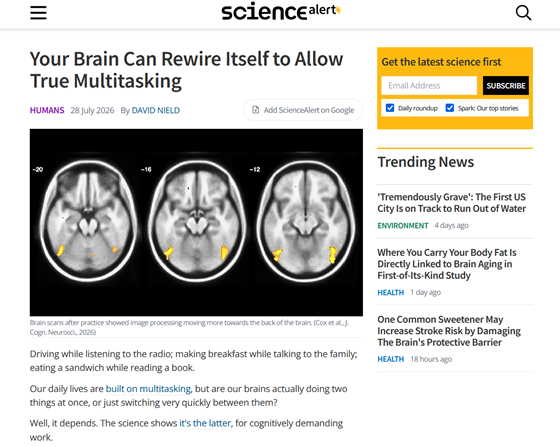
The prefrontal cortex is a highly flexible area responsible for situational judgment and thinking, but it can basically only process one judgment at a time. When working on two tasks that require conscious judgment simultaneously, it becomes necessary to switch processing from one task to the other. However, if the processing becomes automated through repeated practice of the same task, a circuit may be formed that directly connects perception to action without going through the prefrontal cortex, potentially allowing the prefrontal cortex to be used to process other tasks.
To investigate whether the judgments made by the prefrontal cortex could be processed by other brain regions through long-term training, the research team asked participants aged 18-29 to classify grayscale images created by mixing four cars with different shapes into two fictional categories: 'SOVOR' and 'ZUPUD.' In the early stages of this classification, which is not yet automated, a 'two-stage processing' process takes place: first, the visual areas from the occipital lobe to the temporal lobe perceive the shape of the car, and then the prefrontal cortex (pFC) determines which category it belongs to.
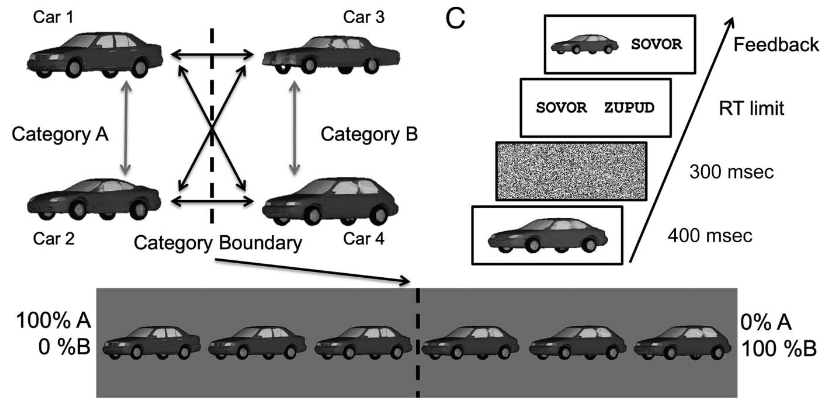
Participants used smartphone or PC apps to repeat this task more than 30,000 times over a period of 5 to 10 weeks. Eleven individuals who completed the training and met the criteria were then included in the analysis.
The research team showed participants two car images sequentially after the first approximately 6,000 trials and again after exceeding 30,000 trials, and asked them to indicate whether they belonged to the same category or different categories. During this task, the researchers measured the locations where processing occurred in the brain using functional magnetic resonance imaging (fMRI) and the timing of processing using electroencephalography (EEG). After adjusting the shape differences between the two images to a similar degree, they compared combinations of images belonging to the same category with combinations spanning different categories, distinguishing between responses to shape differences and responses to category differences.
As a result, in app-based training conducted in five rounds of at least 6,000 trials each, classification accuracy improved from the first to the second round before leveling off. On the other hand, response time continued to decrease until the fourth round, and no significant difference was observed between the fourth and fifth rounds. Furthermore, in a measurement task where users had to determine whether two images of cars belonged to the same or different categories, response time decreased without a decrease in accuracy after 30,000 trials, demonstrating behavioral changes that indicate progress in automated classification.
fMRI and EEG measurements showed that after the first approximately 6,000 trials, the ventroococtorial cortex (vOTC) responded to differences in the physical shape of the car on fMRI. The vOTC extends from the posterior part of the brain to the lower part of the temporal lobe and is a region involved in processing object identification from visual information. On EEG, signals for shape differences appeared in the occipital region, followed by signals for category discrimination in the frontal region. On the other hand, after 30,000 trials, the signal for category discrimination appeared in the occipital region approximately 190 milliseconds after the second image was displayed, and fMRI also confirmed category discrimination activity in both the left and right vOTCs. Furthermore, the category signal observed in the left frontal region after the first approximately 6,000 trials was significantly weakened after 30,000 trials.
In the image below, red indicates regions that responded to shape differences after the first approximately 6,000 trials, yellow indicates regions that responded to category differences after 30,000 trials, and green indicates regions where the response to categories became particularly strong after training. The areas enclosed in red circles are regions within the vOTC in the right hemisphere where training-induced changes were observed.
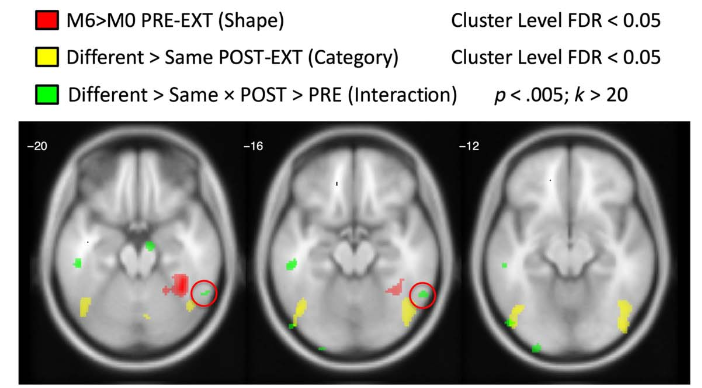
Since the area where increased responses to categories were observed through training was in the right hemisphere, the research team analyzed how the coordination of activity with other brain regions changed, using this area as a reference. As a result, the research team reported that after 30,000 trials, compared to the initial approximately 6,000 trials, the functional connections between the vOTC in the right hemisphere and the left prefrontal cortex weakened, while the connections with the left sensorimotor cortex and the left and right supplementary motor areas strengthened.
The research team interprets these results as meaning that with sufficient training, the center of classification decisions shifts from the prefrontal cortex to the vOTC, and the vOTC, in conjunction with areas involved in movement, is able to overcome the limitation that 'the prefrontal cortex can only process one decision at a time.'
To determine if this change is linked to the ability to multitask, participants were tasked with classifying cars in the center of the screen and identifying which side of a circle displayed around the perimeter of the screen was red and which was green.
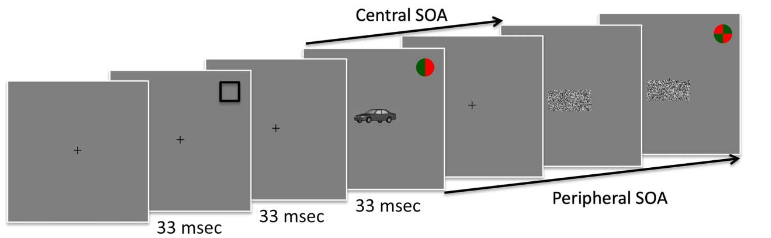
The results showed that, when comparing the performance of each task individually versus simultaneously, the decline in performance in vehicle classification due to simultaneous work was significantly smaller after 30,000 trials. On the other hand, there was no significant improvement in performance during simultaneous work for the circle identification task, which is not a target for long-term training.
Furthermore, participants with significantly weaker functional connections between the vOTC in the right hemisphere and the prefrontal cortex showed a greater improvement in their ability to perform two tasks simultaneously. The research team interpreted this as meaning that the well-practiced car classification task bypassed the prefrontal cortex, freeing up that space to use for circle identification.
While it's possible that the improved performance was due to the ability to efficiently switch between two tasks in the prefrontal cortex, the research team supports the interpretation that the classification process itself shifted from the prefrontal cortex to the vOTC, given that after training, the signals for distinguishing categories appeared earlier in the occipital lobe than in the frontal lobe, and fMRI showed changes in vOTC activity.
According to the research team, while automated processing is fast, it has the weakness of being less flexible in responding to changing situations than processing that uses the prefrontal cortex. Cox said, 'It's possible to chew gum while walking, but using a smartphone while driving is never safe because it takes your eyes off the road,' explaining that in order to balance the two tasks, the neural circuits responsible for each need to be sufficiently separated.
Related Posts:




in Science, Posted by log1b_ok