'analog.watch' is a free game where you try to read three analog clocks as quickly and accurately as possible.
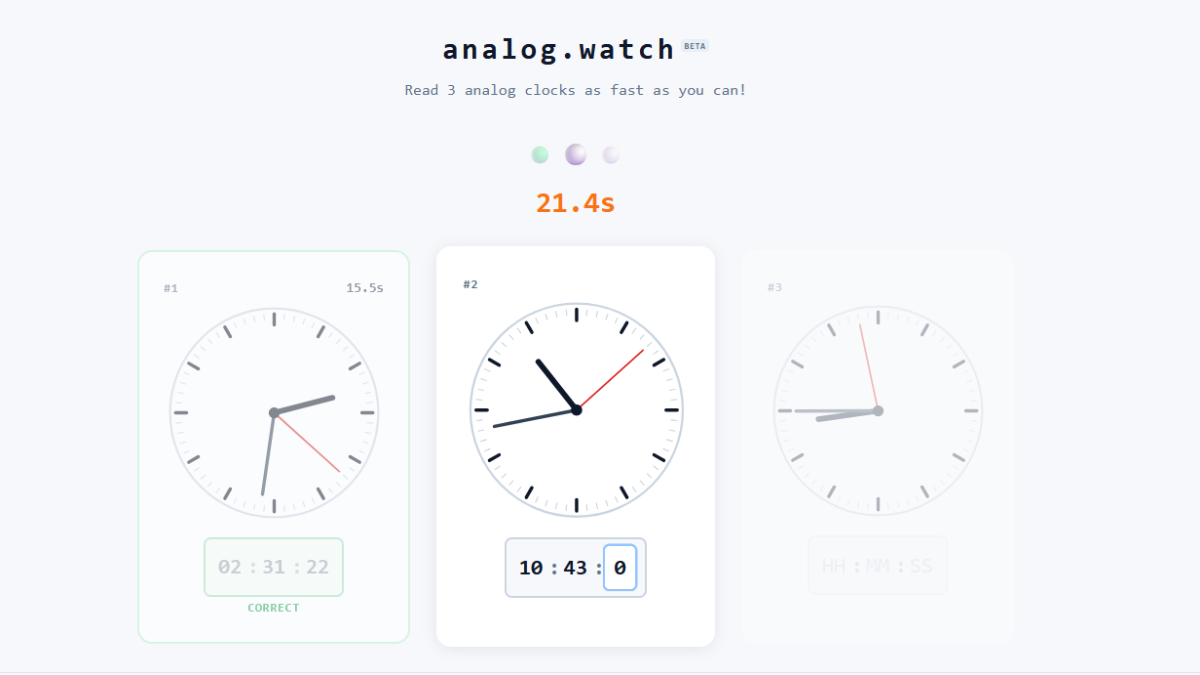
'analog.watch' is a free browser game where you read three analog clocks displayed on the screen and enter the time. I tried playing it to see what it was like.
analog.watch - read 3 analog clocks as fast as you can!
Show HN: Analog Watch | Hacker News
https://news.ycombinator.com/item?id=48846510
Show HN: analog.watch – read 3 analog clocks as fast as you can! | Hacker News
https://news.ycombinator.com/item?id=46318391
'analog.watch' was developed by Zeke Gabrielse , the founder of Keygen , a software license management and distribution API. Gabrielse is a fan of analog watches and has owned the domain 'analog.watch' for some time. He created the game after feeling embarrassed when someone asked him the time on his analog watch and he struggled to read it.
The homepage of 'analog.watch' looks like this.
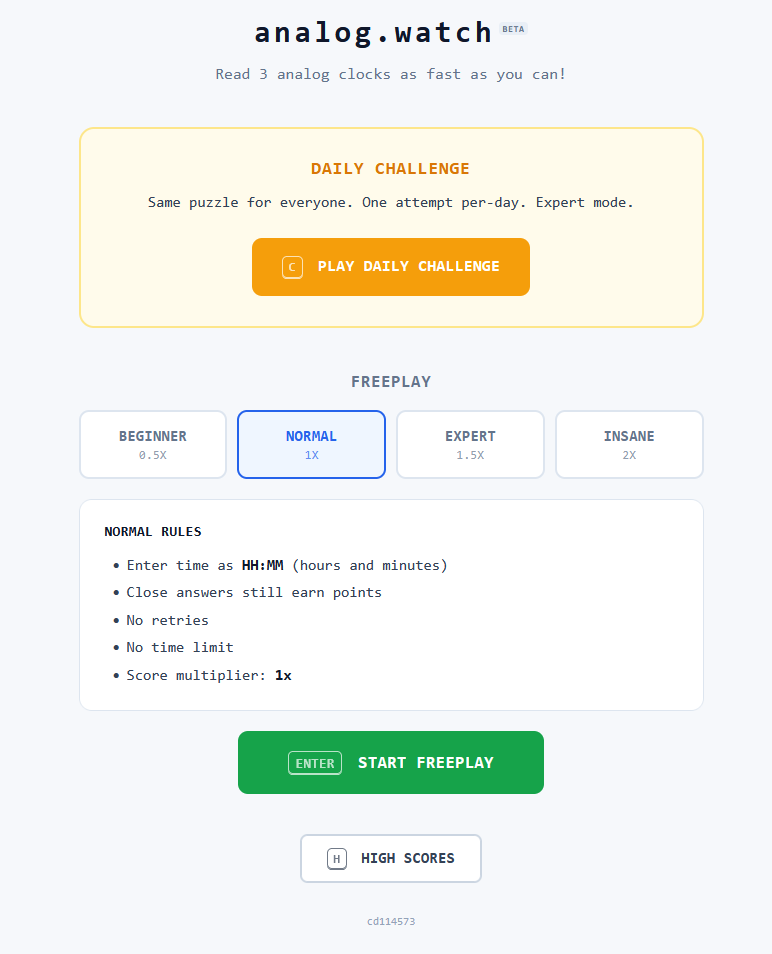
First, let's practice in 'FREEPLAY,' where you can choose a difficulty level and play as many times as you like. The settings for each difficulty level are as follows:
・BEGINNER: Read the numbered dial and enter the time in 'HH:MM' format. There is no time limit, and you can answer as many times as you like until you get it right. The difficulty multiplier is 0.5x.
・NORMAL: Enter the time in 'HH:MM' format. There is no time limit, but you cannot re-enter your answer, and you can earn points even with an answer that is close to the correct answer. The difficulty multiplier is 1.
・EXPERT: Read a clock with a second hand and enter the time in the format 'HH:MM:SS'. No re-answers or restarts are allowed, and there is a 60-second time limit per clock. Points can be earned even with answers that are close to the correct answer. Difficulty multiplier is 1.5x.
- INSANE: Read the time on a clock face with only four markings and enter the time in the format 'HH:MM:SS'. No re-answers or restarts are allowed, and there is a 30-second time limit per clock. Difficulty multiplier is 2x.
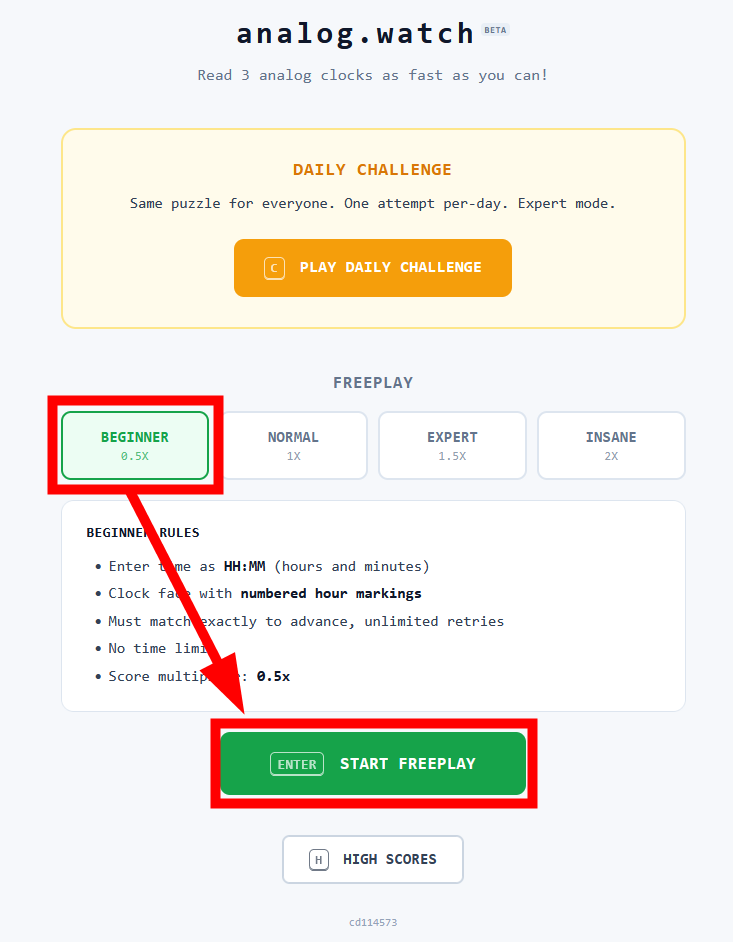
Select the easiest difficulty level, 'BEGINNER,' and click 'START FREEPLAY.'
Then, three analog clocks appeared in a horizontal line. Only the clock on the far left, the first one, was displayed in a darker color, with the elapsed time shown at the top.
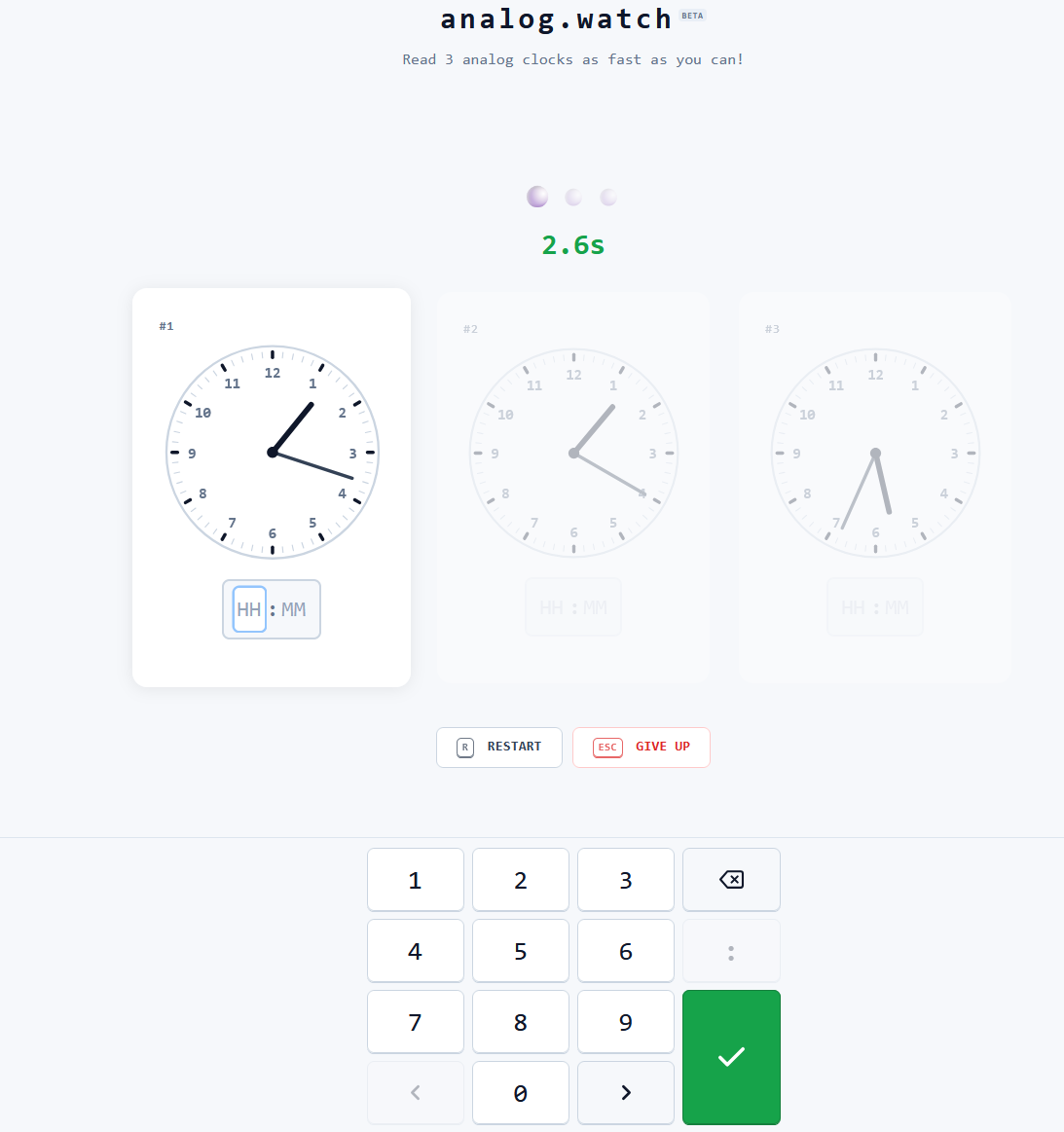
Read the time using the hour hand, then the minute hand, and enter the 'hour' and 'minute' using the numeric keypad or keyboard at the bottom of the screen. Enter each time in two digits, such as '01' for 1 o'clock and '05' for 5 minutes. Once you have finished entering the time, click the green check button or press the Enter key.
To check how it behaves when you make a mistake, I entered '01:27' instead of the correct answer '01:18' for the first question and clicked the check button. The input field was surrounded by a red frame, indicating that it was incorrect.
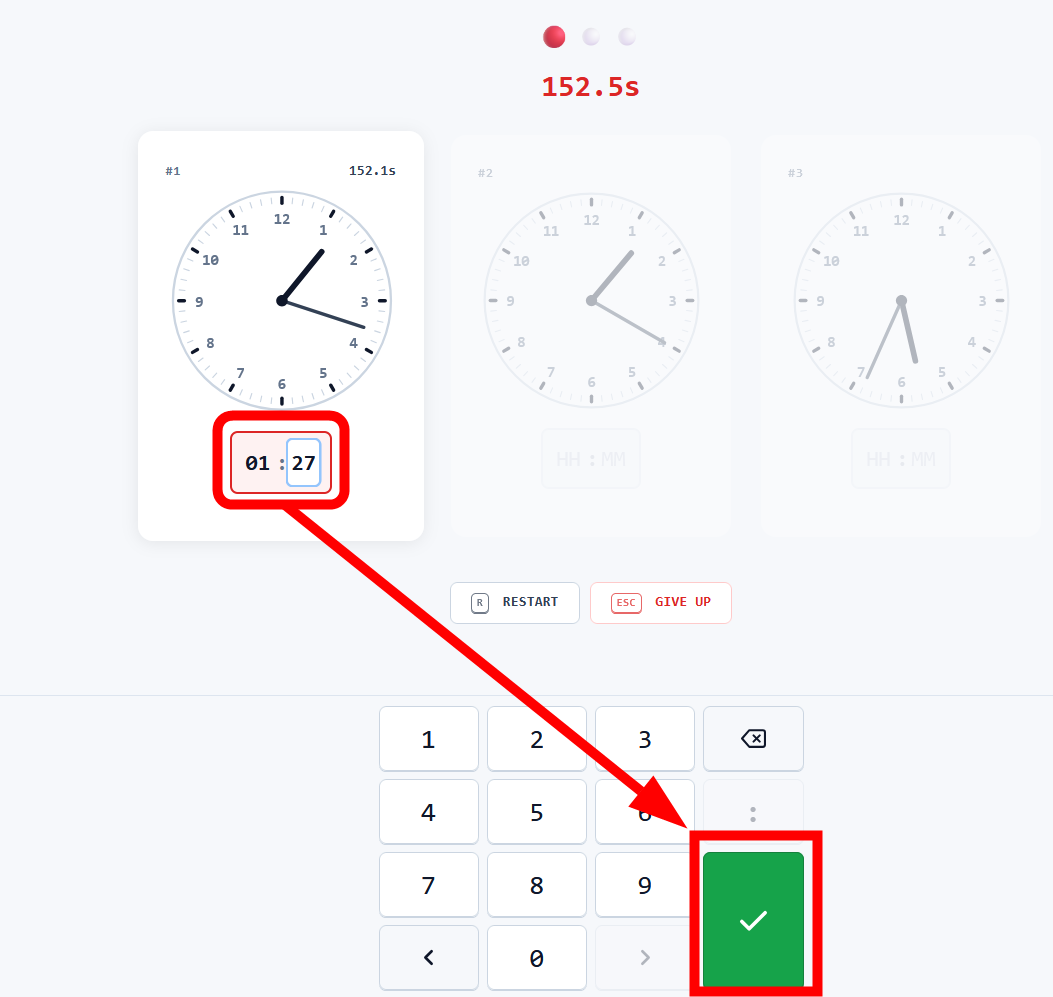
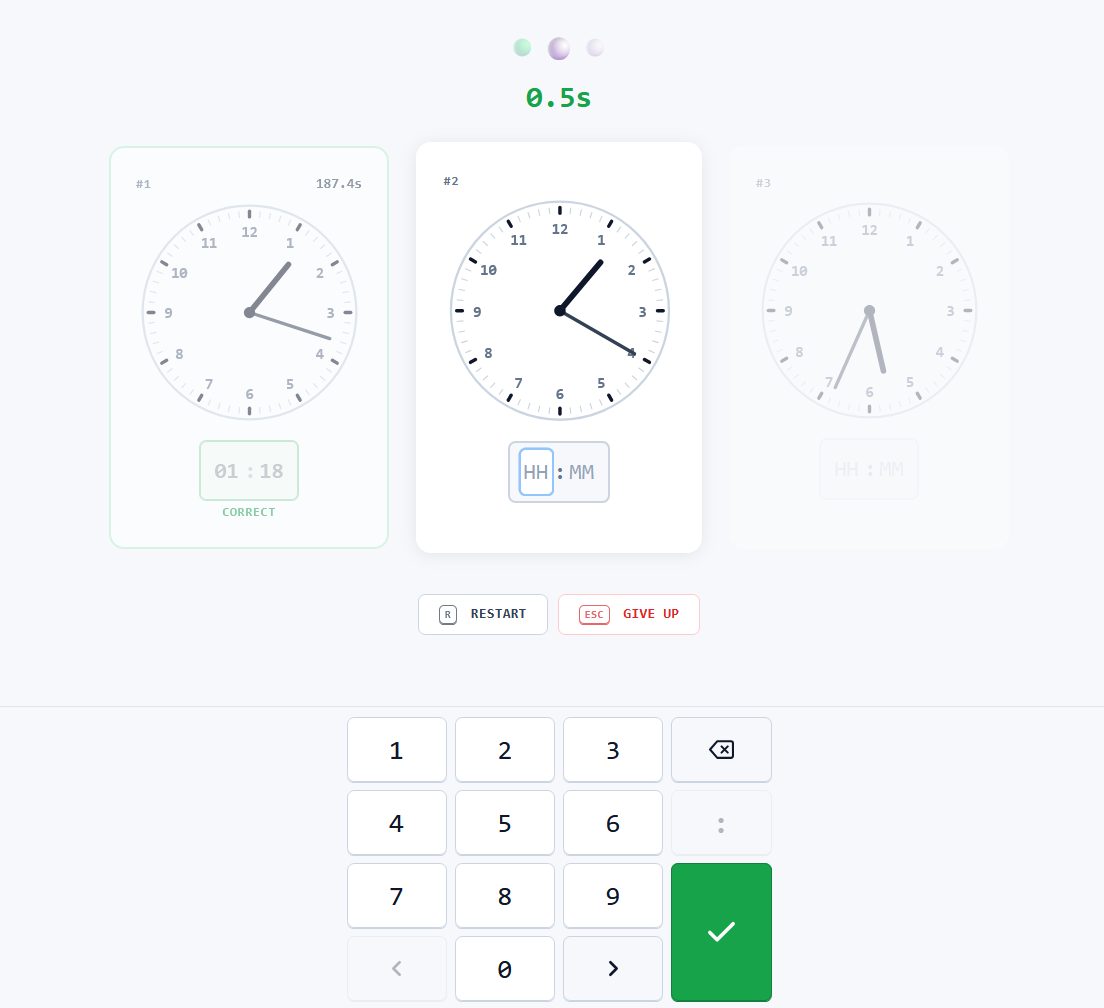
In 'BEGINNER,' you can resubmit your answer even if you enter the wrong time. After re-entering the correct time and clicking the check button, I was able to proceed to the second question.
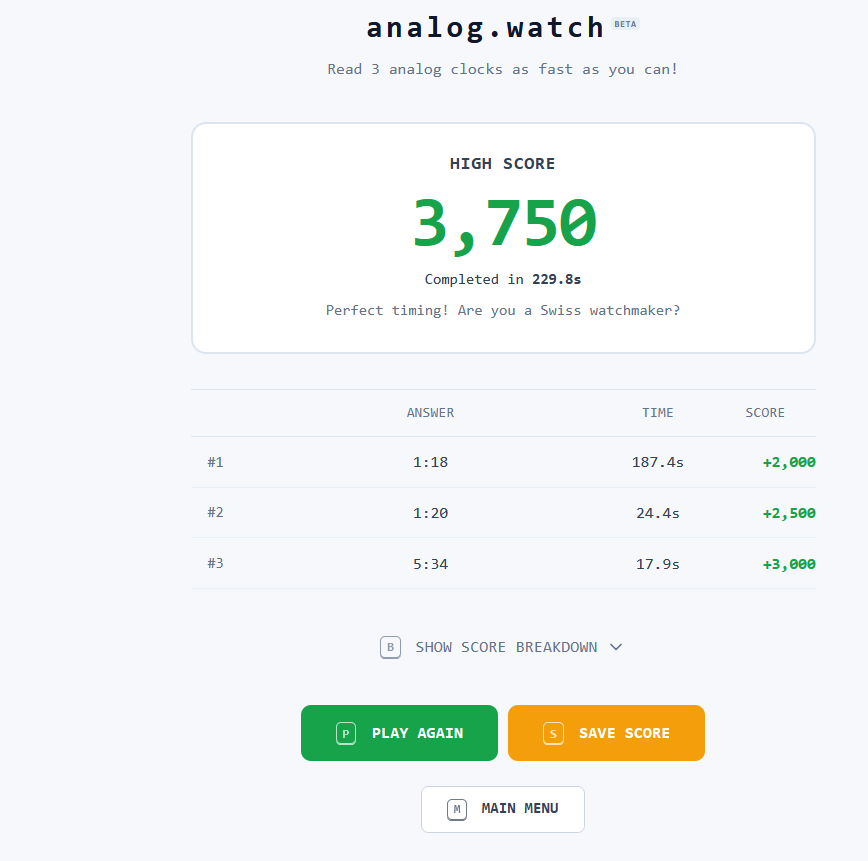
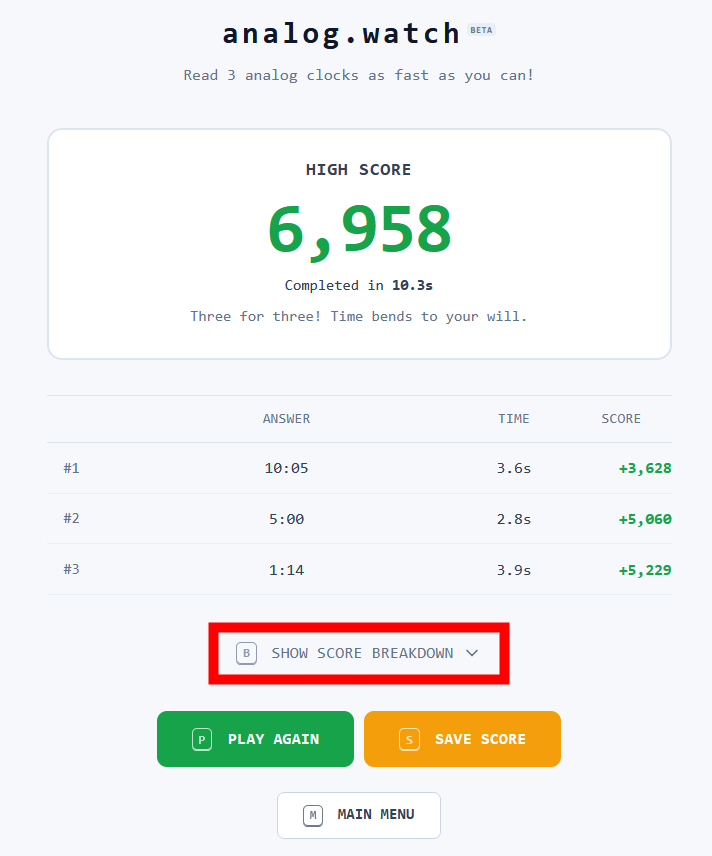
After answering up to the third question using the same method, the results screen will be displayed. This time, the total score was 3750 points, and it took 229.8 seconds to complete. You can individually check your answer, whether it was correct or not, the time taken, and the score earned for each question.
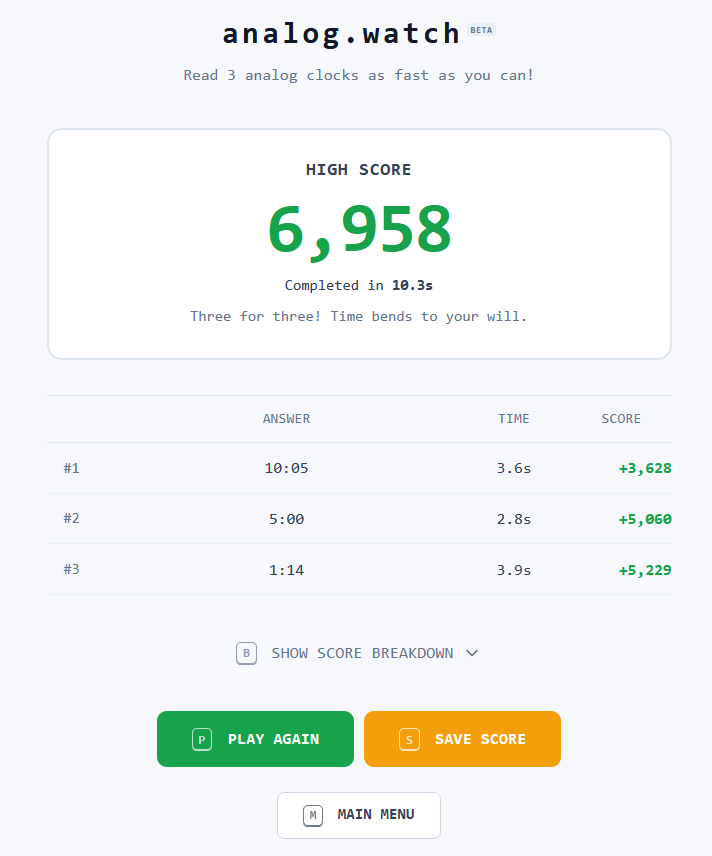
Since my first playthrough involved taking screenshots, here are the results after playing seriously again.
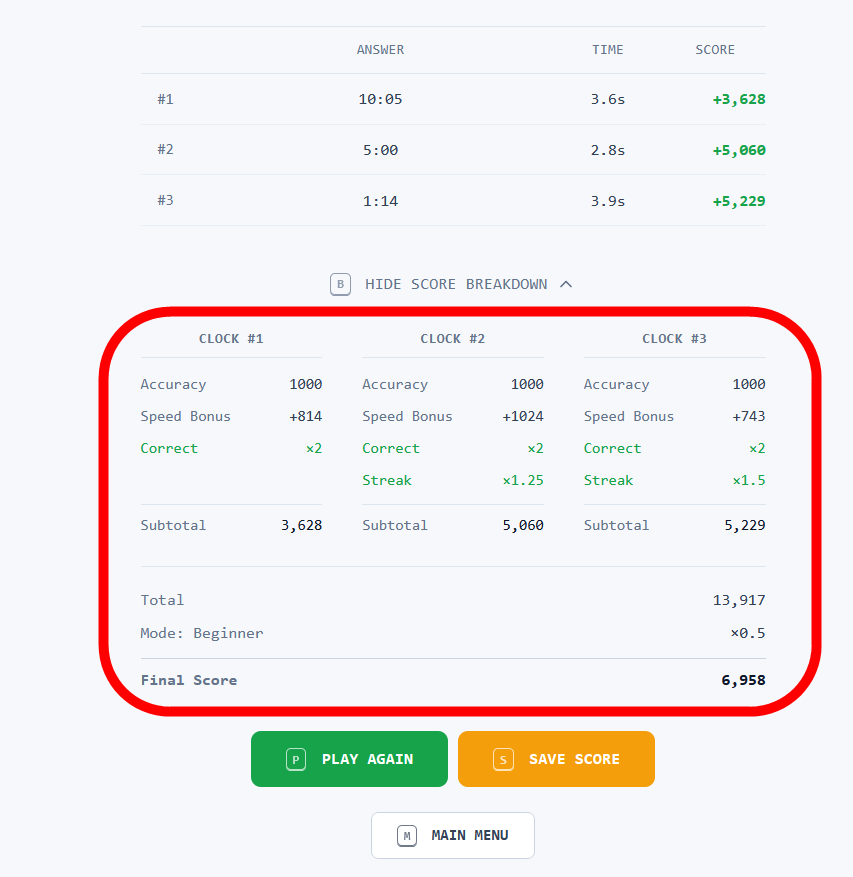
You can also see a breakdown of your score. Click 'SHOW SCORE BREAKDOWN' on the results screen.
In addition to 'Accuracy,' which indicates the accuracy of your reading, and 'Speed Bonus,' which corresponds to your speed, 'Correct ×2' is applied for a perfect score, 'Streak ×1.25' for two consecutive correct answers, and 'Streak ×1.5' for three consecutive correct answers. Finally, a difficulty multiplier of '×0.5' is applied depending on the mode.
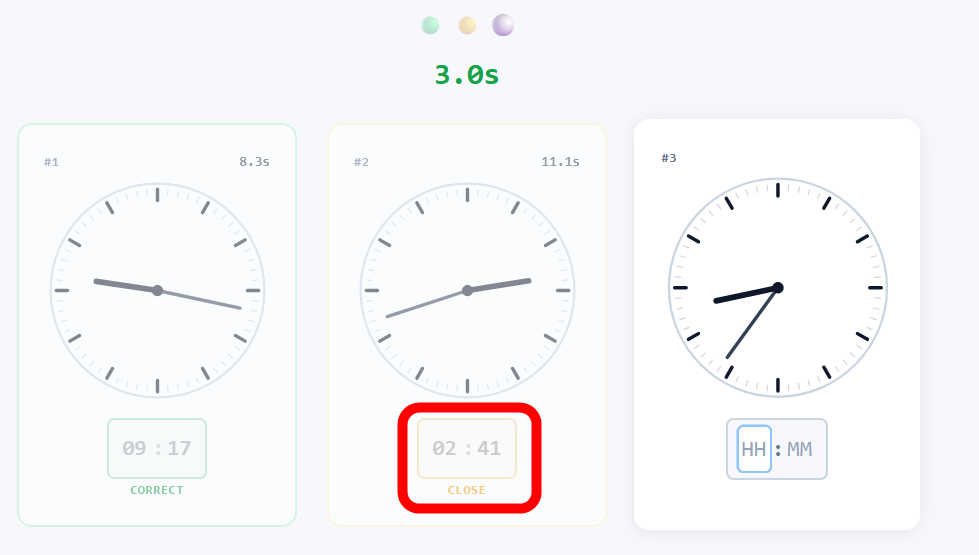
The basic gameplay of 'reading the time on three analog clocks' remains the same regardless of the difficulty level, but the clock faces, judging methods, and time limits change. From 'NORMAL' onwards, you cannot redo a time if you get it wrong, but you will still get points for answers that are close to the correct answer, even if they are judged as 'CLOSE'.
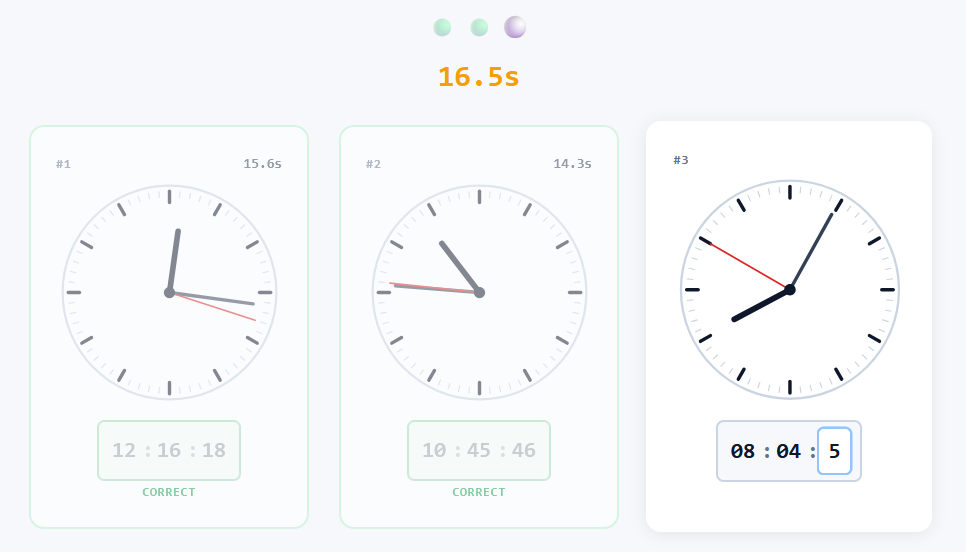
In 'EXPERT' mode, a second hand is added, and the input fields become three: 'hours,' 'minutes,' and 'seconds.' With just the hour and minute hands, you could roughly get a sense of 'what time it is,' but with the addition of the second hand, you now have to look at all three hands and input the time, like 'This is 8:05... no, the second hand is at the 50-second mark, so it must be 8:04:50!'
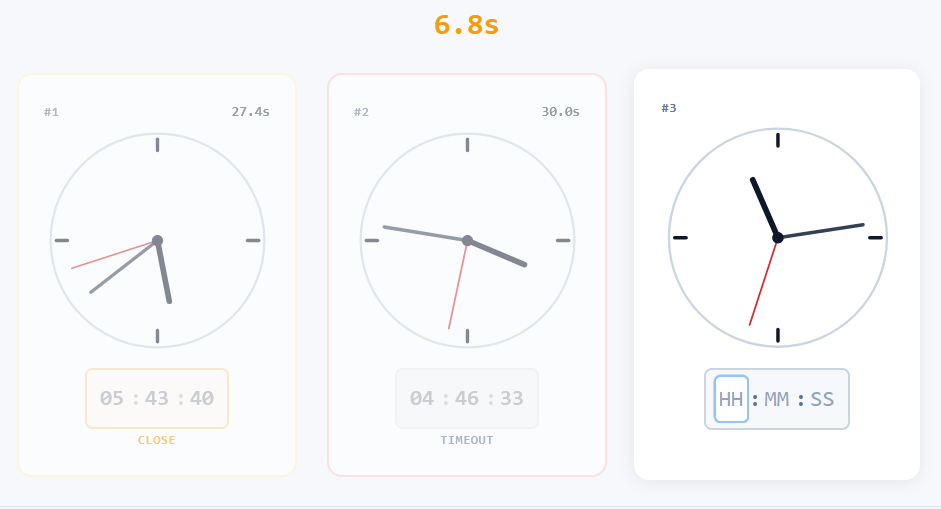
In the highest difficulty level, 'INSANE,' the clock markings are drastically reduced, with only four markings at the 12, 3, 6, and 9 o'clock positions providing clues. You need to visualize the positions of the other markings in your mind and deduce where each of the three hands is pointing. I managed to get a 'CLOSE' rating on one question, but I couldn't get the answer right.
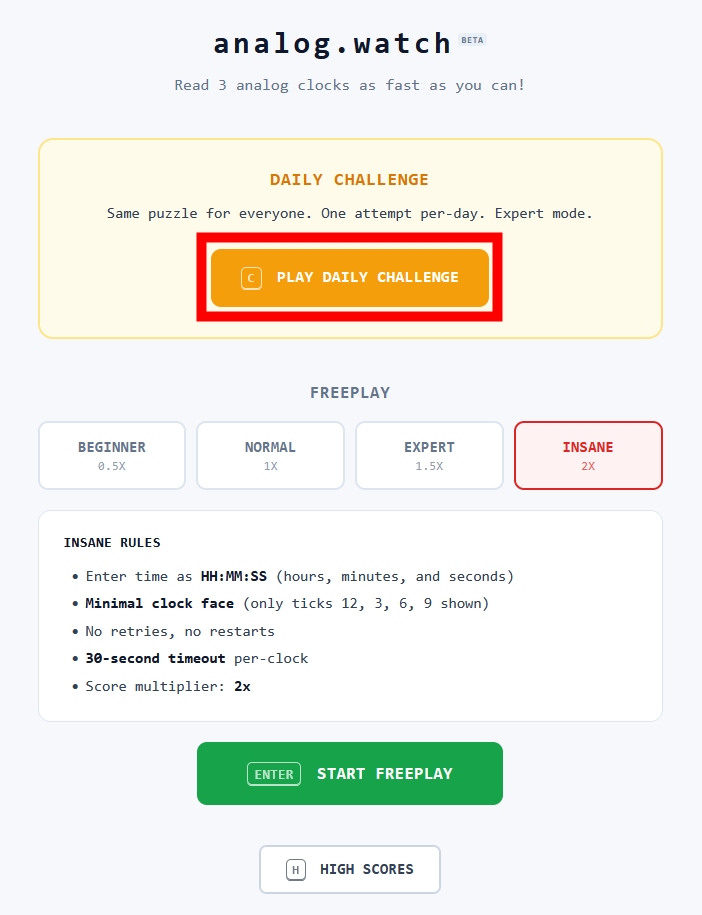
Finally, we'll take on the 'Daily Challenge,' which is given to everyone once a day and presents the same question. Click 'PLAY DAILY CHALLENGE' at the top of the homepage.
A warning appeared stating that 'you cannot replay after starting.' It also recommended practicing in 'EXPERT' free play first. Since I had already practiced, I clicked 'PLAY CHALLENGE.'
The daily challenge is set to 'EXPERT' difficulty, and just like in free play, you look at three analog clocks and answer with the 'hours,' 'minutes,' and 'seconds.'
After answering all three questions, the total score and time taken were displayed, along with the time of the correct answer, the time I entered my answer, the answer time, and the score. This time, I answered all three questions correctly, for a total of 14,428 points, and the time taken was 51.5 seconds.
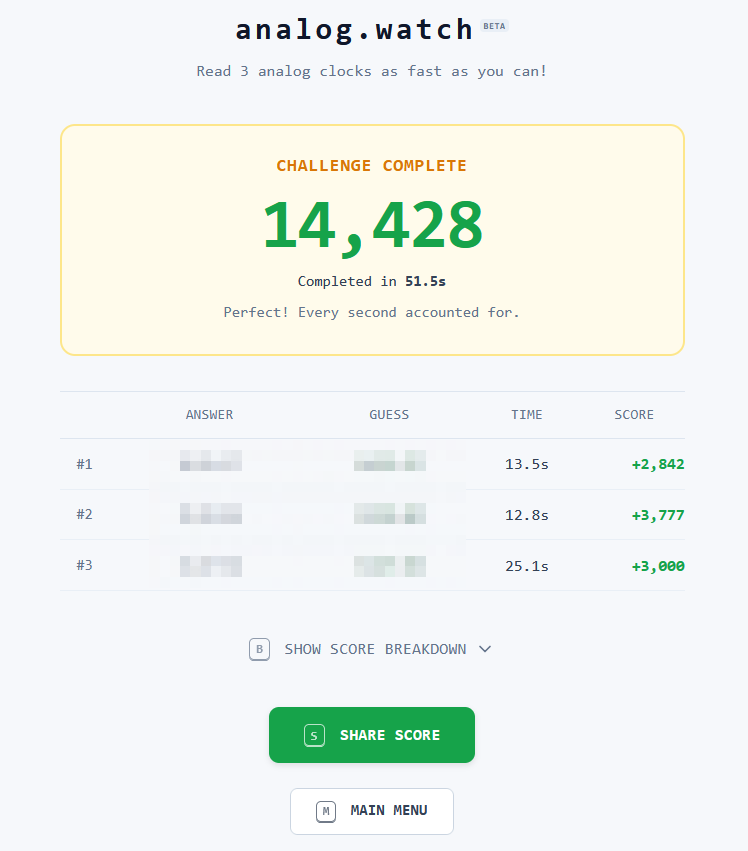
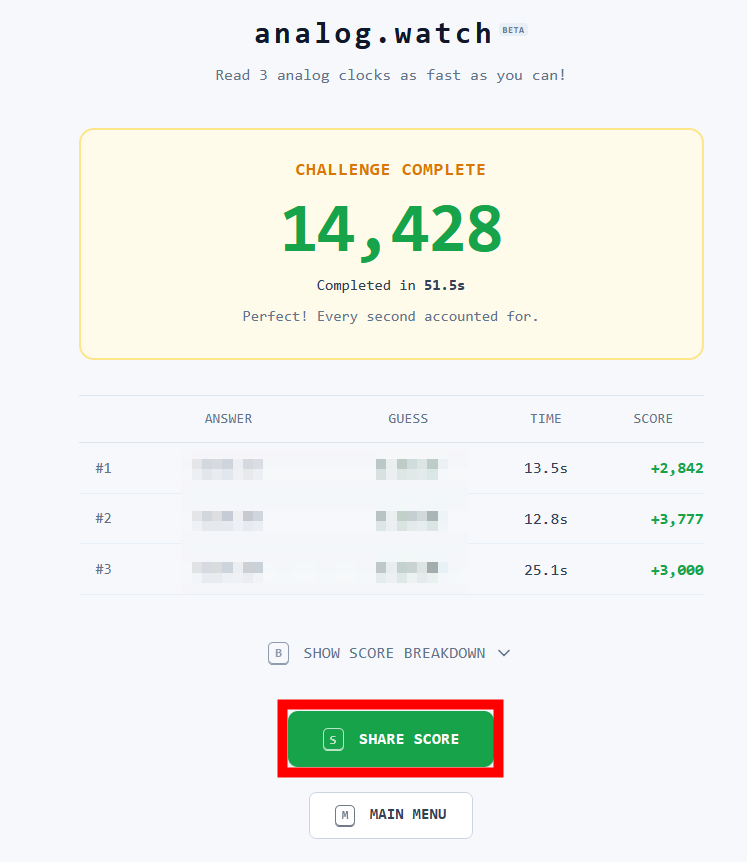
The score you earn in the daily challenge can be copied for posting on social media, etc. Click 'SHARE SCORE'.
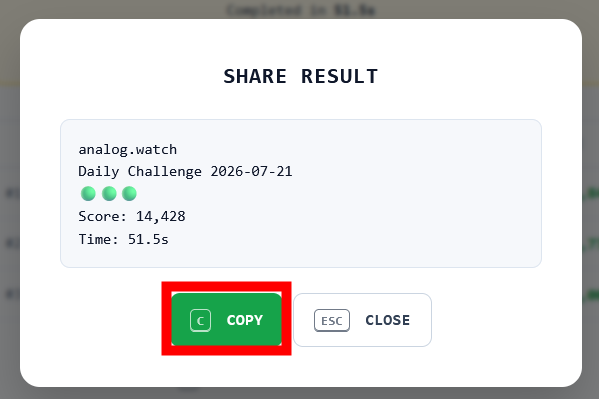
A shareable text file will be displayed, summarizing the play date, colored circles indicating the results of the three questions, the score, and the time taken. Clicking 'COPY' will copy it to the clipboard, so you can simply paste it into social media or other posts.
'analog.watch' is not only a game for practicing how to read analog clocks, but it also seems like it could be a brain training game because it requires you to consciously and accurately recognize the time that you usually perceive intuitively.
Related Posts:

in Web Service, Review, Game, Posted by log1b_ok