The EU and the European Commission have decided to force Google to ensure interoperability of its AI assistant on Android and to share search data.

The European Commission, the executive body of the EU, has decided on legally binding measures requiring Google to allow third-party AI assistants to be used on Android devices on par with Gemini, and to provide search data collected by Google Search to competitors. The sharing of search data is scheduled to begin in January 2027, and the changes to Android will begin in July 2027.
Commission provides guidance to Google for AI interoperability on Android & sharing of Google Search
https://ec.europa.eu/commission/presscorner/detail/en/ip_26_1634
It's official: EU will force Google to share search data and open up AI on Android - Ars Technica
https://arstechnica.com/gadgets/2026/07/its-official-eu-will-force-google-to-share-search-data-and-open-up-ai-on-android/
The European Commission announced two sets of 'specifications' targeting Google under the Digital Markets Act (DMA) on July 16, 2026. One concerns the interoperability between Android and third-party AI services, and the other defines how Google Search data is shared. These specifications are procedures that clarify how obligations under the DMA will be implemented, and are different from investigations that find violations and impose penalties.
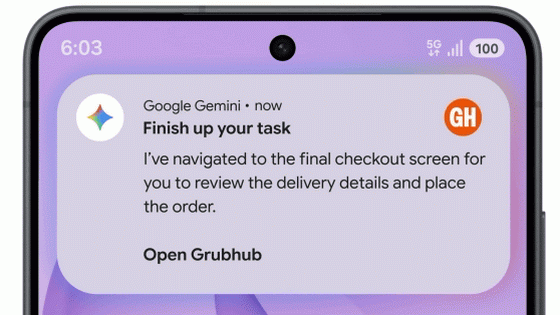
On Android, Google's Gemini has deep access to OS and app functionality, while competing AI assistants have limited capabilities. Gemini is pre-installed on Google-certified Android devices and can be activated with the voice command 'Hey Google,' recognize screen content, and control apps.
The European Commission pointed out that this difference puts other companies' AI services at a competitive disadvantage, as they are unable to adequately serve the 60% of EU users who use Android.
This measure will allow users to activate AI assistants other than Google's using voice commands. It is also expected that third-party AI assistants will be able to perform actions such as booking taxis within apps, displaying suggested replies in chat apps, and asking questions about recently visited places. The European Commission explains that the measures also incorporate steps to protect user privacy, device integrity, and security.
In the search sector, Google is required to provide the vast amount of search data it collects to competing search engines on fair and transparent terms. AI chatbots that provide search functionality will also be included in this sharing, allowing them to receive anonymized data equivalent to the data Google uses to improve its own search services.
The European Commission says this data is essential for smaller search companies and privacy-focused search services to compete with Google.
The anonymization of shared data will employ a combination of multiple processing methods. Before providing data, Google can review whether sharing it with other companies will create significant cybersecurity or data protection risks, and the European Commission can also modify anonymization measures based on market changes and third-party assessments. Fair pricing and transparent usage procedures will also be established for the data.
Google has protested the European Commission's decision. Kent Walker, Google's vice president of global affairs, argued that 'allowing third-party AI to have deep access to Android could allow it to bypass security checks by device manufacturers and others, and sharing search data could threaten user privacy, trade secrets, and national security.'
Meanwhile, the European Commission has included privacy protection measures and stated that the content can be modified as needed, and both parties will now work out the details of how to implement them.
Starting in January 2027, Google will have to begin providing search data to eligible search service providers. Android users will be able to integrate their chosen AI assistant more deeply with the OS starting in July 2027. The European Commission hopes these measures will encourage the emergence of alternatives to Google Search and Gemini, giving EU users more choices.
Related Posts:






in AI, Software, Smartphone, Posted by log1i_yk