Being able to write easily with your dominant hand may not be something you're born with, but rather the result of 'lifelong practice.'

Most people have a dominant hand, and they perform better with their dominant hand when performing tasks such as writing or handling tools. While some theories suggest that handedness is determined at birth by which hemisphere of the brain is dominant (right or left), a new study that investigated handedness using a special experimental method suggests that handedness may be a result of acquired practice.
Arm dominance is an emergent effect of practice executing complex trajectory shapes required by tools and objects | PNAS
Study explains why your dominant hand is better at everyday tasks - Neurology | UCLA Health
https://www.uclahealth.org/news/release/study-explains-why-your-dominant-hand-better-everyday-tasks
Your Dominant Hand Isn't Actually Hard-Wired, New Study Suggests : ScienceAlert
https://www.sciencealert.com/your-dominant-hand-isnt-a-hard-wired-preference-a-new-study-suggests-heres-why-its-better
In recent years, numerous studies have suggested that handedness is determined at birth, with some studies even indicating that handedness can be identified with high accuracy during fetal development. However, a research team of neurologists from the University of California, Los Angeles, and Johns Hopkins University conducted an experiment to explore the possibility that something else might be influencing handedness.
In their paper, the research team states, 'Limb dominance is often seen as evidence that the dominant hemisphere of the brain is inherently better at motor control. We explored another possibility: that handedness dominance may reflect asymmetrical practice with tools and objects that require precise control of complex trajectory shapes.'
In other words, the research team hypothesized that handedness might not be determined by brain structure at birth, but rather by the amount of practice one puts into use after birth. However, since most people continue to use one hand as their dominant hand throughout their lives, designing an experiment to test this hypothesis is difficult. To solve this problem, the research team devised a clever method to control the existing dominance of one's dominant hand.
The method devised by the research team involves having participants write letters and numbers using their elbows instead of their hands. Most people have never written with their elbows in their lives. However, if handedness is determined at birth, the research team reasoned that right-handed people should be better at writing with their right elbow than their left.
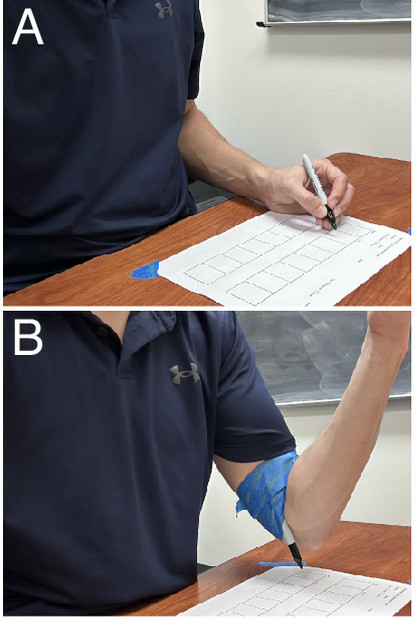
In the experiment, healthy right-handed subjects were first asked to write the letter 'A' and the number '8' eight times each using their right and left hands. Next, the subjects performed the same task using their elbows instead of their hands. Below are images (A) showing the subjects writing letters and numbers with their hands, and (B) showing the subjects writing letters and numbers with their elbows. When writing with their elbows, the pen was firmly fixed to the subject's elbow.
Next, the research team analyzed the letters and numbers written by the subjects using a neural network trained to judge their shapes. The results showed that when writing with the elbow, the advantage of the dominant hand disappeared, and regardless of whether the right or left elbow was used, only poorly written letters and numbers could be produced.
Furthermore, even after taking into account the time spent writing letters and numbers, no evidence was found to suggest that the dominant right elbow was advantageous. The research team stated, 'We found no significant differences or trends in the characteristics of the dominant and non-dominant elbows.'
The following images show photographs of subjects writing the letter 'A' or the number '8' using their elbows. 'D' represents the dominant right elbow, and 'ND' represents the non-dominant left elbow. It is clear that neither the right nor the left elbow is used to writing well.

Furthermore, the research team had half of the subjects practice writing using their right elbow, and the other half practice writing using their left elbow. They reported that writing ability improved significantly with practice using both the right and left elbows.
The image below compares the neatness of numbers written using 'dominant elbow-writing' and 'non-dominant elbow-writing' before and after practice. It shows that, regardless of whether you use your dominant or non-dominant hand, you can improve your writing with practice.
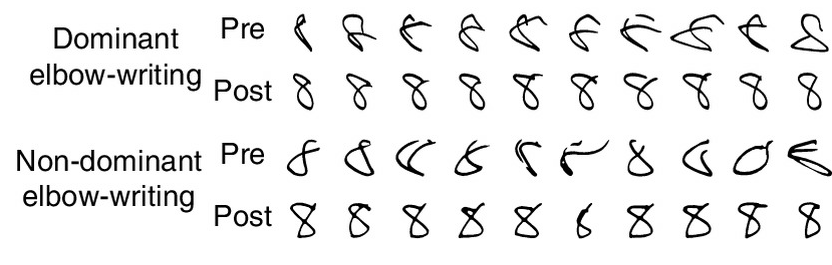
These results suggest that elbow writing ability is not determined by whether or not it is the dominant hand, but can be improved through practice. ScienceAlert, a science media outlet, states, 'These findings provide further evidence to support the theory that dominant hand writing ability is not an innate function of the brain that selects the side best suited for fine motor skills, but rather something that is cultivated through years of practice. The preference for tools such as tennis rackets and pens is also reflected because they are essentially an extension of the hand.'
Dr. Ahmet Allak, the lead author of the paper and a neurologist at the University of California, Los Angeles, commented, 'The reason we are better at using our dominant hand is not simply because one hemisphere of the brain is better at controlling movement. It's because we have practiced certain complex movements throughout our lives that are necessary for using tools and writing.'
Related Posts:








in Free Member, Science, Posted by log1h_ik