The EU is set to exclude wearable devices from its 'rules requiring removable and replaceable batteries.'

Products sold within the EU are generally required to have batteries that can be removed and replaced by the user, with only a few products, such as medical devices, being exempt from this rule. Now, six more categories, including wearable devices, are being considered for exemption.
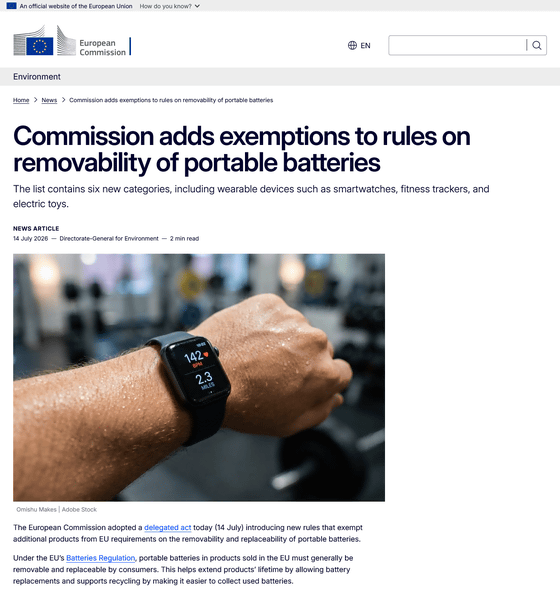
Commission adds exemptions to portable battery removal rules - Environment
Guidelines to facilitate the harmonized application of provisions on the removability and replaceability of portable and LMT batteries - Environment
EU relaxes rules for smart glasses after US pressure – POLITICO
https://www.politico.eu/article/eu-relaxes-rules-meta-glasses-us-pressure/
On July 14, 2026, local time, the European Commission adopted a delegated law that introduces a new rule into the European Battery Regulation, which sets out rules for battery products, that will exempt certain products from the requirements regarding battery removal and replacement.
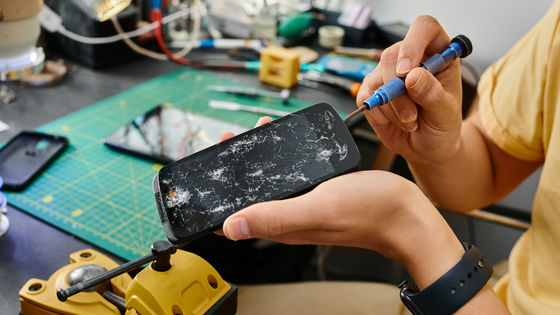
The European Battery Regulation stipulates that battery-powered products sold within the EU must, in principle, allow users to remove and replace the battery. This aims to extend the lifespan of the product by allowing users to continue using it by replacing the battery, while also facilitating the collection of used batteries and promoting recycling.
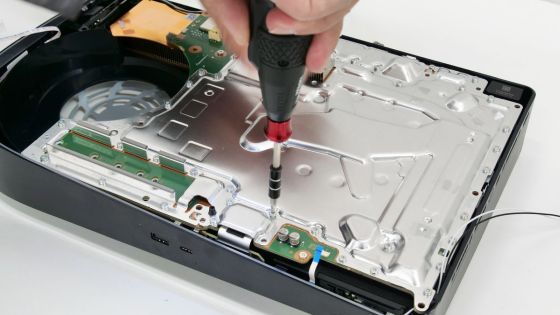
However, some products, such as medical devices, electric toothbrushes, and oral irrigators, are exempt from the requirements for safety reasons, and 'it's OK if a professional can remove the battery.'
The delegated law adopted by the European Commission adds wearable devices such as smartwatches and fitness trackers, electronic toys, and 'products used in potentially explosive environments' that comply with the ATEX Directive to the exclusion list.
The delegated law will be sent to the European Parliament and the Council of the EU for review, and if no objections are raised, it will enter into force 20 days after its publication in the Official Journal of the EU.
This rule revision is believed to be a result of pressure from the United States, as the previous rule was an obstacle for Meta in deploying its smart glasses within the EU.
Meta announces new, more affordable smart glasses under its own brand, 'Meta Glasses' - GIGAZINE

In March 2026, Andrew Puzzter, the US Ambassador to the EU, described Meta's smart glasses as 'very stylish and fantastic,' while criticizing the European Battery Regulation as 'very broad and restrictive, preventing this fantastic product, jointly developed by the US and Europe, from being sold within the EU.'
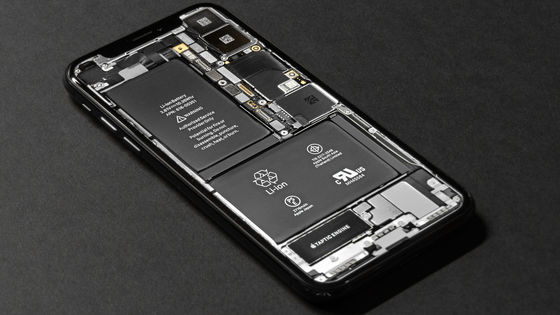
Incidentally, while smartphones and tablets are not yet subject to the European Battery Regulation, they will be required to have removable and replaceable batteries starting February 18, 2027.
Replaceable smartphone batteries in 2027: The new EU requirement
https://www.ecopv-eu.com/en/blog-en/replaceable-smartphone-batteries-2027-eu-regulation/
Related Posts:





in Hardware, Posted by logc_nt