What jobs will be left for us 'humans' as AI advances? The vision of 'joint superintelligence' between humans and AI.

As AI capabilities continue to improve, concerns about 'AI taking away jobs' are frequently raised. In his keynote address at
What will be left for us to work on? - by Arvind Narayanan
https://www.normaltech.ai/p/what-will-be-left-for-us-to-work
Narayanan delivered a keynote speech at ICML 2026 titled 'What Challenges Do We Need to Address?' The speech primarily presented three main points.
Firstly, the intellectual framework of the lecture is the idea that 'AI is Normal Technology.' This is the idea that, like electricity, steam engines, computers, and the internet, it will take a long time for AI to become widely adopted in society, and that the technology itself cannot transform society. Even if the performance of AI improves, it will take decades for companies to change their work processes, for legal systems to be established, and for people to adapt to new ways of working. Narayanan argues that understanding AI as not something special but the same as conventional technologies within this framework is the correct and useful way to think about the impact of AI.
Secondly, while it's important to seriously consider the possibility of AI reaching ' recursive self-improvement ,' where it designs smarter next-generation AI without human intervention, Narayanan argues that groundbreaking results in companies and research institutions won't suddenly leave us all unemployed. Finally, Narayanan states that future jobs will slowly transform into something fundamentally different from today's, requiring many adaptations.
According to Narayanan, there are three stages—invention, innovation, and diffusion—as a framework for understanding how powerful technological advancements like electricity impact the economy. 'Invention' is the discovery of principles like electromagnetism or the difference between alternating current and direct current; 'innovation' is the stage where inventions begin to be implemented in society; and 'diffusion' is the process by which people adopt the innovations.
Applying this to software development, 'diffusion' is divided into 'initial adoption' and 'adaptation,' resulting in a framework consisting of four elements. Narayanan argues that this fourth stage, 'adaptation,' is the slowest, and in modern times, it hasn't even really begun yet, and will take several decades.
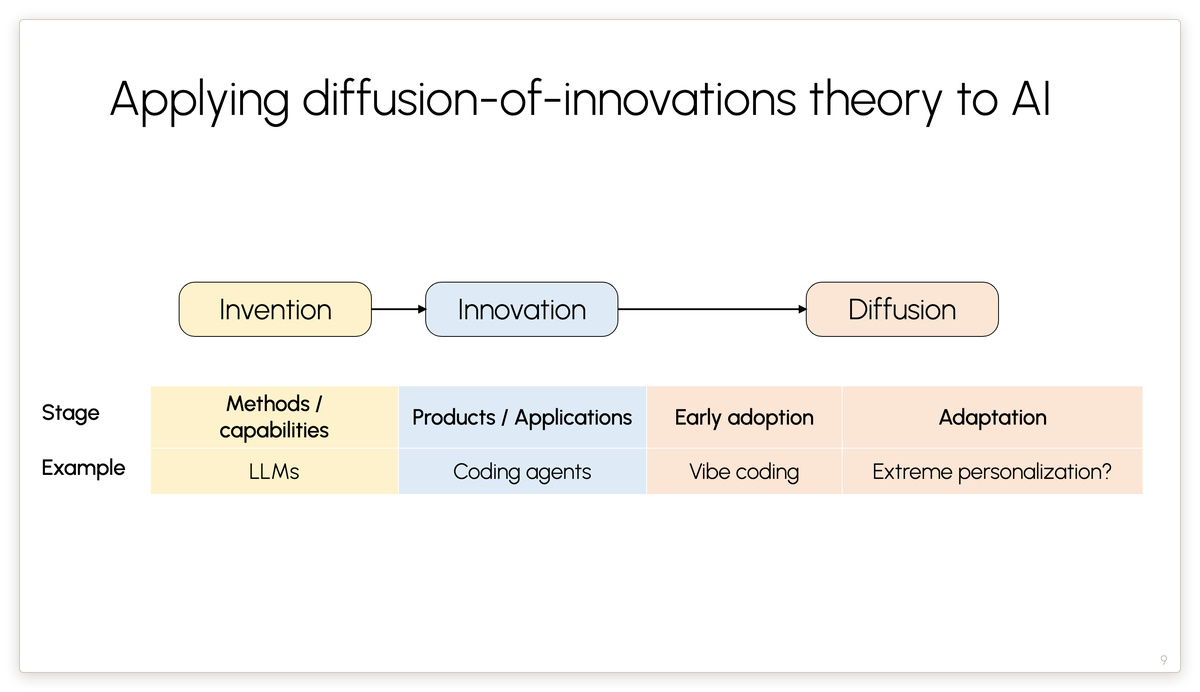
Even in today's world where AI is actually being implemented, we can only speculate on how 'adaptation' will progress. Nevertheless, based on the processes by which past technologies have transformed society, Narayanan believes that in order to fully realize the potential of AI, whether in software engineering or other fields, organizational and human transformations will be very slow, taking several decades.
Furthermore, while some companies do implement large-scale layoffs due to the introduction of AI, Narayanan points out that 'the idea that if software engineers' productivity increases tenfold, then the number of software engineers needed will be reduced to one-tenth, completely contradicts the actual data.' In economics, there is a concept called '
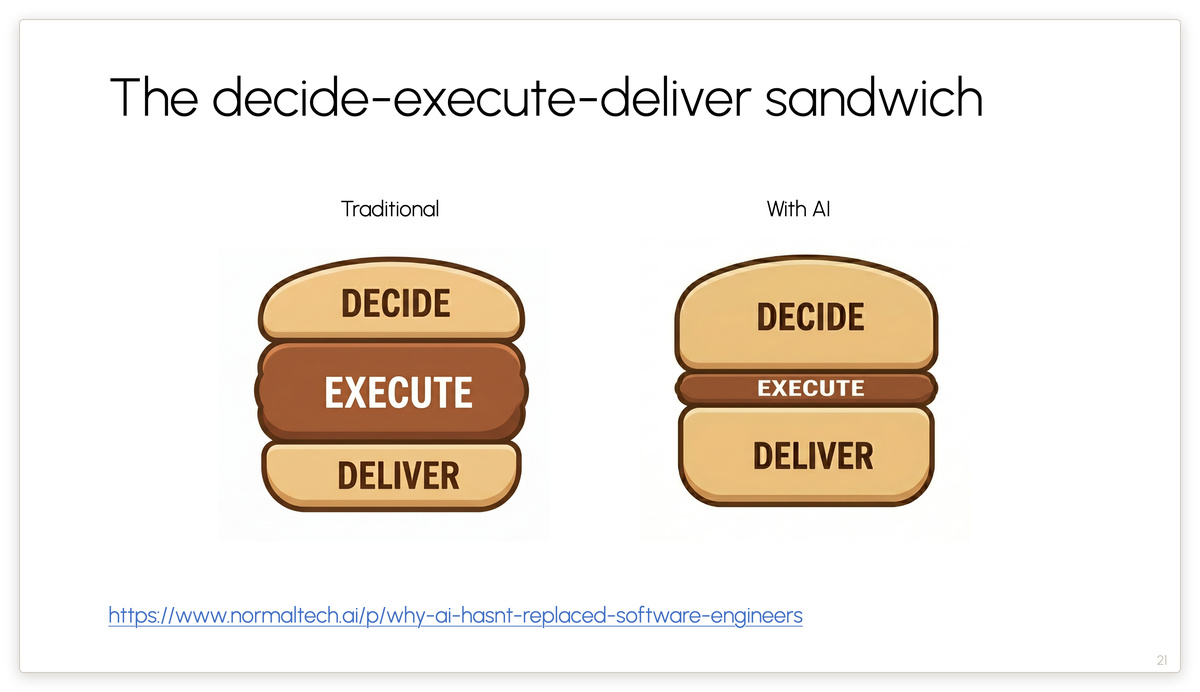
The same applies to software engineering: even if coding agents reduce the effort required to write code to almost zero, the decision-making layer that plans and the delivery layer that integrates and maintains customer systems may not be compressed, but rather may even expand. Narayanan explains that even if productivity improves with AI, demand will increase accordingly, so it does not necessarily mean that employment will decrease.
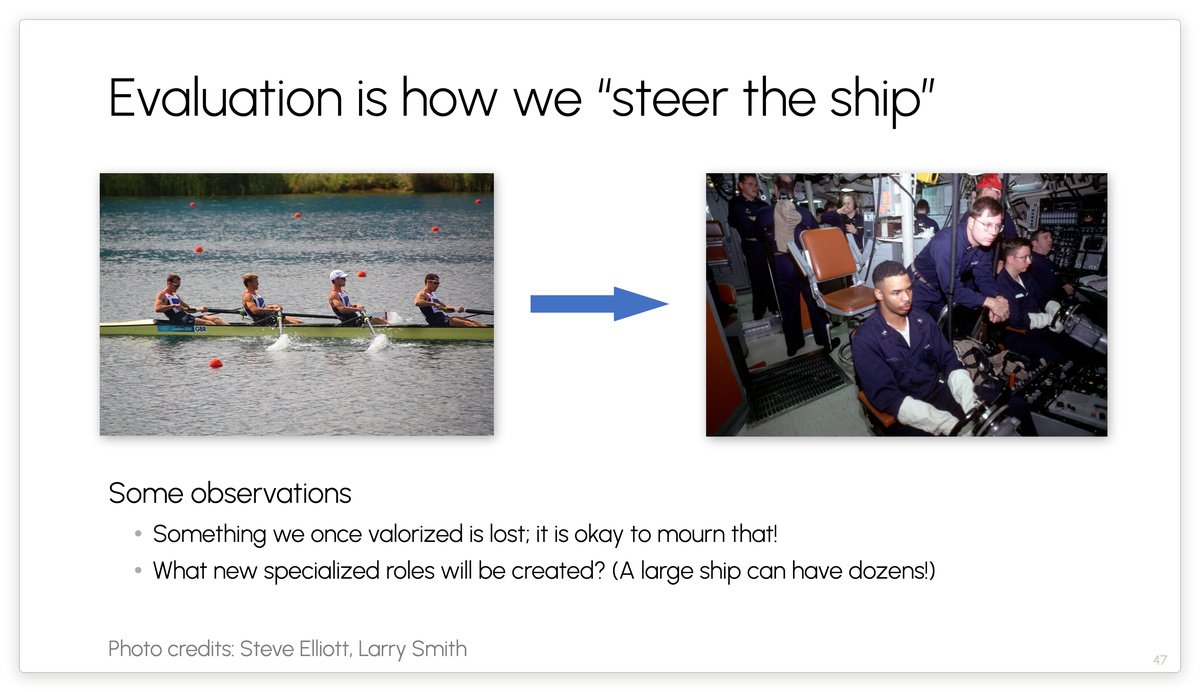
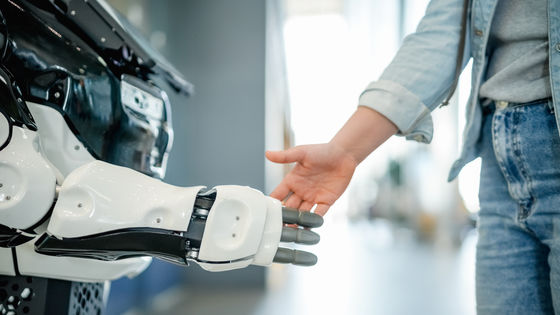
Even if AI doesn't necessarily lead to a decrease in overall employment, some individual tasks will be replaced by AI. In particular, since verifiable tasks can be handled by AI, some or most of the effort will shift from building something to evaluating it, says Narayanan. In his talk, the societal changes brought about by the introduction of AI were likened to a boat: instead of rowing the boat across the water, the human role will shift to steering the boat, determining where we want to go, and adjusting our course to ensure we're on the right track. This shift, where 'AI handles the actual work, and humans take on the role of setting the destination and adjusting the course,' is predicted to occur in the role of humans within the next 10 to 20 years.
Faced with the challenge of rapidly improving AI capabilities, Narayanan argues for the necessity of working alongside AI, such as spending considerable time learning and experimenting with new workflows, acquiring new topics, and investing the time saved by AI-driven productivity improvements into acquiring new skills. He then outlined two heuristics for dealing with AI. First, he points out that companies often want users to use AI agents as black boxes—that is, to expect them to act automatically once given instructions—but this is a dangerous trap that can lead to losing control later on. Therefore, it is crucial to resist the temptation of a black box and make an effort to learn more about it.
Secondly, Narayanan warns that because learning new things is difficult, people are tempted to use AI for tasks outside their expertise, but this can lead to a 'spiral of dependence' where they lose even the slightest skills they possessed for that task. Therefore, Narayanan says that it is far better in the long run to first take the time to master the task before using AI to improve productivity.
Finally, Narayanan described AI as 'something that amplifies our potential to heights we could never have imagined before,' and presented a vision of 'co-superintelligence,' which involves not only relying on AI but also improving one's own skills.
Related Posts:





in AI, Posted by log1e_dh