Unraveling the mystery behind the exorbitant ambulance fees in America, so high that they refuse to transport even those who have been hit by a car.
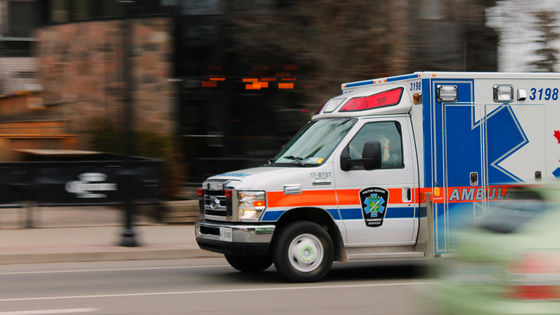
American ambulance fees are notoriously expensive, sometimes so much so that injured people refuse to get in. Author
Why American ambulance rides are so expensive
https://davidoks.blog/p/why-american-ambulance-rides-are
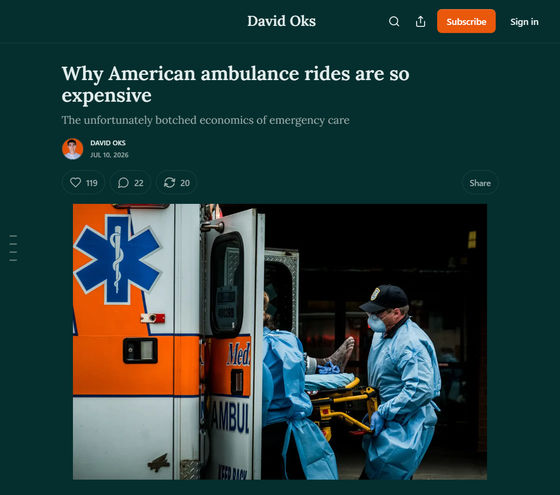
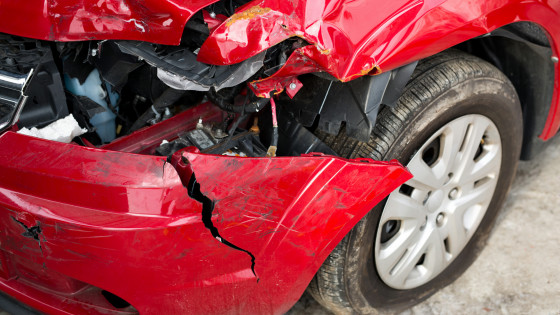
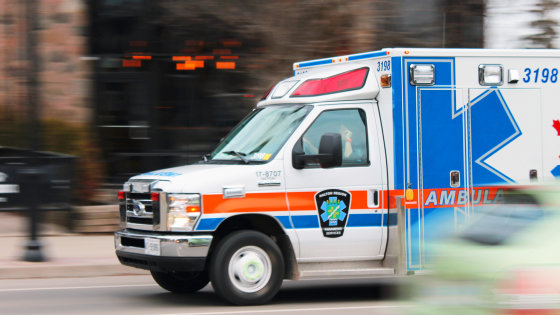
In July 2023, Jagdish Witten, then 25 years old, was hit by a car while running across a busy road in San Francisco. Witten said he 'just fell over a little.' Although a witness called an ambulance, Witten refused to get in, saying he 'knew ambulances were expensive and didn't think I was going to die,' and instead had a friend drive him to a nearby hospital.
At the hospital, Mr. Witten was diagnosed with a mild concussion, a fractured toe, and several bruises. However, due to his injuries, he needed to be transported to San Francisco General Hospital, the city's only designated trauma center. He couldn't refuse the transport, so Mr. Witten was taken by ambulance to San Francisco General Hospital, about 9.6 km away. There, he received a diagnosis and was able to return home that same day without any further treatment.
Afterward, Mr. Witten received bills from the first hospital he was taken to and from San Francisco General Hospital, where he was transported by ambulance. Mr. Witten thought that all his medical expenses should be covered by insurance. However, several months later, he received a bill from American Medical Response (AMR), the ambulance service provider that transported him from hospital to hospital. The bill was broken down into $737 (approximately 120,000 yen) for additional charges based on distance traveled, $314 (approximately 50,000 yen) for cardiac monitoring during transport, $151 (approximately 24,000 yen) for infection control measures, and a base fee of $11,670 (approximately 1,900,000 yen), totaling $12,873 (approximately 2,100,000 yen).
Ms. Witten sent the invoice to the insurance company, but AMR refused to pay the premium, claiming it was not a partner company. After an appeal, the insurance company eventually agreed to pay $9,967 (approximately 1.6 million yen), but Ms. Witten had to pay approximately $3,000 (approximately 490,000 yen) out of pocket. Ms. Witten appealed the claim to AMR, but ultimately had to pay approximately $3,000.
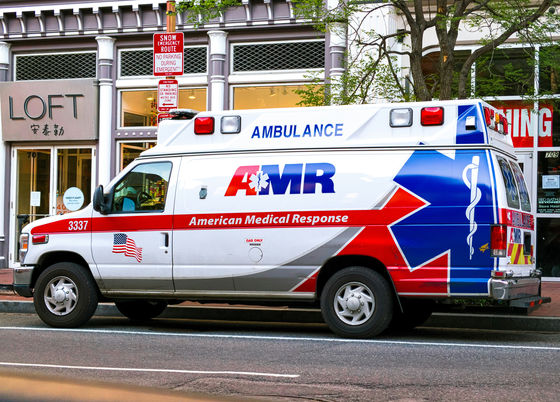
The ambulance bill that Mr. Witten received is called a 'surprise bill,' and it is a bill that arises when a patient receives treatment at a medical facility outside of their insurance company's network without their knowledge or consent.
This is the standard billing system for ambulance services in the United States, and
Therefore, many people in the United States avoid taking an ambulance whenever possible. According to a 2024 poll , 23% of Americans refrain from using ambulances due to concerns about the cost.

One reason why ambulance services in the United States are so expensive is that ambulance companies are owned by unscrupulous
However, Ox noted that this wasn't the only reason. Ambulance operators are chronically operating at a loss, with low profit margins and low salaries for their drivers, causing many to withdraw from the industry every year. Despite the continued influx of patients like Mr. Witten who receive exorbitant bills, it seems that the operators are still struggling financially.
Ox points out that the root cause of the chronic financial difficulties faced by ambulance operators in the United States lies in the way that American law compels emergency services. He adds that almost all of the cost of emergency services is spent on standby time, that is, the salaries of paramedics who are on 24-hour standby to respond to calls that could come at any time.
For example, in the case of fire stations, fire engines and firefighters are always on standby so that citizens can call for help at any time. Citizens pay taxes to cover the costs of this. Ambulance services are similar to fire stations, with vehicles and personnel available 24 hours a day so that citizens can call for an ambulance at any time. However, unlike fire stations, ambulance services are not funded by taxes.

The reason for this stems from the fact that early emergency services were provided by funeral homes. Patients with serious injuries requiring ambulance transport usually need to be transported lying on their backs, as sitting up would worsen bleeding. Therefore, ambulances needed a 'long, flat cargo bed.' In most areas, only hearses had such a cargo bed. As a result, emergency services were provided by funeral homes.
Since it's impossible to know when a person will die, funeral homes operate 24 hours a day, and they offer a service where a hearse will come to pick up the deceased even in the middle of the night if you call. In that respect, funeral homes were considered well-suited to providing emergency services.
However, the emergency services provided by funeral homes were not very good. The equipment was rudimentary, consisting only of stretchers, blankets, and oxygen tanks, and the staff dispatched were not medically trained. As a result, the mortality rate for patients transported by emergency services at that time was reportedly very high.
However, for funeral homes, funerals were their main business and a highly profitable service. In most cases, if a patient transported by ambulance service died, the funeral home would then arrange the funeral. Therefore, ambulance services were often provided at a low cost, and in some cases, no charge was even made for them.
However, in the 1960s, the unique structure of emergency services was codified into federal law. In 1965, the U.S. government created two large social insurance programs: Medicare , which provides public health insurance to Americans aged 65 and older, and Medicaid , which provides similar services to Medicare to the poor.
Both systems involve listing the medical services covered by the payment and providing reimbursement for each service provided. For example, a hospital that performs an appendectomy would bill the government for one appendectomy. Ambulance transport services were added to this system almost as an afterthought. Transport costs were covered by both systems, and the fee was paid to the service provider after each transport.
The very essence of emergency medicine began to change in the 1960s, precisely when American law codified how emergency medical care costs should be covered. This transformation began with the development of cardiopulmonary resuscitation (CPR) at Johns Hopkins University. In 1965, portable defibrillators appeared, dramatically improving the survival rate for cardiac arrests occurring outside of hospitals. Furthermore, around the same time, medical teams became able to transmit patients' vital signs remotely, leading to a significant increase in survival rates for cardiac arrests and serious accidents.
At the same time, this creates a need to fundamentally re-examine the way emergency medical care is provided. Early emergency services simply involved transporting patients to hospitals in hearses used by funeral homes, but the emergence of new technologies has led to cases where full-scale medical procedures are performed during transport.
In 1966, the U.S. National Academy of Sciences published a report titled ' Accidental Deaths and Disabilities: A Missed Disease of Modern Society, ' which pointed out that the U.S. emergency medical service lacked sufficient training and equipment for emergency medical care. According to the report, soldiers who were severely injured in Vietnam had a higher survival rate than drivers who were severely injured in the average urban area.
This led to the emergence of 'Emergency Medical Services (EMS)' and 'paramedics' in the United States. Paramedics are not doctors, but they are able to perform medical procedures inside ambulances on their way to hospitals. The Emergency Medical Services System Act, enacted in 1973, led to the establishment of EMS in approximately 300 regions and the widespread availability of trained paramedics. While there were hardly any government-certified paramedics in the early 1960s, their number had increased to several hundred thousand by the early 1980s.
Early emergency medical services were an inexpensive business offered by funeral homes. However, with the advent of EMS (Emergency Medical Services), emergency medical services have become a high-cost industry. The reason for these high costs is the need to maintain trained paramedics, ambulances equipped with expensive medical equipment, and emergency stations to coordinate them. While the cost of dispatching an ambulance to the scene is minimal, the cost of maintaining the emergency service is enormous.
Since then, the fixed costs of emergency services have continued to rise, but Medicare fixed the insurance premium for ambulance rides in 1965, and private insurance companies followed suit. As a result, the gap between the actual cost of dispatching an ambulance and the amount paid out as insurance premiums (the difference in charges) has become large. However, it is illegal for emergency services to make difference charges under Medicare and Medicaid. In other words, emergency services are forced to incur a loss every time they transport a Medicare or Medicaid recipient.
Therefore, to recoup these deficits, ambulance services are forced to charge higher fees to the uninsured and those with private insurance. This, Ox explained, is why ambulance fees in the United States are so exorbitant.
As a way to resolve this situation, Mr. Ochs proposes funding emergency services directly from taxes, as is done in the UK and Japan. This method is already being used in some parts of the US; in Tulsa and Oklahoma City, Oklahoma, the government purchases the operating hours of fully staffed ambulances from ambulance companies and has residents pay the equivalent amount in advance through their monthly utility bills. As a result, there is no charge for riding in an ambulance in Tulsa or Oklahoma City.
Related Posts:




in Note, Posted by logu_ii