OpenAI officially releases 'GPT-5.6,' demonstrating coding performance exceeding Claude Fable in third-party tests.
OpenAI officially released its AI model '
GPT-5.6: Frontier intelligence that scales with your ambition | OpenAI
https://openai.com/index/gpt-5-6/
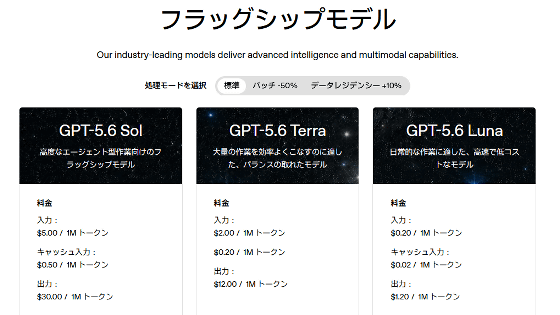
GPT-5.6 is an AI model that was released on June 26, 2026, to a limited number of organizations. GPT-5.6 is divided into three types: the flagship model 'GPT-5.6 Sol,' the balanced model for daily work 'GPT-5.6 Terra,' and the low-cost 'GPT-5.6 Luna.' Even the low-cost GPT-5.6 Luna is touted as having performance comparable to the previous generation model, GPT-5.5. With this official release, GPT-5.6 is now available to general users as well.
OpenAI announces 'GPT-5.6' series, surpassing Claude Mythos 5, but limited preview release due to US government directive - GIGAZINE
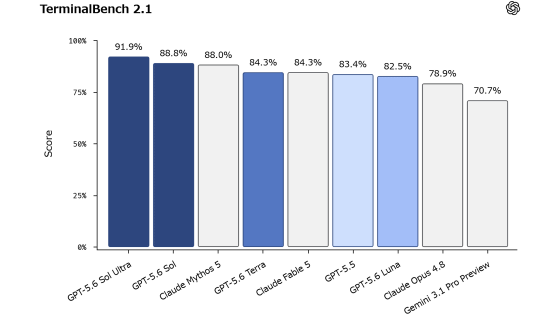
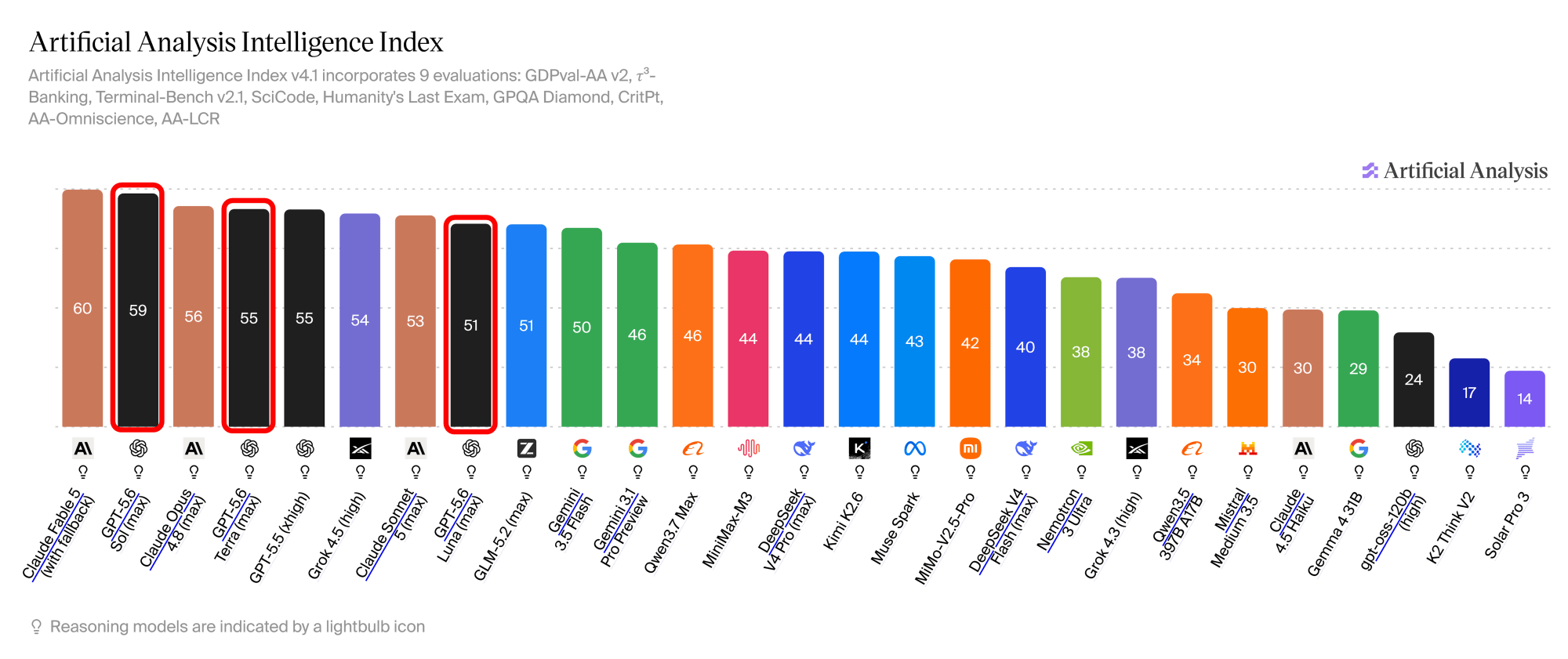
The following are the results of tests conducted by the third-party organization Artificial Analysis. In the Artificial Analysis Intelligence Index, which evaluates the intelligence performance of AI models, GPT-5.6 Sol was rated as the second-best performance, after Claude Fable 5.
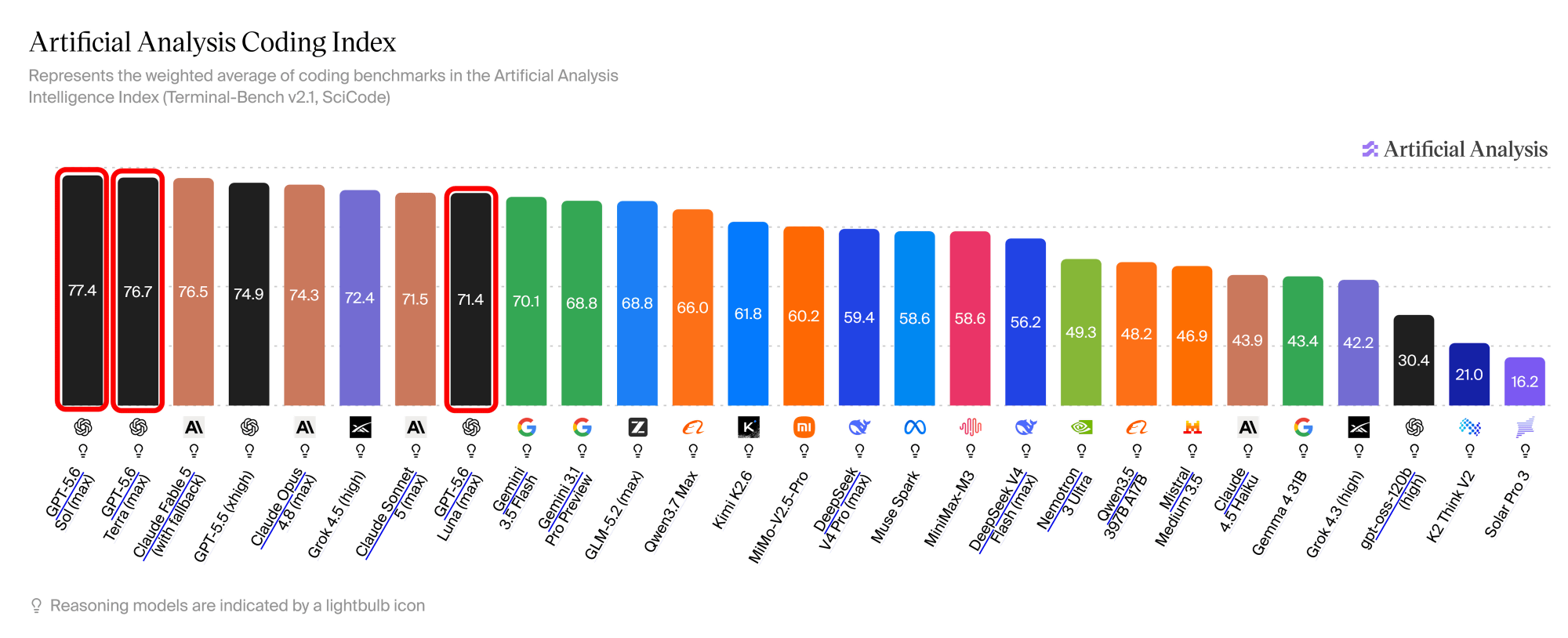
In the Artificial Analysis Coding Index, which evaluates coding performance, GPT-5.6 Sol and GPT-5.6 Terra outperformed Claude Fable 5.
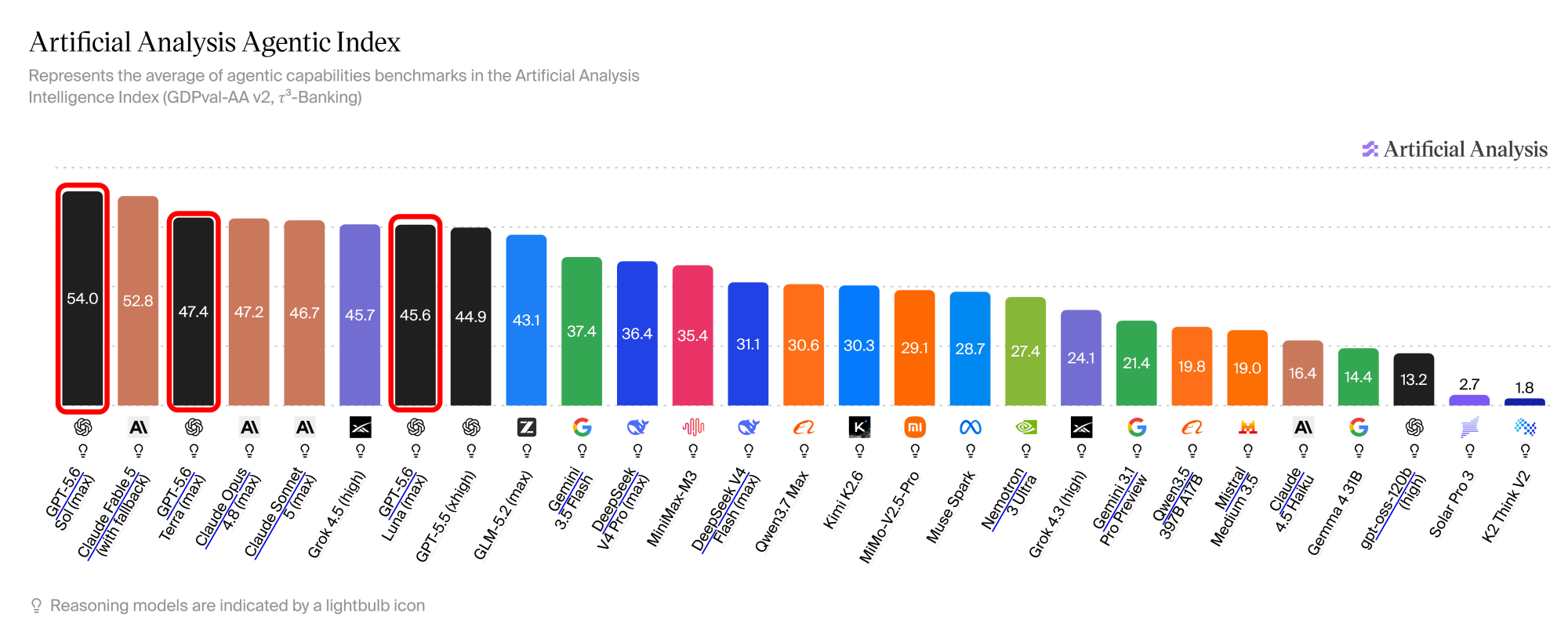
In the Artificial Analysis Agentic Index, which evaluates agent performance, GPT-5.6 Sol outperformed Claude Fable 5, and GPT-5.6 Terra was also rated as performing better than Claude Opus 4.8.
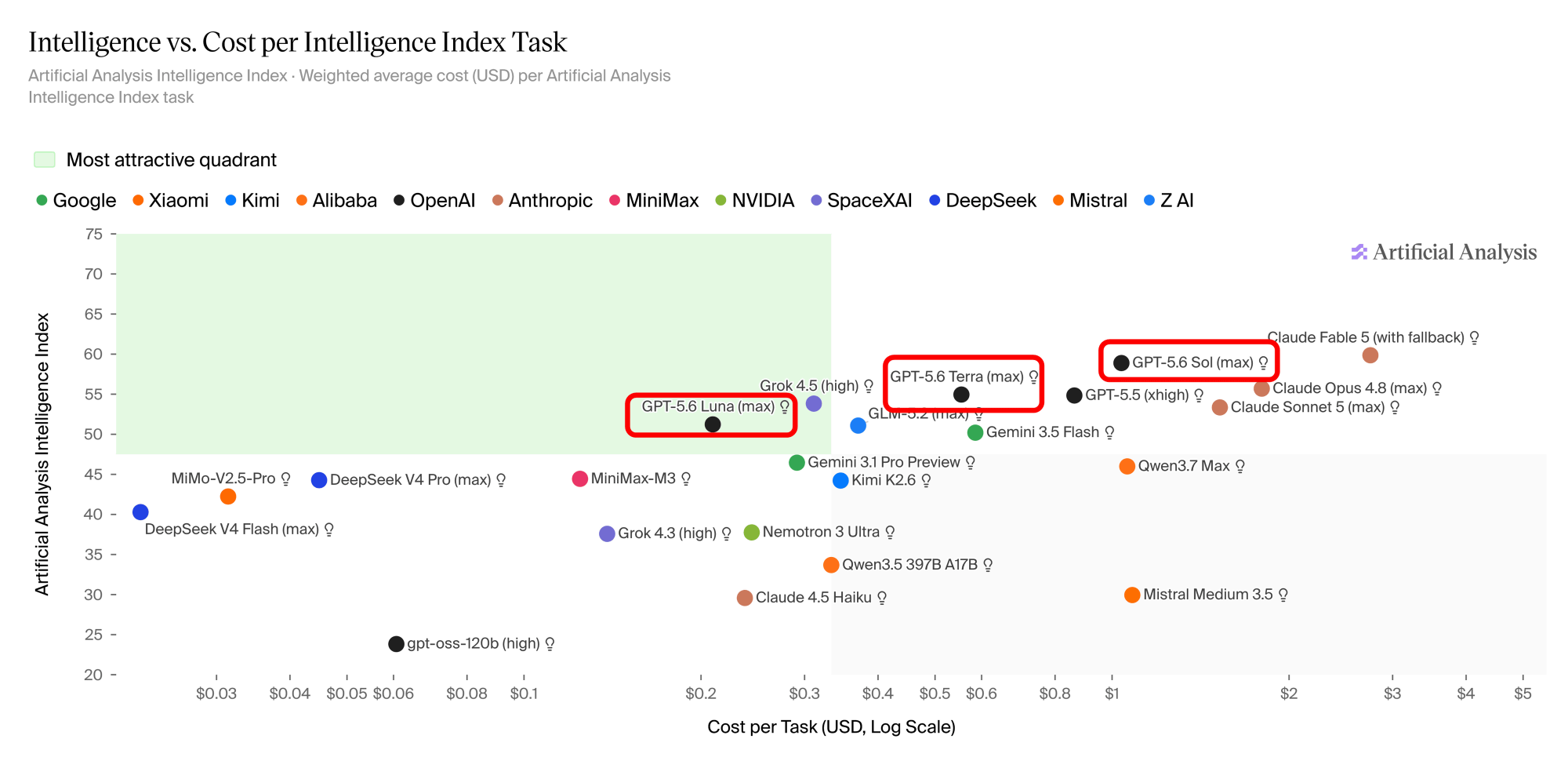
The graph below shows the cost-performance ratio of various AI models. The horizontal axis represents the cost per task, and the vertical axis represents intelligence performance. The GPT-5.6 series shows higher performance compared to models with equivalent cost.
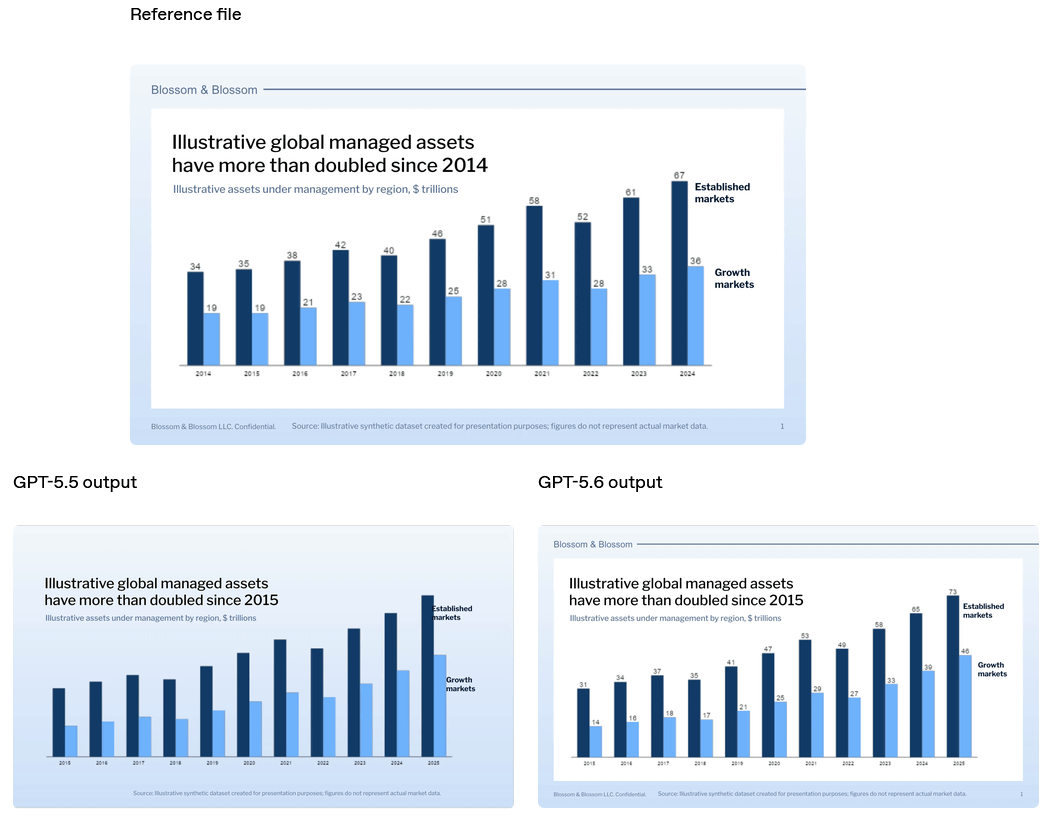
OpenAI emphasizes not only benchmark results but also the quality of its actual output. Below are examples of graphs generated using GPT-5.5 (bottom left) and GPT-5.6 (bottom right) based on the reference file (top). GPT-5.6 was able to create a new graph while maintaining the color scheme and label positions of the reference file.
Derrick Choi, a member of the OpenAI Codex development team, has posted an example of a website created with GPT-5.6 Sol on X. The following post includes an embedded video demonstrating a 'website explaining Apple hardware' created with GPT-5.6 Sol.
#4. I used to be an engineer at Apple, so I asked Codex to build an interactive guide to Apple hardware design.
— Derrick Choi (@derrickcchoi) July 9, 2026
Has scroll-linked scans, draggable cutaways, sourced chapters, and a map tracing the evolution of Apple's circuit boards. pic.twitter.com/Z8xmsZoJB3
Furthermore, as an example of using GPT-5.6 in real-world tasks, OpenAI has posted a video of Mr. Tomiyasu , who runs a farm in Hokkaido, using Codex in his agricultural work.
Meet Hiroki ( @tomiyasu16 ).
— OpenAI (@OpenAI) July 9, 2026
A broccoli farmer running his farm with GPT-5.6. pic.twitter.com/5eXTC3WKfi
GPT-5.6 is available through ChatGPT and Codex, as well as via API. In the case of ChatGPT, Plus, Pro, Business, and Enterprise users can use the medium and higher settings of GPT-5.6 Sol, while Pro and Enterprise users can run the highest-performance GPT-5.6 Sol Pro.
ChatGPT Work and Codex offer GPT-5.6 Terra to Free and Go users, while Plus, Pro, Business, and Enterprise users can choose from GPT-5.6 Sol, GPT-5.6 Terra, and GPT-5.6 Luna models.
The price per million tokens of API is as follows:
| input | output | |
| GPT-5.6 Sol | $5 (approximately 809 yen) | $30 (approximately 4853 yen) |
| GPT-5.6 Terra | $2.50 (approximately 404 yen) | $15 (approximately 2427 yen) |
| GPT-5.6 Luna | 1 dollar (approximately 162 yen) | $6 (approximately 971 yen) |
The API documentation can be found at the following link.
Model guidance | OpenAI API
https://developers.openai.com/api/docs/guides/latest-model
Additionally, a system card outlining the GPT-5.6 specifications is available at the following link.
GPT-5.6 System Card - OpenAI Deployment Safety Hub
https://deploymentsafety.openai.com/gpt-5-6
Related Posts:

in AI, Posted by log1o_hf