Bulgaria's Supreme Court has ruled that blocking pirated websites is 'impossible under current domestic civil law.'

In February 2020, the Bulgarian
Bulgarian Supreme Court: Rights Holders Cannot Use Standard Copyright Claims to Force ISP Website Blocking
https://www.dpc.bg/insights/bulgarian-supreme-court-rights-holders-cannot-use-standard-copyright-claims-to-force-isp-website-blocking
Pirate Site Blocking Is Legally Impossible in Bulgaria, Supreme Court Ruled * TorrentFreak
https://torrentfreak.com/pirate-site-blocking-is-legally-impossible-in-bulgaria-supreme-court-ruled/
Two of the three ISPs strongly opposed the lawsuit seeking to block access, calling it 'unfair and unfounded.' The ISP, labeled 'N.1' in the court documents, pointed out that 'Bulgarian law does not allow claims to block access to internet sites.' Furthermore, Bulgaria, located in southeastern Europe, is a member of the EU, and while the EU has laws that require member states to be able to apply for injunctions against intermediaries, N.1 argued that 'this provision does not apply because Bulgaria has not yet incorporated it into its domestic law.'
In May 2023, the Sofia City Court in Bulgaria ruled in favor of the plaintiffs, ordering three ISPs to block pirated sites, including mirror and proxy sites, within six months. BAMP hailed the ruling as 'a major step forward in the fight against music copyright infringement,' while IFPI CEO Francis Moore called it a 'landmark victory.'
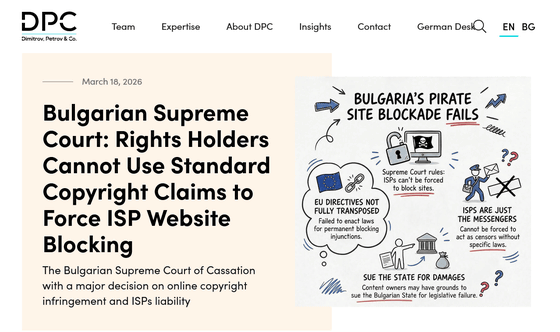
However, following an appeal by the ISP, the Bulgarian Supreme Court ruled in March 2026 that 'under the current Bulgarian copyright law, music and film producers cannot obtain an injunction in ordinary civil copyright litigation to block access to well-known pirated websites by an ISP.'

EU law requires member states to establish mechanisms for injunctions against intermediaries. However, the Bulgarian Supreme Court ruled that Bulgaria has not fully incorporated these EU provisions into its domestic copyright law, and that because ISPs are considered merely relays of communications, permanent injunctions are not an option unless there is clear domestic law that balances freedom of access to information with the protection of rights. The panel of judges was not unanimous, with some judges dissenting, arguing that Bulgarian law should be interpreted in accordance with EU law in order to allow blocking injunctions against ISPs.
While this ruling resulted in a loss for the rights holder, the court did not reject site blocking itself, but rather determined that 'there is no legal basis for it under current law.' Therefore, there is a possibility that site blocking may become possible as EU law is incorporated into Bulgarian domestic law in the future. Furthermore, the Bulgarian Supreme Court pointed out that 'a party that has suffered damages due to the failure to fully comply with EU requirements may have the right to claim damages from the Bulgarian state.'
Following the ruling, BAMP submitted an opinion in June 2026 to the European Commission's 'Call for Comments on Specific Actions to Improve the Copyright Environment,' stating that 'the court acknowledged that the current law lacks legal basis and determined that legislative action is necessary. This demonstrates the importance of EU law being fully implemented in member states.'
Related Posts:








in Web Service, Posted by log1e_dh