In a lawsuit seeking to hold ISPs liable for copyright infringement, the Supreme Court ruled that 'simply providing a service does not constitute aiding and abetting.'
Cox Communications, the seventh largest telecommunications company in the United States, was sued in 2018 by a major record label group for failing to completely eliminate users who repeatedly infringed copyrights and profiting from piracy. In 2019, the court ordered Cox Communications to pay $1 billion (approximately 150 billion yen) in damages. The Supreme Court, in response to the appeal, ruled that 'Internet service providers (ISPs) cannot be held liable for aiding and abetting copyright infringement simply because they continued to provide services to subscribers suspected of copyright infringement.'
Supreme Court Wipes Out Record Labels' $1 Billion Piracy Judgment Against Cox * TorrentFreak
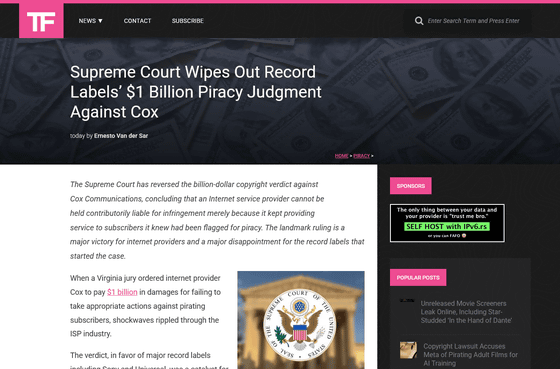
Cox Communications not liable for pirated music, Supreme Court rules | The Verge
https://www.theverge.com/policy/900502/cox-communications-music-labels-piracy-supreme-court
A group of 53 music companies, including Warner Bros. and Sony Music Entertainment, sued Cox Communications for 'willful conspiracy' to infringe copyright, arguing that 'ISPs cannot completely eliminate repeat copyright infringers and profit greatly from this ongoing piracy, all at the expense of record companies and other rights holders.' Cox Communications countered that 'ISPs are not responsible for infringement of subscribers' rights,' but the court ruled that 'Cox Communications is complicit and indirectly responsible for copyright infringement by its subscribers,' and ordered it to pay a total of $1 billion (approximately 150 billion yen) in damages. Several ISPs, not just Cox Communications, submitted statements in response to this ruling, arguing that ISPs should not be held responsible for the actions of their users.
With internet service providers locked in a fierce battle with major record labels over alleged copyright infringement, who is responsible for copyright infringement on the internet? - GIGAZINE

In 2024, the Fourth Circuit Court of Appeals heard the appeal, and while it overturned some of the district court's rulings, including damages, on the grounds that it 'failed to prove that Cox Communications directly profited from the subscribers' copyright infringement,' the original ruling that Cox Communications was a 'willful copyright infringer' was upheld.
Court overturns ruling in copyright infringement lawsuit ordering major labels including Sony to pay 150 billion yen in damages - GIGAZINE

Cox Communications appealed the ruling that held ISPs liable, and the case was heard before the Supreme Court in December 2025. Cox Communications' main arguments are threefold. First, the purpose standard, which states that in order to hold ISPs liable, it is necessary to prove not only awareness that copyright infringement is occurring, but also a 'positive intent' to facilitate copyright infringement. Second, the concept of 'passive usefulness,' which states that ISPs should not be held liable for 'passive inaction (doing nothing)'. Third, based on a past Supreme Court ruling that 'X (formerly Twitter) is not liable for terrorists using it to solicit or raise funds,' the argument is that providing a general service to malicious actors does not constitute aiding and abetting or instigating.
Following a retrial, the Supreme Court ruled on March 26, 2026, that 'Cox Communications is not jointly liable for copyright infringement by users of pirated content.' The ruling stated that in order to hold a service provider liable, it is necessary to prove that the service provider intended to infringe copyright, and to prove this, either 'the service provider actively induced the infringing activity' or 'the service in question had no substantial non-infringing use,' but the court concluded that neither of these conditions applied to Cox Communications.

In his ruling, Judge Clarence Thomas, who wrote the judgment, stated, 'A company is not liable for copyright infringement simply because it provided a service to the general public, even if it knew that the service would be used by some people for copyright infringement. Cox Communications simply provided internet access, which was used for many purposes other than copyright infringement.'
On the other hand, Judge Sonia Sotomayor, who voted against the minority, agreed that Cox Communications was not responsible, but warned that 'the arguments in favor render the ' safe harbor clause ,' which obligates ISPs to stop distributing content from users who repeatedly infringe copyrights, obsolete.' Sony had argued that 'the safe harbor clause is meaningless if ISPs are not held responsible for providing services to copyright-infringing users,' and Judge Sotomayor agreed, stating, 'Until now, ISPs have suspended user accounts in response to notices from rights holders based on the safe harbor clause, but with this ruling making it clear that ISPs are not liable for aiding and abetting, there is little incentive for ISPs to take any action against piracy that takes place within their services. Therefore, the majority decision allows ISPs to sell internet access to any infringer who wants internet access without fear of legal liability and without making any effort to prevent infringement.'
This ruling overturns previous decisions and remands the case to the Fourth Circuit Court of Appeals for further hearing. As of the time of writing, it is unclear whether the music label group will file further lawsuits in the remand hearing and what arguments they will make. In a statement released after the ruling, Mitch Glazer, president and CEO of the Recording Industry Association of America (RIAA), said, 'I am disappointed with the court's decision. Copyright law must protect creators and markets from harmful infringement, and policymakers should carefully consider the implications of this ruling.'
Related Posts:





in Web Service, Posted by log1e_dh