Google, Cloudflare, and Cisco's claims in a French piracy lawsuit have been rejected five times in a row.

Regarding the debate over whether ISPs and platforms should also be held responsible for copyright infringement, the U.S.
Google, Cloudflare, Cisco Lose Pirate Site DNS Blocking Appeal in France * TorrentFreak
https://torrentfreak.com/google-cloudflare-cisco-lose-pirate-site-dns-blocking-appeal-in-france/
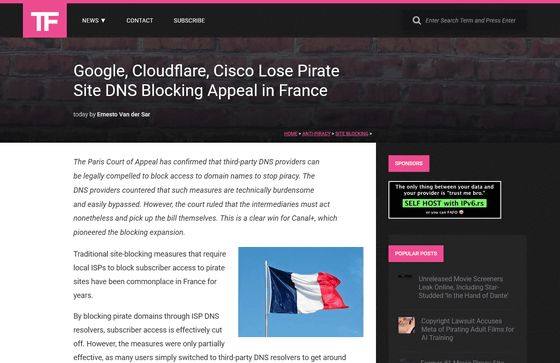
In the United States, in 2018, Cox Communications, a telecommunications company, was sued by a major record label group for failing to completely eliminate users who repeatedly infringed copyrights and profiting from piracy. Although Cox Communications argued that ISPs are not responsible for the infringement of subscribers' rights, it was found to be complicit and indirectly responsible and ordered to pay a total of $1 billion (approximately 150 billion yen) in damages. Cox Communications challenged the ruling that held ISPs responsible, and after an appeal, on March 26, 2026, the Supreme Court ruled that Cox Communications is not jointly responsible for the copyright infringement activities of users of pirated content.
In a lawsuit seeking to hold ISPs liable for copyright infringement, the Supreme Court ruled that 'simply providing a service does not constitute aiding and abetting' - GIGAZINE

On the other hand, the Recording Industry Association of America (RIAA) criticized the ruling, stating that 'copyright law must protect creators and markets from harmful copyright infringement.' Some Supreme Court justices also criticized the ruling, saying it 'degrades the ' safe harbor clause ' that obligates ISPs to cease copyright infringement and eliminates any incentive for ISPs to take any action against piracy occurring within their services.' Thus, there is disagreement as to whether ISPs and platforms providing services should be held responsible for online crimes such as copyright infringement and violations of child pornography laws.
In France, the traditional method of requiring ISPs to block pirated websites to prevent subscribers from accessing them has been common for many years. However, this measure was only partially effective because many pirates circumvented the blocking by using third-party DNS resolvers. Therefore, Canal+ , a French pay television channel that holds the broadcasting rights for football and rugby, requested the court to close the loopholes that allowed piracy. The Paris Court of Justice ordered Cloudflare, Google, and Cisco to 'actively block access to pirated websites through their own DNS resolvers.'
France's 'Article L.333-10 of the Sports Law' stipulates that 'a rights holder can request blocking measures against a particular pirate site if they can prove a serious and repeated infringement of their usage rights.' While this provision has a broad scope, Cloudflare, Google, and Cisco have protested its application to DNS resolvers and appealed to the court.

The court dismissed all five appeals, concluding that 'DNS blocking measures are technically feasible and reasonable.' In the fifth court order issued at the end of March 2026, Cloudflare and Cisco argued that 'their services are purely neutral and passive, and they neither transmit nor participate in infringing activities,' explaining that their involvement ended when they translated domain names into IP addresses and returned the results to users. However, this argument was not accepted by the court, which stated that 'the 'neutral and passive nature' of DNS resolvers is completely irrelevant to Section L.333-10, which does not define liability but rather whether a service helps block access to pirated sites, and DNS resolvers are clearly capable of doing so.'
Google also argued that blocking pirated sites via third-party DNS services is not an effective deterrent because it can be circumvented by using a VPN or switching to a different DNS resolver. The Court of Appeal rejected this argument as well, concluding that 'French law only requires that some visitors to pirated sites be blocked, and that blocking measures do not need to be perfect,' and that 'any filtering measures can be circumvented, and this possibility does not render the measures in question ineffective.'
In this ruling, the DNS blocking scheme under Article L.333-10 was approved for the first time by a French Court of Appeal, and the order repeatedly emphasized that 'DNS resolvers can be obligated to block pirated sites.'
In a statement following the appeals court ruling, Canal+ said, 'These rulings are more than just a victory; they form part of a global approach that is strengthened by the phased deployment of complementary measures, including IP blocking.'
Related Posts:






in Web Service, Posted by log1e_dh