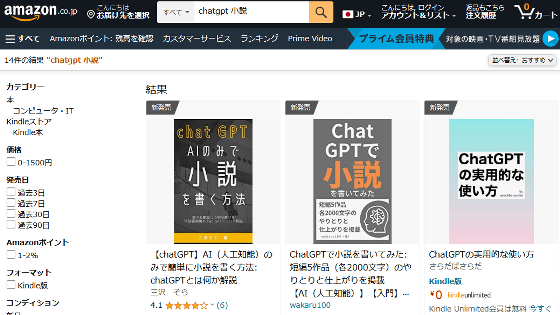
Chinese online novel sites are strengthening measures against AI-generated novels, with some readers saying 'reading AI novels is a waste of time.'
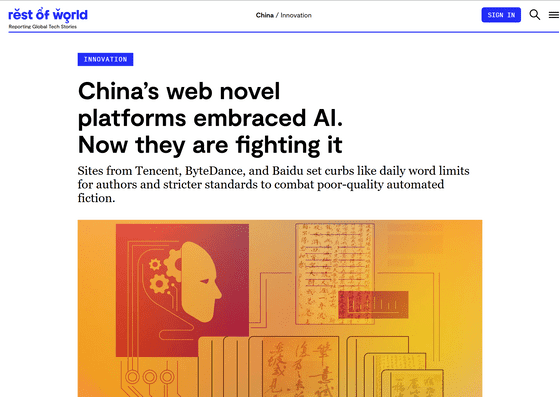
Rest of World reports that Chinese web novel platforms are beginning to restrict submissions and tighten review processes for novels created using AI. The increase in mass-produced AI-generated works has led to reader dissatisfaction with declining quality, prompting major services like Tencent, ByteDance, and Baidu to take action to restrict submissions and strengthen review processes.
Chinese tech giants clamp down on AI web novels after reader backlash - Rest of World
Chinese web novels have spread as serialized content that can be read in short episodes on smartphones. They have become a form of entertainment that is consumed daily, such as reading a few episodes during commutes or before going to bed. Authors are required to update frequently, so AI tools that help with setting creation and writing are a valuable resource.
Gordon Shen, a 32-year-old civil engineer living in China, actually used DeepSeek to create a storyline about divorce, and then used an AI writing tool to generate a short story in about 5 minutes, which he then posted to Tomato Novel. The story was reportedly read more than 5,500 times in 10 days.
Major platforms were also initially keen to use AI for writing support. In 2023, Tencent's China Literature announced an AI tool that can create character names and expand on plotlines. In 2024, ByteDance's Tomato Novel also introduced an AI assistant for authors to help with background research and overcoming writing blockages.

However, as AI tools have improved in performance, writing assistance has led to mass production. On the Chinese social networking site Xiaohongshu, screenshots of novels posted with instructions for the AI still visible in the text have been shared. Some readers have also expressed suspicion of AI use due to the frequent use of unnatural metaphors and similar expressions. Some readers have even said that 'reading something that was made too quickly is a waste of time.'
In response to this situation, platforms are taking measures to curb excessive use rather than completely banning the use of AI. On the web novel site 'Jinjiang,' which has a large female readership, founder Huang Yanming has asked authors to limit the use of AI to research and proofreading, and has encouraged readers to report works that are suspected to have been written by AI.
Tomato Novel imposes a character limit on the number of posts each account can submit per day. The platform announced that in June 2026 alone, it rejected more than 104,000 low-quality submissions, including those created by AI.
Xiang Ren, who studies China's digital publishing industry at the University of Sydney, points out that web novel platforms are trying to strike a balance between increased productivity through AI and the risk of compromising the authenticity of the works. As AI lowers the barrier to writing novels, web novel platforms are being forced to find a balance between increased productivity and the credibility of the works, Xiang says.
Related Posts: