Qualcomm's Linux for IoT devices has evolved to version 2.0, enabling development on a single platform from AI cameras to industrial PCs.

On June 30, 2026, Qualcomm Linux 2.0, a Linux solution for devices equipped with Qualcomm's IoT SoCs, became generally available. Qualcomm Linux 2.0 is a major update to Qualcomm Linux, which was announced in 2024, and features a common Linux platform usable across multiple SoCs and products, an open development system, and a configuration designed with production environments in mind.
Qualcomm Linux 2.0 now available – open, unified IoT development
IoT devices encompass a wide range of products, from factory robots to industrial touch panels, and the required functions vary greatly from product to product. If the OS and drivers are developed individually for each product, the development team would have to manage software for each chip and product, and even just adding security fixes would require numerous verification tasks, placing a significant burden on them.
In Qualcomm Linux 1.x, two separate systems were managed: Base, which was primarily open source, and Custom, which included proprietary features. This required parallel maintenance of the kernel and user space. Therefore, Qualcomm Linux 2.0 adopts a single software stack, a single kernel, and a single root file system. By unifying the foundation and adding only the features necessary for each product, software for multiple products can be built from the same foundation.
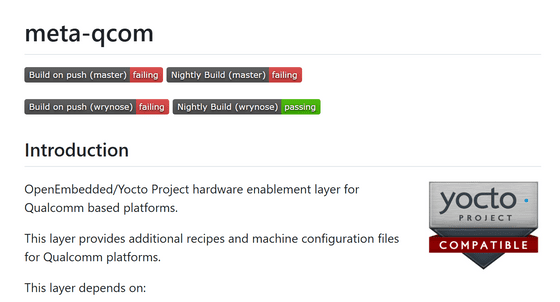
Qualcomm Linux 2.0 is based on the Linux 6.18 LTS kernel and Yocto Project 6.0 Wrynose. The Yocto Project is a mechanism for creating Linux for embedded devices, and is used to create Linux images that combine only the necessary components for a product, rather than directly installing a general-purpose OS like those used in smartphones and PCs. Qualcomm Linux 2.0 includes a BSP layer called 'meta-qcom' that bundles the settings necessary for booting and controlling hardware-specific components. This BSP layer is designed for Qualcomm platforms and follows the best practices of the Yocto Project, allowing developers to build software images using settings and recipes for Qualcomm chips.
GitHub - qualcomm-linux/meta-qcom: OpenEmbedded/Yocto Project BSP layer for Qualcomm based platforms · GitHub
https://github.com/qualcomm-linux/meta-qcom
Because a common platform alone may not fully unlock the performance of each individual product, Qualcomm Linux 2.0 provides a mechanism called 'overlays.' Overlays are like components that allow you to add necessary functions later. For example, you can add cameras and vision processing for a camera that performs video analysis, or configure network equipment without unnecessary video processing.
In addition to AI and video processing, real-time performance, which is crucial in factories and robotics, has also been enhanced. Real-time performance refers to 'the ability to respond stably within a set time,' and Qualcomm Linux 2.0 is designed to enable the use of real-time functions as standard through the Linux 6.18 LTS RT kernel. Low-latency scheduling is achieved through the PREEMPT_RT patch, and verification is performed using the Linux Foundation's RT test suite.
Furthermore, IoT devices are often used for many years after installation, so simply having them work at the time of shipment is not the end of the story. Vulnerability countermeasures, feature updates, access control, virtualization, and OTA updates are all necessary. Qualcomm Linux 2.0 provides production-ready components such as mandatory access control via SELinux, OSTree-based OTA updates, enhanced security, and virtualization layers including Docker, Kubernetes, and KVM. In addition, Qualcomm Linux releases are designed to align with the entire product lifecycle of the SoC, ensuring a supported migration path by overlapping support periods between major versions.
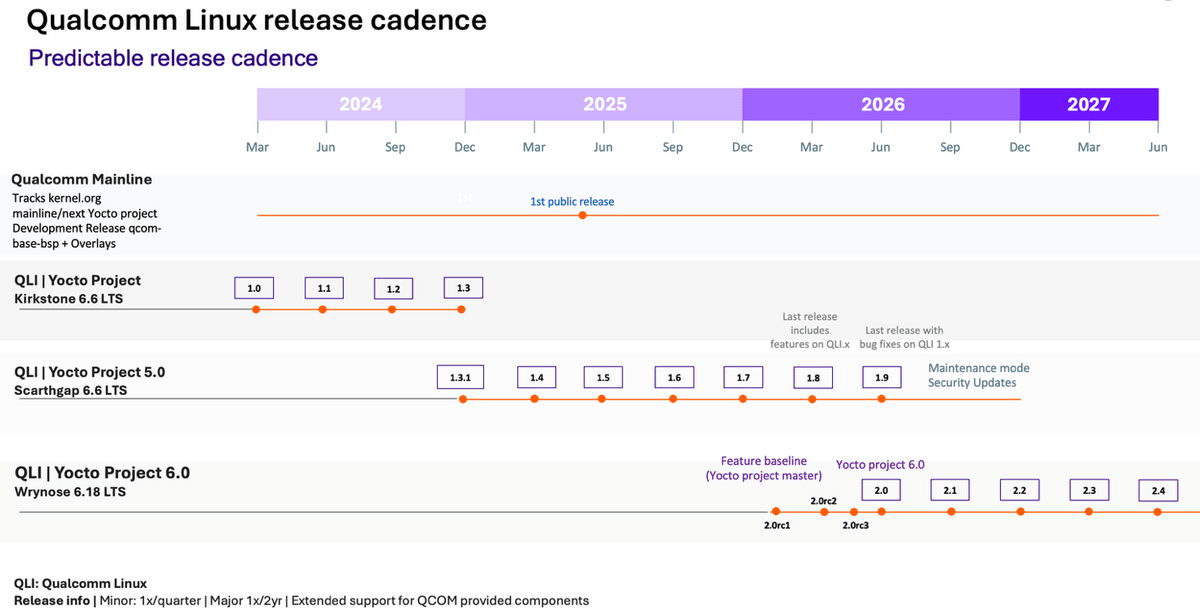
The development structure has also changed from Qualcomm Linux 1.x. With Qualcomm Linux 2.0, the underlying meta-qcom has been released on GitHub, and changes can now be verified through a public CI that automatically verifies development branches and code changes. The meta-qcom-releases repository also provides lock files that support qli-[version] format tags, making it easier to reproduce the same configuration.
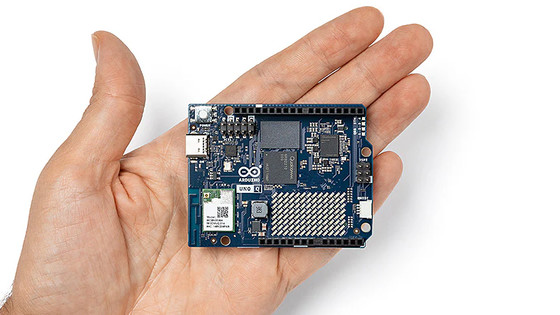
Supported platforms include the QCS6490, QCS5430, IQ-9 series, IQ-8 series, and IQ-6 series, and Qualcomm Linux 2.0 also adds the IQ-X series for industrial PCs. Qualcomm aims to enable the use of the same platform across a wide range of products, including edge AI, industrial computing, and cost-conscious IoT devices.
Qualcomm Linux 2.0's source code and metadata layers are publicly available on GitHub . Development of Qualcomm Linux 2.1 is already underway, and future plans include working on an open-source boot flow and OP-TEE integration to provide a secure execution environment.
Related Posts:


in Software, Posted by log1d_ts