Brainstem neurons that support 'concentration' have been identified.

When we are distracted by surrounding sounds or movements while working, we try to ignore the unnecessary stimuli and focus our attention on important information. A research team led by Ninad B. Kotari of Johns Hopkins University has reported identifying the group of brainstem neurons that support this 'concentration' through experiments with mice.
Evolutionarily old brainstem neurons are required for the control of selective spatial attention | Nature Communications
https://www.nature.com/articles/s41467-026-72340-9
Scientists discover ancient brain cells that help block distractions | ScienceDaily
https://www.sciencedaily.com/releases/2026/06/260624025426.htm
The ability needed to hear someone's voice in a noisy room or find a friend in a crowd is called ' selective spatial attention .' This is not simply the ability to work for a long time, but rather the ability to ignore unnecessary stimuli and focus attention on important information.
For many years, the prefrontal cortex has been thought to play a central role in attentional control. While the prefrontal cortex is a particularly well-developed brain region in primates such as humans, animals that do not have a highly developed prefrontal cortex, such as birds and fish, can also focus their attention on specific information. Therefore, Kotari et al. also focused on brain regions other than the prefrontal cortex.
Kotari and his colleagues focused on ' PLTi ,' an inhibitory neuron circuit located in the brainstem that is widely present in vertebrates, including birds and fish.

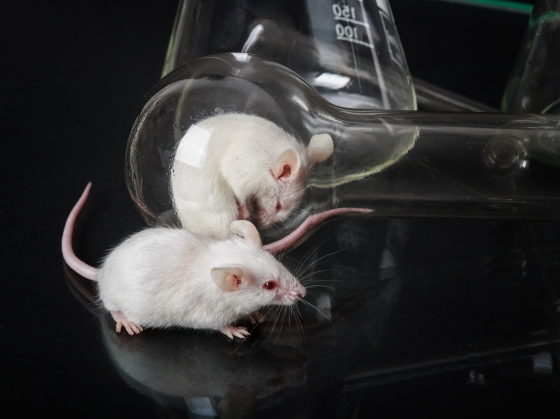
The experiment conducted by Kotari et al. involved having mice perform a visual task similar to those used in human attention research. Mice were rewarded if they could focus their attention on visual information displayed in front of the screen, ignore distracting stimuli displayed to the sides, and touch the location indicated by the information in front of them with their noses. Even mice that had been performing this task without problems became strongly distracted by the distracting stimuli displayed to the sides when Kotari et al. temporarily disabled the PLTi.
Shreesh P. Mysore, a member of Kothari's research team, stated, 'One of the characteristics of ADHD is that attention is easily diverted even by weak distracting stimuli. That's exactly what we saw when we silenced the PLTi in mice.' On the other hand, when the function of PLTi was restored the following day, the mice were able to ignore even very strong distracting stimuli.
However, this result alone does not allow us to distinguish whether the mice failed the task because they 'couldn't see well' or because they 'couldn't properly touch the screen with their noses.' Therefore, Kotari et al. conducted additional experiments under conditions without distracting stimuli to investigate whether the mice 'could distinguish a single target,' 'could choose whether to touch the left or right side with their noses,' and 'could direct their noses in the direction required for the task.' The results showed that even when PLTi was temporarily disabled, the ability to perceive a single target and the selection and direction of movements required for the task were not significantly impaired.
A series of additional experiments showed that inactivating PLTi only impaired the ability to receive multiple competing pieces of information, compare them, and direct attention to where the most important information is located. Mysore explains that brainstem neurons, including PLTi, are 'like an attentional selection engine that helps solve the problem of what the most important information is that we should be paying attention to right now.'
Furthermore, Kotari et al. state that PLTi is not simply involved in responding to conspicuous stimuli, but rather in distinguishing between 'stimuli that are important for the current task' and 'stimuli that should be ignored.' They suggest that PLTi may work in conjunction with the superior colliculus, a brain region involved in directing the eyes and attention, and thus support the function of focusing attention on the target and ignoring distracting stimuli.
Kotari and his colleagues plan to investigate how PLTi controls spatial attention in vertebrates and to what extent it is involved in human attention. They are also considering measuring PLTi activity in people with ADHD and autism, stating that 'if PLTi functions differently, a closer examination of attention-related disorders may provide clues to finding drugs and treatments.'
Related Posts:







in Science, Posted by log1b_ok